Location
Mount Vernon, WA 98274

Location
Mount Vernon, WA 98274
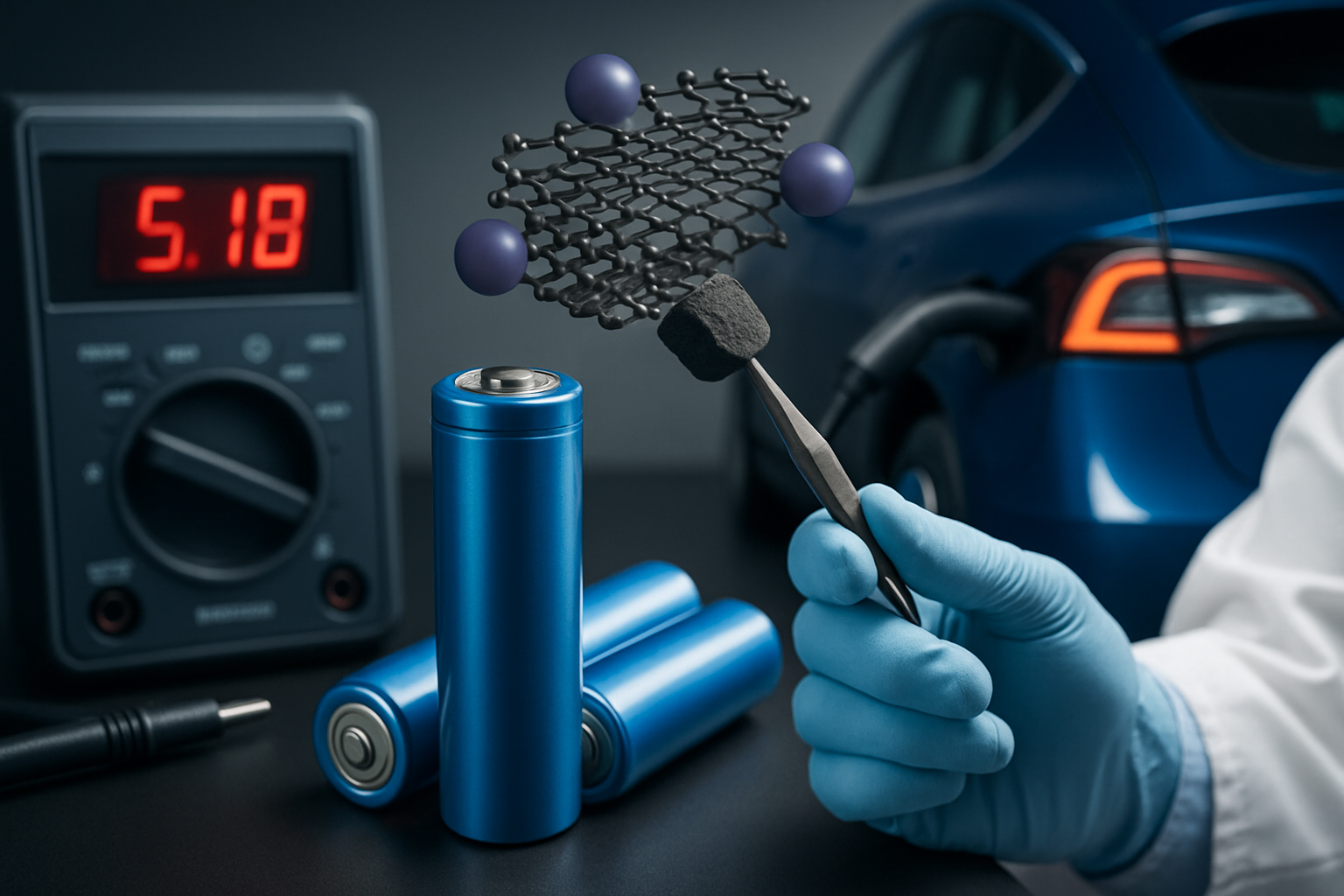
A recent collaboration between leading materials scientists and battery manufacturers has yielded a silicon-graphite composite anode that promises up to 40 percent longer lifespan and faster charging rates for lithium-ion batteries. This development could reshape electric vehicle range, grid-scale energy storage economics, and portable electronics endurance.
In a concerted effort to overcome the long-standing limitations of conventional lithium-ion batteries, a team of researchers and industrial engineers has unveiled a new silicon-graphite composite anode that delivers significantly higher energy density and cycle stability. The announcement follows three years of iterative testing and pilot-line trials at a major battery fabrication facility in the American Midwest. By incorporating a carefully engineered silicon-infused layer, the composite anode accommodates more lithium ions without suffering the rapid degradation that has historically plagued silicon-based electrodes.
Silicon’s theoretical capacity to store nearly ten times more lithium ions than graphite has long been recognized as a potential pathway to higher-performance batteries. However, silicon expansion during charge cycles leads to structural breakdown, capacity fade, and early battery failure. The breakthrough composite employs a network of nanoscale silicon particles embedded in a flexible carbon matrix. This structure allows the silicon to expand and contract without compromising the electrical contact or cracking the electrode. Early testing indicates that battery modules using the new anode can achieve more than 1,500 full charge-discharge cycles before capacity drops below 80 percent of its original value.
High-rate charging is another key advantage of the new anode design. Traditional graphite anodes often suffer from lithium plating when charged quickly, raising safety concerns. The composite’s porous architecture facilitates rapid lithium-ion transport and heat dissipation, enabling charge rates that could reduce EV charging times by up to 30 percent. Independent tests conducted by a third-party lab confirmed that the composite cells maintained stable voltage and temperature profiles even under aggressive charging protocols.
Industry stakeholders are already signaling strong interest. An electric vehicle startup has announced plans to integrate prototype cells into its next-generation sedan, aiming for a 600-mile range under real-world driving conditions. Meanwhile, a leading grid storage provider is evaluating large-format modules to support peak-shaving and frequency regulation services. By enhancing both energy density and durability, the technology promises to lower the levelized cost of storage in applications that demand frequent cycling, such as behind-the-meter residential systems and renewable energy smoothing.
Manufacturing scalability was a central consideration for the development team. Silicon nanoparticles can be expensive to produce and challenging to handle at scale, but the researchers adopted a modified chemical vapor deposition process that yields uniform particles on standard battery-grade graphite. This approach leverages existing production lines with minimal retrofitting, reducing capital expenditure barriers. Early-phase production trials at a 100-megawatt-hour-per-year facility demonstrated consistent anode quality and process yields above 95 percent.
The partnership responsible for the breakthrough includes a national laboratory, a university materials department, and a decade-old battery company. Funding sources range from government grants aimed at lowering carbon emissions to private equity investments targeting the electric mobility market. By aligning academic innovation with industrial know-how, the consortium has navigated the complex path from lab bench to pilot-scale hardware in record time.
Environmental and sustainability implications are also drawing attention. Silicon is abundant in the Earth’s crust and can be sourced from low-cost precursors, potentially reducing reliance on imported metals. The new composite’s extended cycle life means fewer battery replacements over a vehicle’s lifecycle, translating into lower resource consumption and downstream waste. Moreover, improved charging efficiency cuts grid demand peaks, supporting the integration of intermittent renewables without the need for expensive grid upgrades.
While the results to date are promising, several engineering hurdles remain before wide adoption. Managing electrode swelling in large-format cells, optimizing binder formulations for mass production, and ensuring consistent performance under extreme temperature conditions are on the development roadmap. The consortium is conducting accelerated life testing in climate chambers, spanning temperature ranges from -30°C to 60°C, to validate long-term reliability across diverse geographies.
Battery management systems (BMS) will also need to adapt. The altered voltage profile and thermal characteristics of silicon-enhanced cells may require new state-of-charge algorithms and safety protocols. To address this, the team is collaborating with BMS vendors to co-develop firmware updates that leverage real-time cell monitoring. Early simulation models suggest that advanced cell balancing and adaptive charging controls can further prolong battery life by mitigating uneven silicon expansion.
Beyond electric vehicles and grid storage, portable electronics stand to benefit. Manufacturers of laptops and power tools are exploring retrofit options that replace conventional cells with the composite for slimmer designs and longer run times. Consumer electronics brands may be able to tout all-day operation without increasing device weight, positioning the technology as a differentiator in a highly competitive market.
Looking ahead, the consortium plans to expand pilot production capacity to over 500 MWh per year and to engage additional commercial partners. A second generation of the composite, featuring dopants that enhance mechanical resilience, is already under development. Early lab data indicate that these doped materials could push cycle life beyond 2,500 full-depth cycles, potentially enabling battery second-life applications such as stationary backup systems once they no longer meet stringent EV requirements.
As the race for next-generation lithium-ion technology intensifies, the silicon-graphite composite anode represents a critical milestone. By addressing both energy density and durability, it bridges the gap between ambitious performance targets and real-world manufacturability. Stakeholders from automakers to grid operators will be watching the technology’s scaling trajectory closely, eager to leverage its benefits for faster charging, longer life, and a smaller environmental footprint.
The journey from concept to commercial reality underscores the importance of cross-disciplinary collaboration. Materials scientists, chemical engineers, electrical experts, and sustainability analysts have joined forces to tackle interlocking challenges. Their progress demonstrates how aligning research goals with industry priorities can accelerate the path to impactful, large-scale deployment. While further refinements lie ahead, the new anode formulation signals a pivotal shift toward batteries that are not only more powerful but also more resilient and sustainable.
A surge of announcements and pilot programs is expected over the coming months as cell makers begin integrating the composite technology. Early adopters could gain a competitive edge by offering electric vehicles with extended range or by marketing grid storage solutions with superior lifecycle economics. For consumers and utilities alike, the promise of longer-lasting, faster-charging batteries may soon become an everyday reality, reshaping expectations for mobility, energy, and electronics alike.