Location
Mount Vernon, WA 98274

Location
Mount Vernon, WA 98274
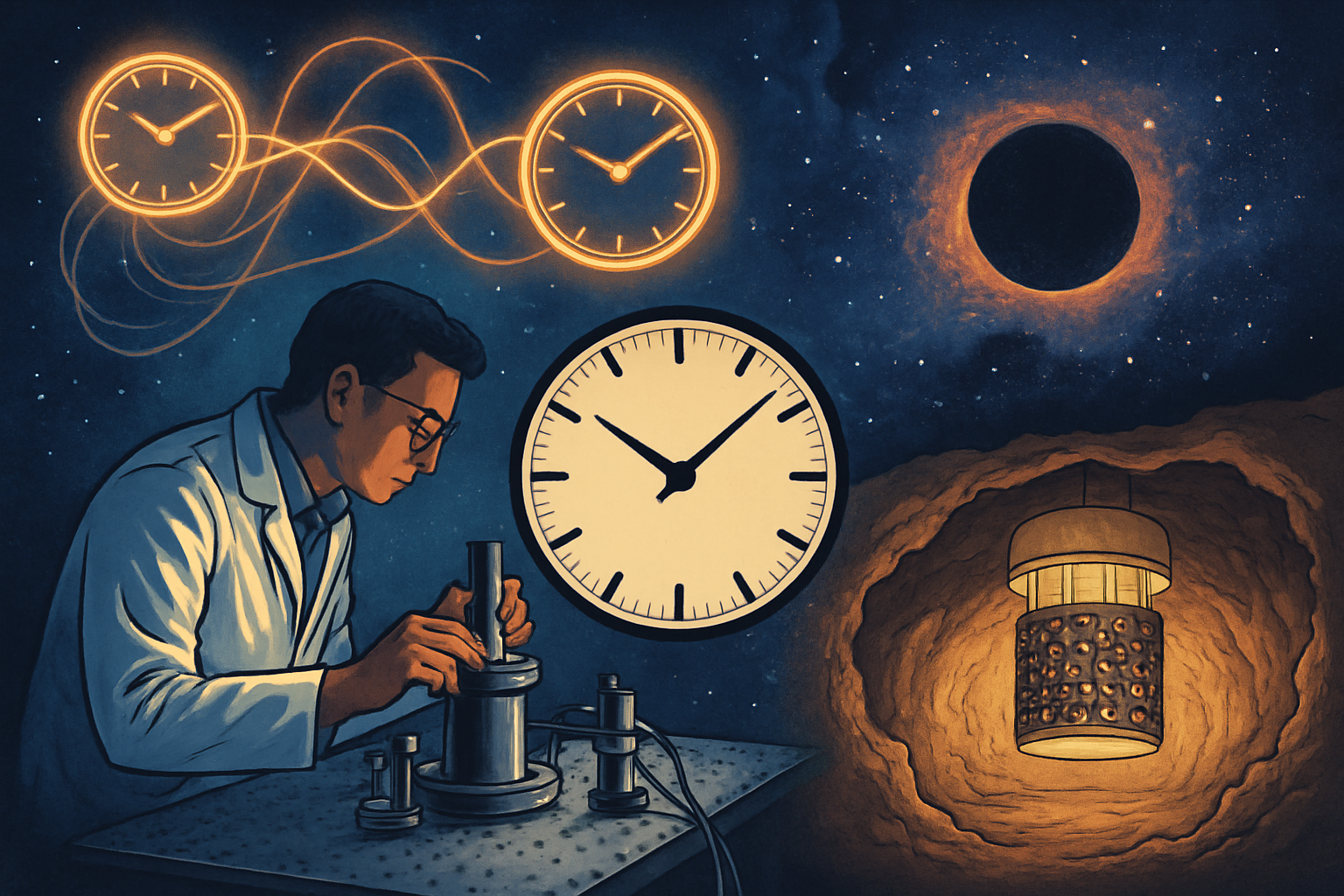
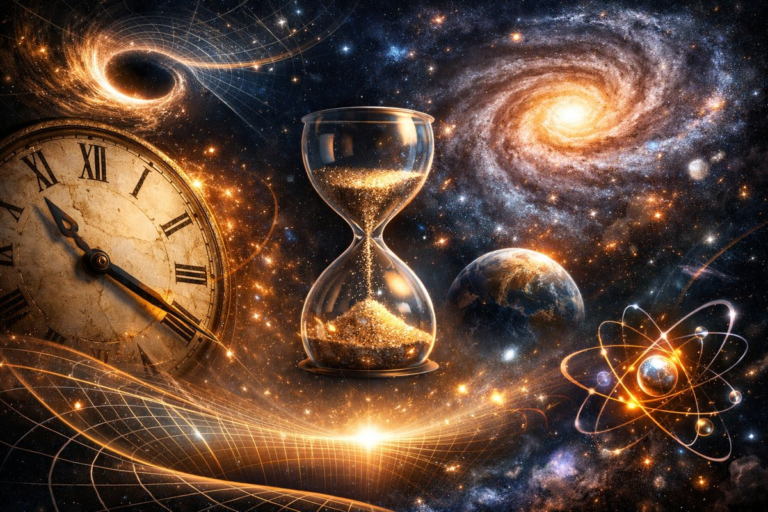
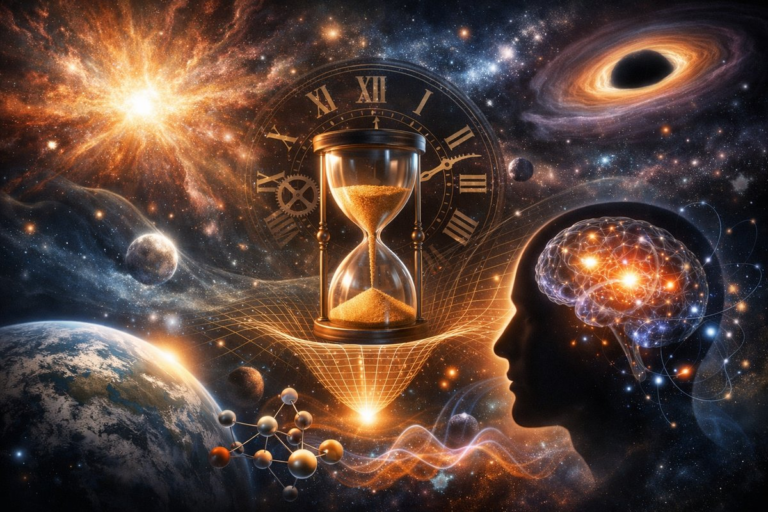
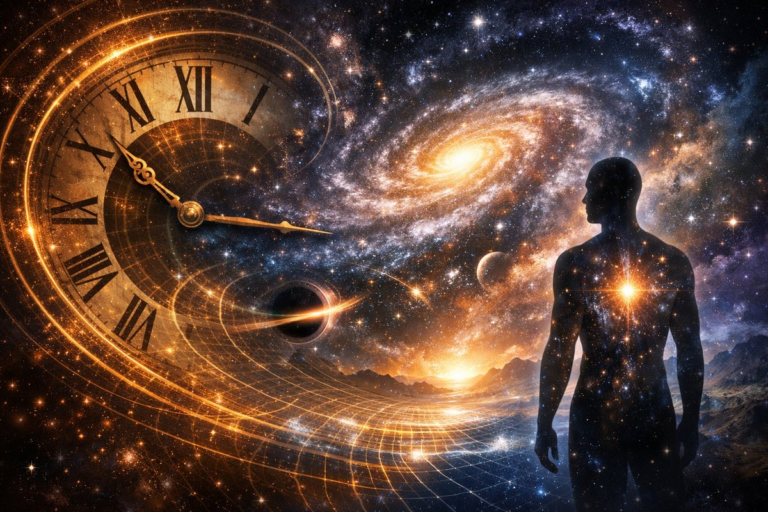
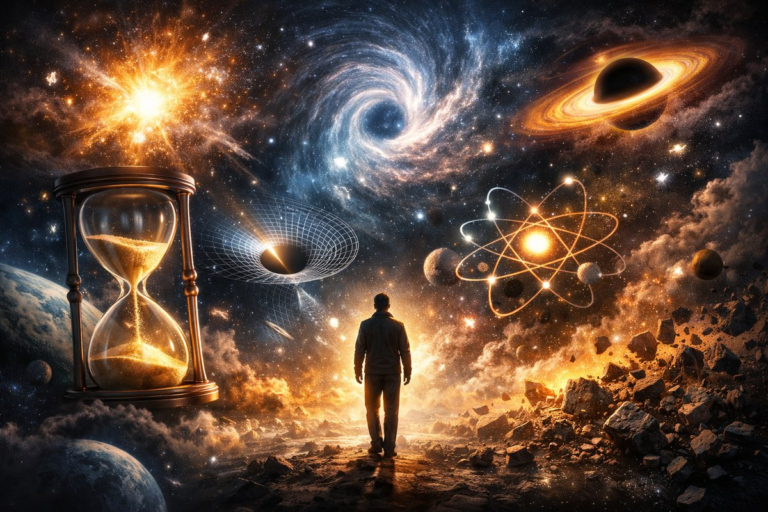
Scientists are deploying quantum sensors, subterranean detectors, and entangled clock networks in an unprecedented effort to unravel the intertwined mysteries of time and matter. From elusive dark matter interactions to the arrow of time, these cutting-edge experiments are redefining our understanding of the cosmos and sparking philosophical questions about reality itself.
In a hidden cavern beneath the rocky crust of our planet, a new generation of detectors is awakening to subtle whispers from the cosmos. These aren’t conventional telescopes or particle colliders but networks of ultra-precise quantum sensors and entangled atomic clocks designed to probe distortions in space-time and trap fleeting signatures of dark matter. Physicists long ago realized that gravity waves, dark matter particles, and time itself held secrets waiting to be unlocked-but only now are instruments sensitive enough to register their faintest tremors.
Across the globe, in facilities spanning from undersea platforms to high-altitude observatories, teams are weaving an interconnected web of measurements. In one such outpost, researchers buried beneath a mountain range monitor synchronized optical cavities for infinitesimal shifts in length caused by passing gravitational waves or exotic particles. In a distant desert, a phased array of atomic clocks remains in constant dialogue, exchanging laser pulses to maintain quantum entanglement. Variations in their tick rates can betray minute fluctuations in the gravitational potential or encounters with previously undetected fields.
But what drives this surge of interest in the dance of time and matter? At its core lies a profound gap in our picture of the universe. Ordinary atoms, neutrons, and electrons constitute less than five percent of all energy and mass in existence. The rest remains hidden in forms we refer to as dark matter and dark energy. These elusive components shape galaxy clusters and cosmic expansion, yet evade direct measurement. To catch a glimpse of these shadowy players, physicists are turning to unconventional strategies that exploit time itself as a detector.
Take the concept of an “entangled clock network.” In classical science, measuring time relies on stable oscillators that tick away uniformly. But in the quantum realm, clocks can be linked so that their frequencies become correlated across vast distances. If a dark matter field interacts with one segment of the network, it will slightly shift its ticking pattern. By comparing data from clocks stationed in different gravitational environments-deep underground versus high above sea level-scientists hope to isolate these perturbations and map the hidden landscape of matter fields.
Beyond clocks, neutrino detectors originally engineered to study particles born in nuclear reactors are now being repurposed to track rare events that might signal dark matter collisions. Enormous vats of ultrapure liquid or crystalline arrays cooled to near absolute zero sit ready to capture tiny flashes of light or heat pulses when an exotic particle strikes. Such interactions could reveal whether dark matter is composed of heavy, slow-moving particles or a swarm of ultralight bosons permeating every corner of space.
Time, too, plays a subtle role in these investigations. The so-called “arrow of time” emerges from thermodynamics: systems evolve from lower to higher entropy, giving directionality to otherwise reversible physical laws. Some theorists propose that dark matter and dark energy might influence entropy production at cosmological scales, potentially offering clues about why time appears to flow in a single direction. Experiments studying heat dissipation in isolated quantum systems are underway to test whether minute couplings to unseen fields subtly tilt this arrow.
While laboratories on Earth push the limits of sensitivity, telescopes and gravitational wave observatories peer into the depths of space for complementary signals. Black hole mergers detected by laser interferometers not only confirm Einstein’s century-old predictions, they also open a novel window on time dilation near event horizons. Minute delays in the arrival times of gravitational waves or faint echoes following collisions could encode information about the structure of space-time at the smallest scales, hinting at quantum gravitational effects.
Bridging quantum mechanics with general relativity is the holy grail of modern physics. For decades, the two frameworks have excelled within their domains yet stubbornly resist unification. Some speculative models introduce new particles or fields that mediate interactions between space-time curvature and quantum phenomena. These candidates often predict tiny oscillations in fundamental constants, such as the fine-structure constant or particle masses, over time. Atomic clock networks may be our first line of defense in spotting such cosmic whispers.
Collaboration lies at the heart of these ventures. Astronomers, particle physicists, geologists, and quantum engineers are pooling expertise to design hybrid facilities. An undersea neutrino array might house an entangled clock module. A gravitational wave station could integrate magnetometers tuned to detect passing domain walls of dark matter. By sharing data and correlating events across different platforms, researchers can weed out false positives and build a more comprehensive map of matter and time fluctuations.
Looking ahead, several flagship projects are poised to come online. A next-generation space probe carrying a free-floating atomic clock aims to test gravitational time dilation with unprecedented precision as it orbits Earth. Deep underground, a colossal xenon chamber will search for dark matter interactions at mass ranges previously unexplored. And quantum gravimeters deployed in remote polar regions will track minute tidal distortions of space-time induced by shifting mass distributions and passing gravitational waves.
These experiments don’t just push the boundaries of fundamental physics; they promise cascading benefits for technology and society. Ultra-stable clocks could revolutionize global positioning, enabling centimeter-level accuracy in navigation. Quantum sensors refined to detect geophysical signals might transform earthquake forecasting or resource exploration. Even if some dark matter detectors return null results, the technological breakthroughs from pursuing such high-precision measurements will seed innovations in computing, communication, and precision manufacturing.
Yet immense challenges loom. Quantum sensors demand environments isolated from electromagnetic noise and thermal disturbances, driving costs sky-high. Interpreting data from entangled clocks requires new statistical tools to separate genuine cosmic signals from local perturbations. Dark matter detectors face background radiation that can mimic rare collision events, forcing researchers to refine shielding and analysis methods continually.
Amid these technical hurdles, the philosophical dimension grows ever more compelling. What does it mean if space-time itself has a granular, quantum origin? How does the existence of dark components reshape our view of reality? If time can run differently under subtle influences, can we ever claim an absolute temporal standard? Such questions resonate beyond laboratory walls, rippling into metaphysics and even art, inviting us to rethink our place in a universe that may be far stranger than we ever imagined.
As the next wave of experiments flickers to life, one thing is clear: the interplay of time, matter, and mystery is no longer a philosophical aside but a concrete frontier of discovery. With each tick of an entangled clock and each photon captured in a cryogenic chamber, we inch closer to unveiling a reality woven with unseen threads. Whether those threads will bind the quantum and the cosmic into a unified tapestry remains unknown-but the journey promises revelations that could transform our understanding of everything from the tiniest particle to the grandest cosmic horizon.