Location
Mount Vernon, WA 98274

Location
Mount Vernon, WA 98274
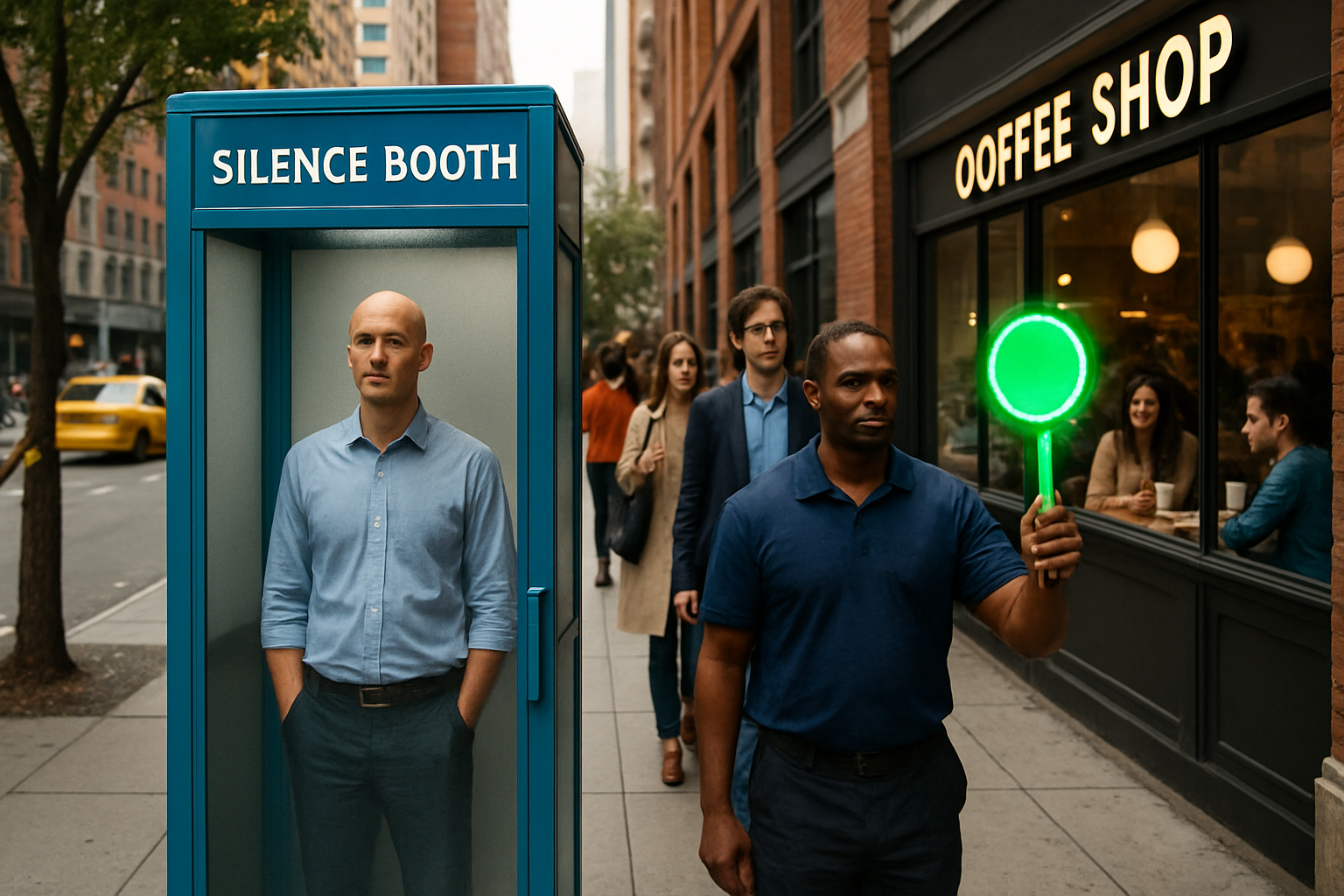
In an unprecedented policy shift, Meadowbrook has mandated thrice-daily five-minute 'mind-blanking' sessions, complete with public Silence Booths and neon-paddle enforcers. The oddball experiment has sparked a caffeine-fueled rush to coffee shops, legal challenges over thought policing, and a grassroots movement to preserve unstructured imagination. City officials claim the initiative will reduce stress, spur creativity, and revolutionize how communities think-or unthink.
In a move hailed as both revolutionary and deeply perplexing, the City of Meadowbrook has enacted the Cognitive Sabbatical Act, requiring citizens to drop all trains of thought at designated intervals. Under the new code, every resident must engage in a five-minute mind-blanking session at 10:00 am, 2:37 pm, and 8:19 pm daily.
The regulation mandates placement of bright orange Silence Booths in public squares, libraries, grocery stores, and even bus stops. Citizens queue up, insert noise-canceling earpads, and stare into nothingness while a soothing chime echoes through the chamber. The City Council insists this will reduce stress, spark creativity, and cut down on awkward small talk at office water coolers.
Local reactions are wildly mixed. Retiree Helen Pritchard describes her first session as “liberating, like my brain finally pressed the eject button.” Meanwhile, college student Jordan Ramirez attempted to cheat by playing mental Sudoku puzzles inside the booth and was promptly ejected by booth attendants wielding neon paddles labeled “Thought Police”.
Booth attendants were hired through an intensive observational training program at Meadowbrook Community Theater’s spin-off division. Applicants sat through endless improv sketches about existential dread and completed pop quizzes on philosophical paradoxes. The final test: go ten seconds without forming a coherent sentence. Those who passed are now roaming the city, flashcards in hand, ensuring compliance.
Critics argue that forced mind-blanking sessions violate constitutional protections against unreasonable mental searches. Legal scholar Avery Whitworth filed an injunction, claiming the city has no right to police the contents of citizens’ thoughts, even if those thoughts are blank. In response, the City Attorney retorted that citizens freely choose to walk into the booths, akin to signing a check-in waiver at a trampoline park.
Entrepreneurs smelled opportunity. Local tinkerers launched the Mindscape Memory Bank, a subscription service promising to store fleeting memories stolen by the mandatory blanks. Subscribers pay a monthly fee to have their daily thoughts extracted, digitized, and replayed as waveforms on holographic displays. At a downtown launch event, attendees complained the holographic memories kept glitching into looped daydreams about lunch.
Schools have adopted a half-hour extension to the program, citing studies that prolonged blank minutes boost test scores in geometry. In third grade, students now carry silent bubble helmets that look vaguely like medieval armor. Parents visit the helmet customization fair on weekends to bedazzle them with glow sticks, adhesive googly eyes, and motivational stickers reading: “Now you’re thinking about nothing.”
Local workplaces have faced the greatest logistical headaches. At constructing firm Granite & Snail, a foreman blanked out momentarily and crashed a cement mixer into his own lunchbox. At a call center, operators struggle to handle emergency 911 calls during mandated brain naps. The dispatch board now includes a blinking indicator for agents “in blank,” leading to confusion whenever calls go unanswered for exactly 300 seconds.
The city’s Mental Health Coalition raised alarms that orchestrated blanks could trigger collective psychosis. Dr. Lin Mei argued that minds need offbeat tangents to process trauma, and a rigid schedule of intentional emptiness risks creating a generation of thought-agnostic zombies. The Council responded by commissioning a performance art troupe to stage “The Ode to Oblivion,” a play reenacting the moment thought died under fluoride in the drinking water.
On social media, the hashtag #MindTheBlank went viral, with influencers posting selfies mid-void. One TikTok star livestreamed her entire first blank, captioning it “When your brain goes AWOL, but you gotta fame-chase.” Views spiked when she broke her silence early, gasping, “I blanked so hard, I forgot my own name.” Management companies are drafting blank-themed merch lines, including T-shirts that read: “I Survived the 2:37 Void.”
Veteran philosopher Ralph Gunders offered free pop-up seminars in the park titled “Mastering the Art of Nothing.” He teaches breathing exercises that allow attendees to approach certified mental oblivion gracefully. Gunders claims that learning to let thoughts drift away like forgotten laundry makes everyday stress vanish. Critics call the sessions “elegant napping with pretentious footnotes.”
Elsewhere, a clandestine group known as The Thoughtful Insurgents emerged, distributing pocket-sized “Brain Darts” that bypass the mind-blanking requirement by firing tiny mnemonic triggers. One insurgent, who only identifies as “Mnemonic Molly,” insists her darts keep people mentally agile under duress. She was last seen handing them out at a subway station, scribbling notes to avoid detention by the blank enforcers.
City Council member Rita Flores championed the policy to increase sales in local coffee shops. She argued that citizens would flock to nearby cafes just before each scheduled blank to cram five cups of espresso and stave off oblivion. Early sales figures appear to confirm her theory: Meadowbrook’s three most popular spots now sell 47 percent more double lattes in a ten-minute interval.
Local barista Marco Chen reports an uptick in customers jittery enough to bounce coffee cups off tables in pre-blank hypercaffeination. One customer demanded a triple shot with a side of philosophical reassurance: “Will I survive without thoughts for five minutes?” Chen handed him a latte printed with “Everything is nothing,” and watched him abruptly drop his spoon in grateful confusion.
The Chamber of Commerce is brokering partnerships with meditation app developers to embed blank countdown timers within guided visualization tracks. Early testers criticize the soothing narrations: “Inhale calm, exhale tension, and now accept total mental darkness.” One user wrote in an app review: “I paid for my serenity, not for a reminder that I have no serenity.”
As the first week of nationwide implementation ended, the city published preliminary data: stress-related tweets decreased by 63 percent, local headache clinic appointments rose by 112 percent, and incidents of spontaneous karaoke soliloquies in the park surged after blanks concluded. Data analysts call the pattern “oxymoronic but statistically noteworthy.”
Watching the unfolding experiment, neighboring towns are torn between envy and horror. The adjacent suburb of Pine Hills passed a resolution to observe the policy “at arm’s length,” deploying protest banners reading: “Our Thoughts Are Not On Loan.” Meanwhile, the capital city’s mayor has scheduled a telegram to Meadowbrook, requesting step-by-step instructions for installing public Silence Booths and hiring thought monitors.
Back in Meadowbrook, a small contingent of citizens launched the “Thinkathon,” a weekend event celebrating unstructured thought. Attendees convene in the town square, sketching mind maps on chalkboards, hosting free-association speed rounds, and awarding prizes for the most garbled stream-of-consciousness narratives. Organizers describe it as “a reverse festival of blanks,” though police officers occasionally break the vigil to remind tinkerers to brace for the 8:19 silence moment.
Through it all, the squirrels in Central Park-undisturbed by mandates-continue to race up trees, bury acorns, and generally wrestle with nature’s random impulses. While humans labor to choreograph emptiness, the local wildlife serves as a pointed reminder that thoughtlessness, in the wild, remains untamed and uncatalogued.
As dusk settles on a city slowly unlearning the habit of rumination, the question lingers: will enforced naiveté pave the way to a wittier, more imaginative community, or simply leave residents in a perpetual stupor? Only time-and several missed brainwaves-will tell.