Location
Mount Vernon, WA 98274

Location
Mount Vernon, WA 98274
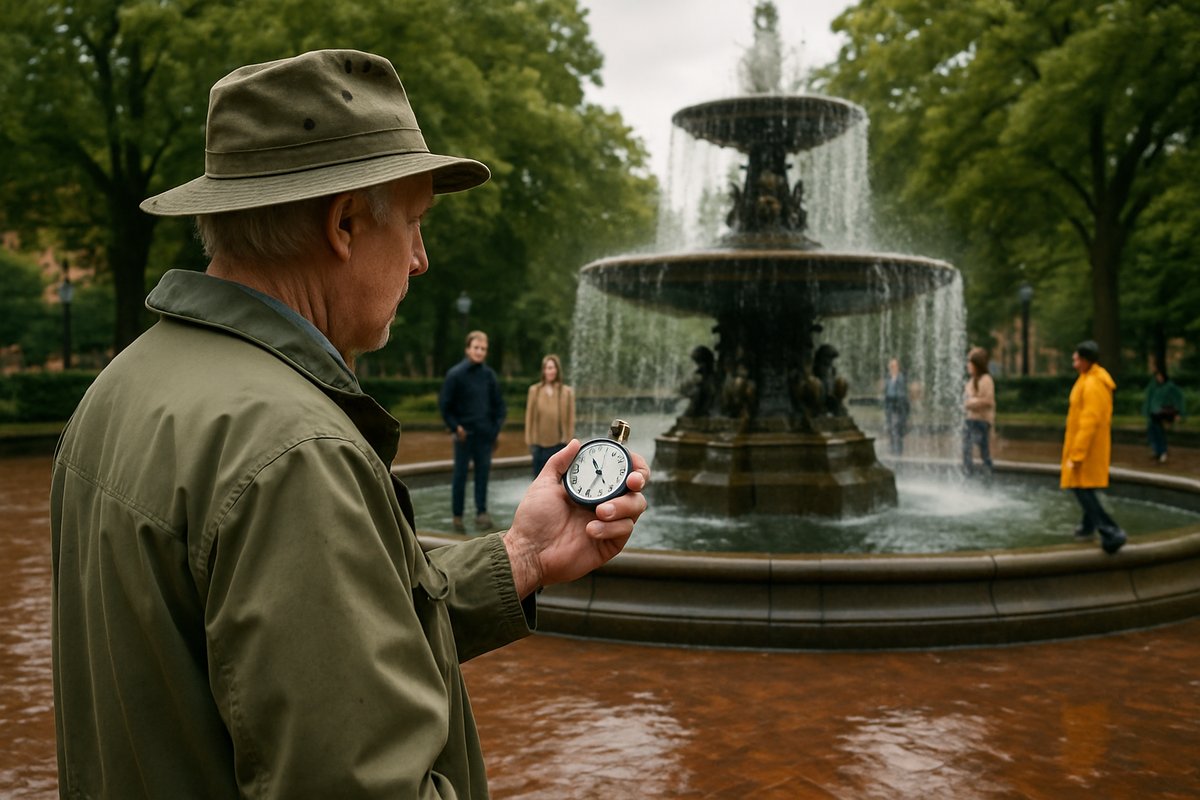
In a move that has residents clutching stopwatches and rubber boots, Parkridge's town council has passed the Water Feature Participation Act, requiring every adult to spend at least fifteen minutes per week at the central fountain. Critics call it an Orwellian stunt, but Mayor Dunbar insists it will restore social cohesion in the digital age.
The Parkridge Town Council convened under fluorescent lights last Tuesday and unanimously approved the Water Feature Participation Act, a law that mandates each of the city’s 32,487 residents to spend no fewer than fifteen minutes per week seated by the sprawling limestone fountain in Central Plaza. Dubbed “Fountain Time,” the new ordinance aims to combat “social fragmentation” caused by screen addiction. Failure to clock in mandatory fountain minutes, officials warn, will trigger monetary penalties starting at twenty dollars per offense.
Local reaction has ranged from bemusement to outright fury. Janet Alvarez, a barista at the nearby Maple Latte Café, was shocked when she got her first citation slip. “They handed me a ticket saying my seven-minute visit last Wednesday didn’t count because I was on my phone texting my friend. Apparently, fountain time only counts if you’re not fiddling with electronics,” she said, clutching a stack of infrared-stamped receipts. “Now I’m officially in contempt of water art.”
Mayor Cynthia Dunbar defended the measure in a public address, calling it “a modest effort to reclaim communal spaces from our devices.” She described the fountain as “an unsung civic therapist” whose gentle cascade can soothe stress and spark spontaneous conversations. “We’ll heal as a community,” she declared. “We’ll look each other in the eye again-preferably dry-eyed.” Dunbar also announced the hiring of twenty “Fountain Marshals,” civilians equipped with clipboards to patrol the perimeter and verify compliance via body cam footage.
In the weeks since the ordinance passed, the fountain plaza has become a spectacle worthy of a theme park. Color-coded benches now indicate “Early Birds,” “Lunchtime Loungers,” and “Twilight Soakers,” guiding residents to schedule their required visits. A small army of pop-up vendors hawk “Fountain Time Kits” that include waterproof timers, foldable newspapers to sit on, and branded stress balls shaped like tiny water droplets. One entrepreneur even launched a “Fountain Fashion” line featuring quick-dry trousers and umbrellas with transparent canopies so passersby can see your face while you observe fountain etiquette.
Some enterprising Parkridge residents have devised loopholes. A group calling itself the Central Plaza Men’s Society has been found conducting relay shifts: one member keeps an eye on the Marshal while another fetches coffee. Records indicate they’ve repeatedly clocked in over an hour each day with scarcely a sip of fountain-side contemplation. Meanwhile, five high school students were cited for attempting to rig an automated rotating chair against the fountain’s edge. They claimed it would “simulate the meditative rhythm of rushing water” without stepping foot in the wet zone.
Law professor Imogen Hartley of Parkridge State University warns that the new law could set an unsettling precedent. “When we permit the government to dictate where citizens must go and how they must reflect once they arrive, we inch closer to an Orwellian society,” she argued. Hartley is now preparing a suit to challenge the ordinance on grounds of freedom of movement. “You can’t impose psychological quotas. If they cared about mental health, they’d expand public therapy services, not weaponize a fountain.”
Even local businesses have felt the ripple effect. Kendra’s Keepsakes, a gift shop on Fountain Street, reported a 70 percent drop in foot traffic. “People don’t browse jewelry when they’re timing themselves against a waterfall,” owner Kendra Liu lamented. Contrastingly, dental practices have reported an uptick in appointments: “Guilt-induced teeth-grinding from fountain anxiety,” one dentist joked. Meanwhile, the city’s fitness centers claim membership has soared as residents attempt to multitask fountain breaks with calisthenics-“because fifteen minutes of fountain squats counts as required attendance,” said one trainer.
Enforcement has also produced unexpected complications. “Last Thursday I escorted a grandmother who brought her ceramic teacup set to sip chamomile at the fountain,” reported Marshal Allison Finch. “Her teacup slid into the water, shattered, and she was so distressed that she forgot to log her minutes entirely. She left sobbing, and we had to call her family.” Finch admits the job isn’t glamorous: “I spend eight hours watching grown-ups stare at a water feature. Then I write reports saying whether they looked ‘genuinely contemplative.’ It’s surreal.”
Protesters have begun staging a weekly die-in around the fountain, lying motionless until someone from City Hall promises to rescind the law. On Tuesday, the crowd held “Louder for the Fountain” signs and chanted, “We don’t want organized tranquility!” A small brass band accompanying the protest played an off-key rendition of “Sittin’ By the Water’s Edge,” further rattling Passersby. In response, the council announced plans for a “Low-Volume Zone” around the fountain to minimize noise pollution-another ordinance slated for next month.
Community organizers critical of the law have embraced humor as a weapon. The group “Soggy Socks United” is distributing free paper umbrellas and mock “Wet Zone Violation” stickers to anyone who complains loudly enough in public. They’re also hosting “Virtual Fountain Time” evenings on video conference platforms, where participants display looping videos of flowing water on their screens to satisfy the requirement without leaving home.
Despite the uproar, some residents say Fountain Time has unexpectedly brightened their week. Retiree Clarence Boyd confessed that watching the fountain “has restored my will to meet my neighbors.” He’s since formed a “Senior Splash Squad,” hosting gentle tai chi sessions at dawn and charging newcomers a dollar for a foam fountain-shaped stress toy. “You’re never too old to appreciate a government-mandated water fountain,” he quipped, raising his plastic droplet in salute.
As tensions swirl, the fountain itself seems to have become the town’s de facto seat of power. Local rumor holds that City Hall is considering similar mandates for other features-weekly gazebo attendance, mandatory park bench portrait hours, even communal birdwatching quotas. If the Water Feature Participation Act stands, Parkridge might become the first municipality to claim a legal right to its own decorations.
Next Tuesday, the town council will hold an open forum at Central Plaza, requiring anyone who wishes to speak to first log their current fountain minutes on a government app. If nothing changes, Parks & Rec plans to upgrade the fountain with synchronized LED light shows and Wi-Fi hotspots-so residents can livestream their civic duty to friends. In the meantime, the entire population of Parkridge will continue shuffling through spray and stone, clipboard in hand, counting each drop in exchange for a reprieve from the $20 fine.
Whether this crusade to recapture community spirit will succeed or simply rinse away at the edges of public patience remains to be seen. But one thing is certain: in Parkridge, you can’t escape state surveillance-and you might as well sit and watch the water while they’re at it.