Location
Mount Vernon, WA 98274

Location
Mount Vernon, WA 98274
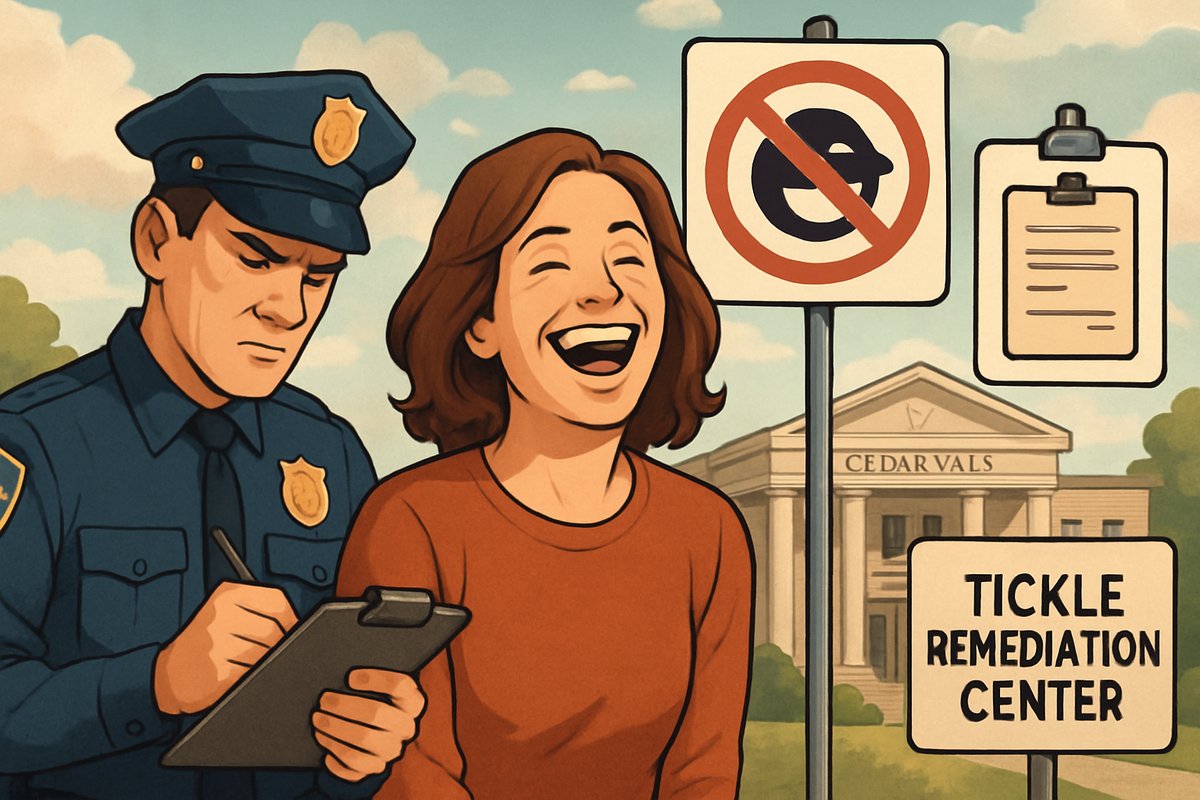
In a move dubbed 'tone-policing gone bureaucratic,' Cedarvale's local government now requires citizens to secure permits before indulging in spontaneous laughter. Residents caught giggling without approved documentation face fines, mandatory apology letters, and stints in the new 'Tickle Remediation Center.'
Last Tuesday, Cedarvale’s town council passed Ordinance 478B-officially christened the Unprompted Chuckle Regulation Act-forcing every resident to apply for a permit before emitting any unplanned guffaws, giggles, or snickers. The measure, proponents argue, aims to protect public decorum and curb disruptive noise pollution. Opponents call it “the most ludicrous overreach since someone tried to ban singing in the shower.”
Mayor Prudence Stickler, flanked by three stern-faced council members, declared the act “a necessary evolution in community standards.” She recited statistics showing a 27 percent spike in spontaneous laughter complaints over the past six months, citing eyewitness reports of “laughter echoing off brick walls,” “public snorts injuring bystanders,” and worst of all, “hashtag-chuckle clusters” forming outside coffee shops.
To obtain a chuckle permit, applicants must submit Form C-LLH (Chuckle Log and Liability History), pay a nonrefundable $14 fee, and attend a mandatory one-hour online seminar titled “Advanced Chuckle Management: Techniques for Regulated Release.” Successful applicants receive a QR-coded digital badge granting up to five spontaneous chuckles per week, with rollover permitted only upon approval from the Bureau of Laugh Oversight (BLO).
Inspector Earl Sternface, head of the newly formed Chuckle Enforcement Unit (CEU), described his team as “part social worker, part auditor, and part laughter assassins.” Armed with clipboards and sound meters, CEU officers patrol parks, sidewalks, and even residential porches, measuring decibel levels and scanning pedestrians for unapproved facial contortions associated with humor. “We’re not joyless,” Sternface insisted, “we just like our humor pre-vetted.”
Local reactions have ranged from resigned compliance to outright rebellion. Eleanor Marsh, a librarian and self-proclaimed ‘serial chuckler,’ told reporters she now practices laughter in her bathroom mirror for fifteen minutes each morning to ensure proper form. “I’ve nearly whittled my chuckle down to a polite ‘heh,'” she lamented, “but even that requires an official squeak endorsement.”
Meanwhile, underground giggle rings have sprung up in basements and abandoned warehouses. Participants trade forged permits, barter expired smile stamps, and host secret “Laugh-Out-Loud Salons” where stand-up poets declaim absurd ballads about sock puppets and existential angst. Attendees speak in hushed tones about a master plan codenamed “Operation Belly Roar” that aims to overwhelm the CEU with simultaneous outbursts.
Local baker Ted Ramos has capitalized on the chaos by introducing “Approved Chuckle Cookies,” stamped with edible QR codes, each granting one instant giggle token upon consumption. The treats fly off shelves, prompting the council to threaten closure of his bakery for “unauthorized laughter inducement.” Ramos responded by launching a “Cookies for Chuckles” loyalty card program, making him an unlikely folk hero among clandestine chucklers.
At Cedarvale Central High School, teachers now require students to wear color-coded wristbands indicating their remaining chuckle quota. Detentions have shifted from textbook reading to “Tickle Remediation Sessions,” where offenders undergo stern lectures on “The Appropriate Use of Humor in Public Spaces.” The school choir reportedly dropped several upbeat songs for fear that crescendos might trigger unsanctioned cackles.
The unintended consequences have been as bizarre as the law itself. Local gyms report a sharp decline in camaraderie during group classes, with participants declining high-fives over worry they’ll accidentally giggle. Two daycare centers suspended storytime after toddlers tried to register for permits in crayon and staged a classroom-wide silent protest, holding up placards reading “Free the Giggle!”
Councilmember Jonathan Hewitt, who originally sponsored the bill, now admits he underestimated public pushback. “I thought we’d see a 50 percent drop in nuisance laughter,” he said at a recent hearing. “Instead, I’m fielding calls about people installing soundproof closets and whispering jokes into socks. We might have created a black market for humor.”
Amid mounting chaos, civic activist group Citizens for Responsible Humor (CRH) has petitioned for an immediate repeal. Their proposal: two free public chuckle days per month, open-mic nights in every park, and a Community Laughter Commission to review permits. “Regulation belonged in the Stone Age,” CRH chair Marin Solis declared. “We’re here for a balanced approach: laugh responsibly, but let laughter bloom.”
Meanwhile, rumors swirl that the town payroll can’t keep up with CEU salaries, leading to proposals for a “Laughter Tax” on comedy clubs and novelty joke shops. If passed, comedians might be forced to declare every punchline at tax time. One local stand-up comic quipped, “At this rate, I’ll owe more on jokes than on my car.”
With tension mounting, the town council scheduled a midnight emergency session in the old train depot. Citizens plan to attend with rubber chickens, whoopee cushions, and-most defiantly-unregistered laughter. The drama promises to pit red tape against red noses, spreadsheets against snorts, and regulations against roars.
Whether Cedarvale ends up as a utopia of measured mirth or a cautionary tale of bureaucratic overreach depends on tomorrow’s vote. Until then, residents are advised to guard their smiles, stockpile registered chuckles, and keep a straight face around any official bearing a clipboard.
As the sun sets on the most surreal chapter in Cedarvale’s history, one thing is clear: laughter may be free, but under Ordinance 478B, it’s also duly ticketed.