Location
Mount Vernon, WA 98274

Location
Mount Vernon, WA 98274
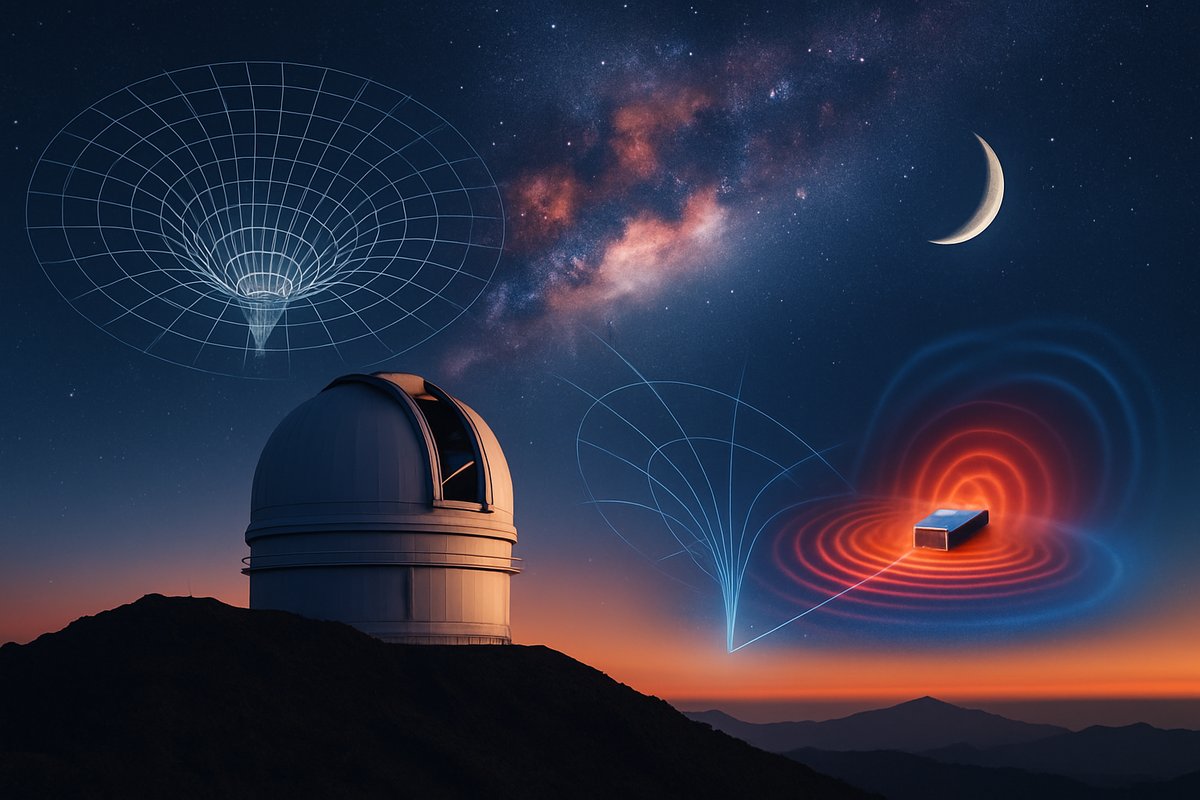
A fresh wave of cosmic measurements is revealing subtle discord in the forces that shape space-time, prompting scientists to rethink dark energy's role in cosmic expansion. From precision observatories on mountain peaks to quantum sensors in underground labs, researchers are racing to decode the universe's faintest signals.
In observatories perched atop remote summits and in underground laboratories shielded from terrestrial noise, an international cohort of researchers has detected slight but persistent deviations in measurements of cosmic expansion. These findings, drawn from the analysis of gravitational lensing, supernova surveys, and large-scale galaxy maps, hint that the force we call dark energy may behave differently across cosmic epochs than our current models predict.
At the heart of the mystery lies the Hubble constant, a value that describes how fast galaxies recede from one another as space itself stretches. While measurements based on cosmic microwave background radiation-a relic glow from the universe’s infancy-point to one rate of expansion, direct observations of distant supernovae suggest a modestly faster pace. The discrepancy has persisted despite ever more sensitive instruments, leading scientists to wonder whether an unknown component of dark energy, or even a new physical law, could be at play.
Recent work utilizing gravitational lensing-the bending of light from distant galaxies by intervening mass-adds yet another layer. By tracking tiny distortions in the shapes of millions of background galaxies, researchers have reconstructed a three-dimensional map of matter distribution. Their analysis indicates slight anomalies in how structures have grown over cosmic time, raising questions about whether dark energy remains constant or evolves in strength.
Meanwhile, space-based missions equipped with infrared telescopes are scanning billions of galaxies across vast stretches of space-time. These observatories employ detectors cooled to just above absolute zero, achieving unprecedented sensitivity to faint infrared light. The resulting galaxy catalogs are feeding into sophisticated simulations that blend general relativity with quantum field theory. Some theoretical physicists propose that transient quantum fluctuations in the vacuum could leave imprints on the cosmos, subtly altering the rate of expansion in different regions.
On the quantum side of the equation, laboratory experiments are testing the limits of vacuum fluctuations and their potential coupling to gravity. Employing ultra-stable atomic clocks and laser interferometers, physicists can measure minute shifts in energy levels caused by the quantum foam that underpins space-time. Although these tabletop systems operate at scales millions of times smaller than galactic clusters, they offer a unique window into how quantum processes might influence cosmic dynamics.
These efforts extend to underground laboratories, where seismic, thermal, and electromagnetic noise are minimized. Here, physicists are building prototypes of quantum sensors that use entangled atoms to detect the slightest perturbations in space-time geometry. Such sensors could one day probe gravitational waves at frequencies inaccessible to large observatories, unveiling signals from the earliest moments after the Big Bang.
The interplay between cosmic-scale observations and quantum-scale experiments is driving a paradigm shift. Researchers are developing new mathematical frameworks that marry elements of string theory and loop quantum gravity with the standard cosmological model. These theories predict subtle deviations from Einstein’s general relativity, potentially testable through precise measurements of cosmic curvature or the polarization patterns in the cosmic microwave background.
Back on Earth, multinational collaborations are assembling networks of telescopes that synchronize observations across continents. By combining optical, infrared, and radio measurements, these networks aim to cross-validate distance estimates and cosmic expansion rates. Data from these combined arrays are streamed in near-real time to central processing centers, where machine learning algorithms sift through petabytes of information, flagging events of interest such as supernovae or gravitational wave counterparts.
Citizen scientists, too, are playing a role. Online platforms invite volunteers to classify galaxy shapes, identify gravitational lenses, and even spot potential anomalies in survey images. Their contributions accelerate the vetting of millions of candidates, freeing professional researchers to focus on the most intriguing cases. This democratization of science underscores a broader truth: curiosity-driven inquiry flourishes when diverse perspectives contribute to the quest.
Yet the new findings also stir more questions than answers. If dark energy varies over time or interacts with matter in unexpected ways, what implications would that have for the fate of the universe? Some models predict a “big rip,” where cosmic acceleration grows without bound, eventually tearing galaxies, stars, and even atoms apart. Others suggest a more benign slowdown of expansion, giving rise to a static cosmos that coasts indefinitely.
Efforts to resolve these possibilities include proposals for next-generation space observatories with meter-class telescopes, capable of detecting faint signals from the farthest reaches of the observable universe. These missions plan to survey billions of galaxies in multiple wavelengths, building a panoramic history of cosmic expansion and structure formation. On the ground, planned upgrades to radio arrays will trace hydrogen gas clouds that acted as cosmic scaffolding billions of years ago, revealing how dark energy influenced the web-like distribution of matter.
Educational institutions are also adapting. New curricula bridge astrophysics with quantum information science, training students in techniques that span scales from subatomic particles to superclusters of galaxies. Workshops on data science, machine learning, and advanced instrumentation prepare the next generation of explorers to handle the torrent of data that modern telescopes and experiments produce.
Even as the field hurtles forward, one lesson endures: the universe remains a playground for human curiosity. Each incremental advance-be it a refined measurement of cosmic curvature or a demonstration of quantum gravitation effects-offers a chance to revisit our assumptions about reality’s deepest underpinnings. The quest to understand dark energy exemplifies science at its most expansive, weaving together precision experiments, mathematical imagination, and the boundless wonder that drives us to look skyward.
In coming years, we can expect a series of critical milestones: new gravitational wave observatories seeking signals from cosmic dawn, laboratory tests probing vacuum structure with atomic interferometers, and space telescopes charting the universe’s accelerating expansion. Whether these efforts confirm the current paradigm or usher in a radical new framework, they will deepen our grasp of the forces that sculpt space-time.
Ultimately, the ongoing dialogue between theory and observation embodies the spirit of scientific discovery. As researchers tune in to dark energy’s faint whispers, they remind us that the cosmos is not a closed book but an invitation to wonder. Each unanswered question is a doorway to unexpected revelations, keeping the tradition of curiosity alive for generations to come.