Location
Mount Vernon, WA 98274

Location
Mount Vernon, WA 98274

Ghostly neutrinos-born in stars and supernovae-are now helping scientists unveil the hidden architecture of our planet. By harnessing global detector networks and open data platforms, researchers are composing a detailed 'neutrino tomography' of Earth's inner layers, blending quantum precision with cosmic scale. This breakthrough not only redefines geophysics but also embodies a model for ethical, transparent, and collaborative science.
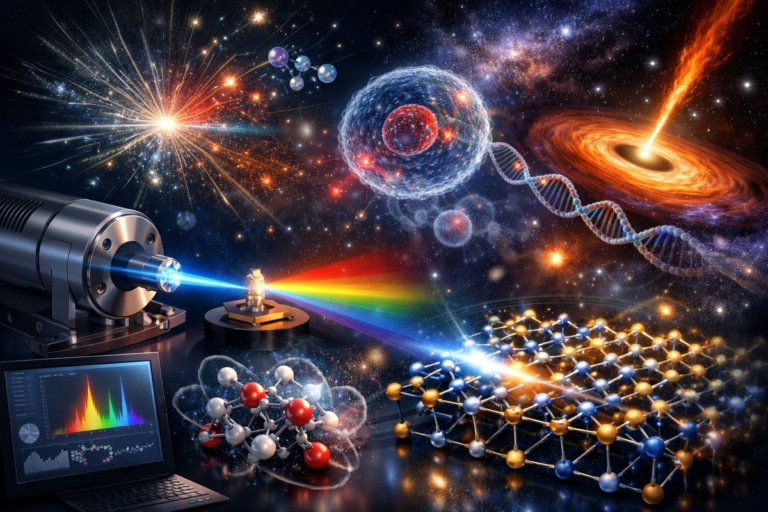
Invisible to nearly every instrument, neutrinos stream through space and matter alike, born in the heart of the Sun, distant supernovae, and high-energy cosmic collisions. Once dismissed as elusive oddities, these subatomic phantoms now carry the promise of revealing our planet’s deepest secrets. Scientists call it neutrino tomography-a technique that uses the faint shadow neutrinos cast as they pass through Earth to map density variations in the core, mantle, and crust. In an age where curiosity meets precision, this new form of planetary imaging is reshaping our view of Earth’s interior and setting a precedent for transparent, values-driven research.
Early efforts to probe Earth’s innards relied on seismic waves from earthquakes, offering a rough sketch of layered structure but leaving many details blurred. Neutrino tomography, by contrast, tracks tiny variations in neutrino flux as these particles traverse thousands of kilometers of rock and metal. Since neutrinos interact only via the weak force, just one in a trillion will collide with an atom along its journey. By comparing the known output of neutrino sources in the cosmos with detections at different angles, researchers can infer density differences that deflect or absorb a fraction of the influx.
At the forefront of this revolution are massive detectors like the IceCube Observatory at the South Pole and the Super-Kamiokande array in Japan. Each consists of vast volumes of ultra-pure water or ice instrumented with thousands of ultra-sensitive light sensors. When a neutrino occasionally interacts with a water molecule, it emits a flash of Cherenkov radiation-an optical ‘sonic boom’ that betrays the particle’s energy and direction. By stitching together millions of such events, scientists have begun to tease out a three-dimensional neutrino density map of Earth.
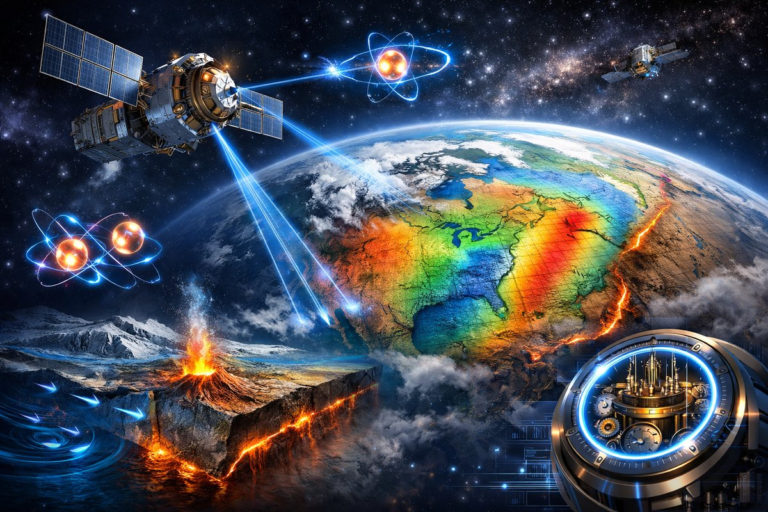
Recently, an international consortium announced a pilot project integrating data from six detector sites spanning both hemispheres. Advanced reconstruction algorithms-powered by quantum-inspired computing-have improved resolution fourfold, allowing researchers to spot subtle variations in density at the core-mantle boundary and even detect pockets of anomalous material deep below volcanic zones. One surprise emerged beneath the Pacific: a high-density plume consistent with an ancient subducted plate, reshaping theories about mantle convection and heat transfer.
These findings carry far-reaching implications. By refining models of Earth’s inner heat engine, geophysicists can better predict volcanic activity, understand plate tectonics, and even assess mineral resources. Beyond practical gains, neutrino tomography exemplifies a new breed of science that bridges quantum and cosmic scales. It thrives on cutting-edge sensors, petabyte-scale data pipelines, and a global network of collaborators working across time zones and disciplines.
Central to this approach is a commitment to open science and digital rights. From the outset, project leaders published raw neutrino event data on a decentralized repository with robust access controls. This ensures that any researcher-whether at a major lab or a small university-can query the data, run their own analyses, and contribute improvements. The platform employs end-to-end encryption and transparent versioning, giving credit to contributors while safeguarding integrity. By treating scientific data as a shared public resource, the consortium models how digital-rights principles can advance discovery without compromising privacy or trust.
Ethical considerations also inform the technology’s footprint. Building and operating vast detectors in remote locations raises environmental and cultural concerns. In Antarctica, IceCube’s drilling camp partners with environmental agencies to minimize ecological impact, recycle water, and monitor wildlife. In Japan, the Super-Kamiokande facility engages local communities through public outreach events, educational programs, and collaborative planning. These efforts reflect an ethical-tech ethos-designing scientific infrastructure that respects ecosystems and upholds the dignity of nearby residents.
Beyond professional labs, citizen scientists are finding ways to contribute. Amateur physics groups have deployed small cosmic-ray detectors in schools and public spaces, tracking variations in background radiation that correlate with solar activity and atmospheric conditions. While these devices don’t detect neutrinos directly, they serve as testbeds for calibration techniques and deep-learning algorithms eventually applied to neutrino data. Online hackathons invite coders to refine reconstruction code, visualize 3D density maps, and simulate novel detector designs. This inclusive model underscores how curiosity, rather than specialization, fuels innovation.
Looking ahead, researchers envision combining neutrino tomography with gravitational-wave observations to produce truly multispectral Earth images. Gravitational waves-ripples in spacetime detected by facilities like LIGO-carry information about mass movements on cosmic scales. By correlating those signals with neutrino transmission data, scientists hope to capture dynamic processes deep within Earth, such as core oscillations or sudden shifts along the inner core boundary. Such synergy could usher in a new era of planetary science where we don’t just see Earth in static layers, but as a living, breathing system in motion.
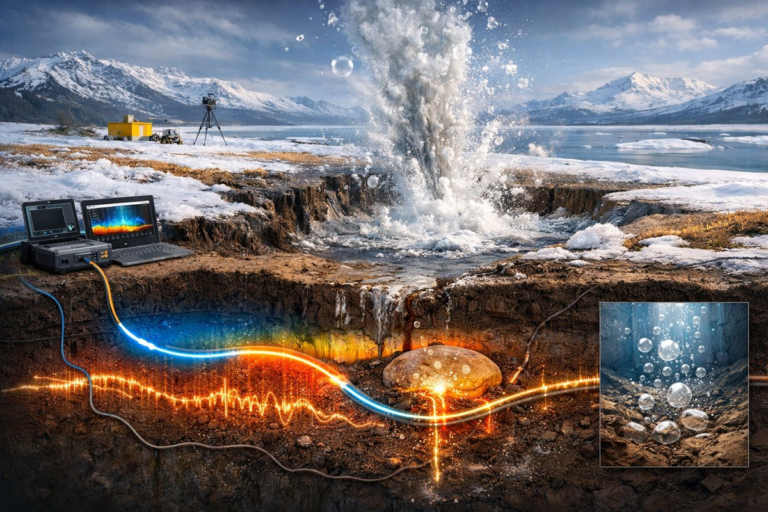
Moreover, forthcoming quantum sensors promise to boost sensitivity by orders of magnitude. Teams are exploring superconducting nanowire detectors cooled near absolute zero, capable of registering single neutrino interactions with unprecedented clarity. When paired with AI-driven pattern recognition, these devices could reveal previously invisible features-microscopic mineral inclusions or transient phenomena linked to solar storms. The same quantum leaps powering neutrino imaging may also advance dark-matter searches, unify particle physics experiments, and illuminate cosmic phenomena across the expanse of space and time.
As this science unfolds, it reminds us that curiosity, precision, and ethical stewardship can coexist. By charting Earth’s hidden heart with cosmic messengers, we not only deepen our understanding of planetary mechanics but also forge a blueprint for responsible, inclusive, and sustainable discovery. From the quantum realm of individual particles to the cosmic stage of star death, neutrinos guide us toward fresh insights-and an inspiring vision of science as a shared journey into the unknown.
Whether you’re a seasoned geophysicist, a data-science enthusiast, or simply someone awed by the idea of Earth’s inner melodies, neutrino tomography invites you to listen in. It’s a reminder that the universe, and our own world within it, remains a playground for curiosity and wonder-waiting to be explored one ghostly particle at a time.