Location
Mount Vernon, WA 98274

Location
Mount Vernon, WA 98274

A new wave of cosmic discoveries is inviting us to peer deeper into the night sky and question our place in an ever-expanding universe. From ripples in spacetime to the faint glow of distant exoplanets, today's breakthroughs are reshaping how we explore, document, and connect with the unknown.
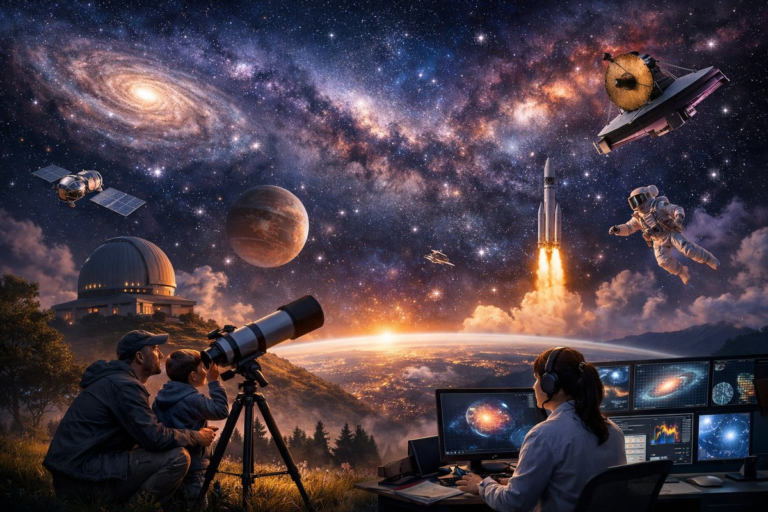
On a clear evening, when city lights fade and the horizon stretches wide, the sky becomes a canvas painted with ancient light. Each glittering point hints at worlds we have yet to touch, and every sweep of the Milky Way whispers stories from billions of years past. This cosmic curiosity-an urge to turn our gaze upward-has always been part of the human spirit, but recent technological leaps are sparking a renaissance of wonder and hands-on exploration.
Just a few years ago, the first images from a next-generation space observatory revealed galaxies whose dim tendrils shimmer like phantom seas on a dream’s shore. Those detailed snapshots shattered our assumptions about star formation and the early cosmos. Meanwhile, observatories on Earth captured faint tremors in spacetime as massive black holes collided light-years away. Those gravitational wave detections aren’t just scientific trophies; they are proof that reality has hidden dimensions, waiting to be felt as much as seen.
At the same time, a new boom in exoplanet research is bringing far-off worlds into sharper relief. Sensors can now pick up the chemical fingerprints of alien atmospheres, searching for water vapor, methane, or oxygen. In one striking observation, researchers found a super-Earth ten times our planet’s mass, orbiting a star so dim it would be invisible to the naked eye. Such discoveries reignite a fundamental question: if a world with conditions for liquid water exists out there, might life have taken root beyond Earth’s shores?
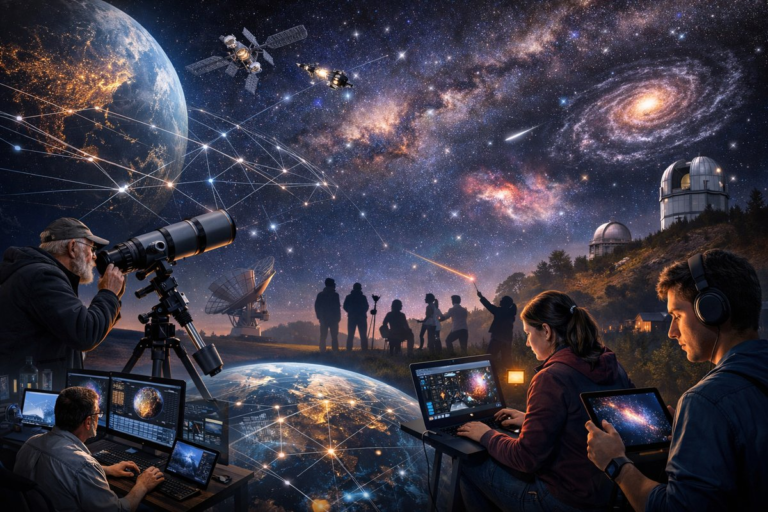
Yet this era of discovery is not confined to ivory-tower labs or billion-dollar rockets. Citizen science platforms invite enthusiasts to sort through millions of galaxy images, classify star types, or flag unusual light curves that could herald new phenomena. Online communities now host global star parties, where hobbyist astronomers compare sketches, share tips on reducing light pollution, and even submit their own observations for professional follow-up. The boundary between amateur and expert is blurring, united by a shared enchantment with the cosmic tapestry.
Astrophotography, once a niche pursuit requiring darkroom chemicals and bulky equipment, has become more accessible thanks to compact trackers and high-sensitivity digital sensors. With a camera, a simple lens, and a portable mount, you can capture spiraling nebulae and dusty star clusters in vivid detail. Night after night, dedicated observers refine their techniques-fine-tuning focus, calibrating color balance, and stacking exposures to tease out faint details. The result is a gallery of natural art that brings the universe’s palette right into our living rooms.
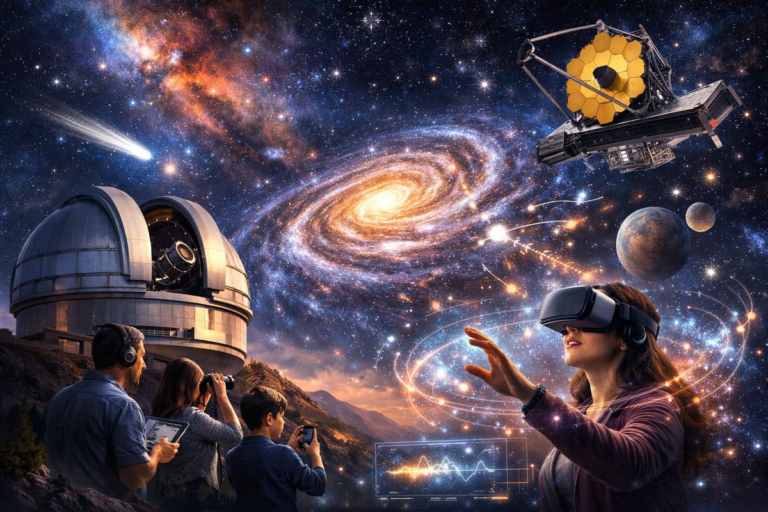
Even if you’re not setting up a tripod under a rural sky, new digital planetarium software can project the heavens onto any ceiling, turning bedrooms into observatories. Virtual reality headsets can whisk you on a tour of Saturn’s rings or plunge you into an animated reconstruction of the universe’s first few minutes. These immersive experiences foster a sense of scale and timeline that textbooks alone cannot convey.
Meanwhile, researchers studying cosmic rays-high-energy particles that crash into Earth from unknown origins-are building networks of backyard detectors. Constructed from scavenged electronic parts and open-source designs, these DIY instruments record particle strikes, timestamp them, and forward the data to collaborative databases. By mapping the arrival directions of these neutrinos and muons, citizen physicists assist in pinpointing astrophysical accelerators like supernova remnants or active galactic nuclei.
Behind every new data point lies a story of ingenuity and persistence. Engineers refine mirror coatings to overcome thermal distortions, software developers craft algorithms that scour terabytes of telescope data, and volunteers sit by their laptops, sifting through pixel clusters for anomalies. Together, they weave a tapestry of insight that stretches from our backyards to the edge of the observable universe.
But cosmic curiosity isn’t just about cataloging remote phenomena. It strikes at the heart of our collective psyche, reminding us of how small we are in an immense cosmos-and yet how intimately connected. The same stardust that coils in distant supernova remnants also forms the calcium in our bones and the iron in our blood. This chemical kinship bridges time and distance, urging empathy not only with distant worlds but also with the one we call home.
In classrooms around the world, educators harness this narrative to inspire new generations. Students code mini-satellites on credit-card-sized circuit boards to measure temperature fluctuations in low Earth orbit. They simulate asteroid impacts in water tables and chart the orbits of simulated planetary systems. Beyond rote memorization, they learn to think like explorers-posing hypotheses, designing experiments, and grappling with unexpected results.
These educational initiatives often emphasize sustainability, recognizing that our technologies must tread lightly on Earth even as they reach for other worlds. Solar-powered observatories, reusable rocket stages, and modular satellite designs all reflect a growing awareness of cosmic and terrestrial stewardship. After all, the lessons we learn scanning the heavens apply equally to preserving the delicate biosphere beneath our feet.
When we marvel at a crimson nebula or ponder the ripple of spacetime, we partake in a story that predates humanity and will outlast us all. The narrative is one of curiosity, collaboration, and creative resilience-a testament to what can happen when we question the world rather than accept it at face value.
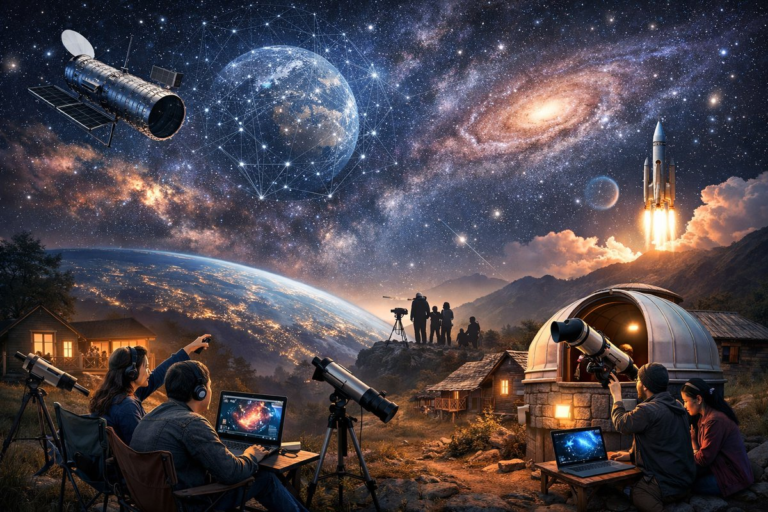
For the endlessly inquisitive, the invitation is clear: step outside after dusk, let your eyes adjust, and search for constellations you’ve never before noticed. Consult open databases for the latest comet discoveries. Join a virtual meetup where someone demonstrates how to align a small telescope with Jupiter’s cloud bands. Or simply sit quietly under a canopy of stars, aware that each pinprick of light is a gateway to untold mysteries.
In the final analysis, cosmic curiosity isn’t a destination but a journey-one that thrives on questions as much as answers. It transforms solitude into shared wonder and curiosity into collective discovery. It reminds us that our greatest adventures lie not in conquering but in contemplating, not in claiming dominion but in celebrating the vast unknown. As long as we keep looking up, the echoes of infinity will continue to stir our minds and expand our dreams.