Location
Mount Vernon, WA 98274

Location
Mount Vernon, WA 98274
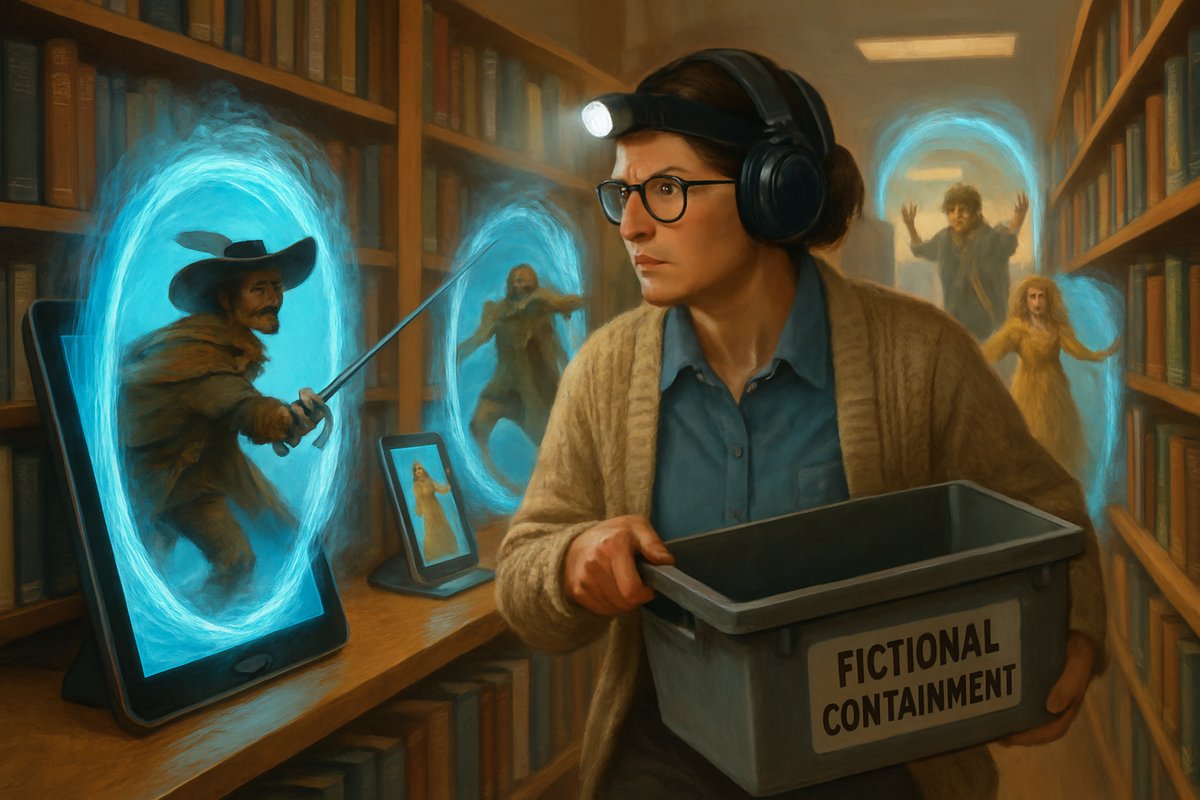
A small-town library has declared a state of emergency after several e-readers spontaneously opened portals to fictional worlds, allowing escaped characters to roam the aisles. Librarians have armed themselves with headlamps, noise-cancelling headphones, and "fictional containment" bins to keep wayward protagonists from staging protests in the nonfiction section.
Librarians in Pinewood Springs woke up to a most peculiar crisis when the first e-reader at the circulation desk began to glow with an eerie blue light and promptly vomited a miniature wizard muttering about overdue wands. Word spread faster than a bestselling thriller: digital devices around the building were tearing open tiny portals into storybook realms, and characters from every genre were stepping through.
The inaugural breach occurred at precisely 9:07 a.m., when the town’s only part-time assistant librarian tapped a touchscreen to renew a copy of “Unicorns for Beginners.” Instead of the expected confirmation screen, a curly-bearded dwarf wearing a waistcoat appeared, slammed a paw down on the checkout counter, and demanded interest on his investment in enchanted pickaxes. Startled by the dwarf’s insistence on financial restitution, staff members spent the next hour placating him with library coupons until he retreated back into the e-reader, muttering about rotten service.
By noon, multiple aisles were dotted with curious breaches. Patrons reported hearing a low, philosophical monologue in the philosophy section that seemed suspiciously akin to Camus, though no physical volume of existential essays was on loan. In the children’s area, a group of talking kittens from a children’s fantasy series ambled through the shelves, demanding snacks and reading recommendations. One tiny tabby even signed a library card-though fortunately it lacked thumbs and could not complete the paperwork.
Recognizing the seriousness of cross-dimensional literary migration, Head Librarian Marjorie Knolls activated the emergency response kit she’d jokingly assembled last year “just in case authors decided to write themselves free.” The kit included battery-powered headlamps, makeshift cardboard shields painted with “Do Not Read Aloud” warnings, and rolls of tape labeled “Plot Stabilizer.” Librarians donned noise-cancelling headphones to block out distracting monologues and harmonized siren calls, while interns scurried around installing temporary LED string lights above each e-reading station to keep the edges of reality well-lit.
A town hall meeting followed that evening in the community center, where the mayor reluctantly swapped his ceremonial gavel for a plush velvet “fiction containment” puppet. Residents demanded action-some called for hiring dragon slayers, others suggested banning e-books altogether. One outspoken local, Mrs. Feldspar, urged for “Beware of Book Ghouls” signage on every shelf. The mayor’s response: allocate emergency funds to purchase transparent plastic bins for “holding rogue villains until they show their library cards.”
Meanwhile, the escaped literary figures staged their own demonstrations. Hamlet materialized in the reference section, delivering his famous soliloquy at full volume, prompting a flood of “Quiet, please!” reminders from annoyed patrons. A squad of sirens from a maritime epic tried luring curious readers toward the aquarium exhibit. Even a trio of detectives from a classic mystery novel convened behind the stacks to debate alibis-unaware that the nearest crime scene was a lost-and-found bin filled with mismatched umbrellas.
As containment efforts ramped up, librarians recruited a cast-off private investigator from a pulp noir series (“Downtown Detective D.B. Steele”) to patrol the aisles in a trench coat. Steele carried a miniature magnifying glass and offered dramatic commentary: “I’ve seen clues scarier than misplaced commas, but this one’s got me turning pages in my sleep.” Patrons appreciated his flair but remained nervous when he tried to interrogate an encyclopedia entry on rare fungi.
With each passing day, the phenomenon grew more absurd. The spot reserved for “New Arrivals” became a revolving door of fictional visitors offering unsolicited reading recommendations. A steampunk airship pilot materialized above the magazine rack, demanding docking clearance. A rom-com protagonist showed up in the romance section, eyeing every patron suspiciously as potential love interests. To restore order, librarians organized a shoot-an improvised re-enactment of a courtroom drama in the biography area, complete with witness stand made from old book carts.
Experts at the University of Libraria’s Quantum Media Symposium weighed in, suggesting that an overload of e-reader downloads had created a resonance frequency capable of fracturing narrative space-time. Their remedy: recalibrate device firmware to include a “fiction firewall,” bolster ambient lighting around digital devices, and keep background noise at a steady hum to discourage dramatic monologues. In practice, this translated into librarians hosting a nightly playlist of elevator jazz and ensuring every e-reader station had a desk lamp with adjustable color temperature.
By the time the Pinewood Springs Hardware Emporium sold out of transparent, sealable storage bins labeled “Fiction Quarantine,” residents had accepted that their library was now equal parts lending institution and interdimensional embassy. The local PTA even organized a bake sale fundraiser to cover overtime for librarians donning headlamps after sunset. Shifts now begin with a roll call of who’s on “door duty” to watch for drifting knights or runaway space operas.
Reflecting on the chaos, Head Librarian Knolls admitted she’d underestimated the power of reader-device interactions. “I thought our biggest threat was overdue fines,” she said, adjusting her noise-cancelling headphones. “Turns out, it’s unauthorized guest appearances by dramatic narrators.” She paused as a heroic princess strode by, sword drawn and demanding her romance novel back. Knolls sighed. “We really need a better system for interlibrary loans,” she muttered.
As Pinewood Springs transitions into this new era of literary pandemonium, one thing is certain: the line between fiction and reality has never been thinner. Patrons now approach the digital catalog with both excitement and trepidation, wondering if they’ll check out an e-book or accidentally summon an entire fantasy epic. For librarians who once quietly stamped pages and shelved paperbacks, the next chapter promises to be far more adventurous than any plot they’ve ever cataloged.