Location
Mount Vernon, WA 98274

Location
Mount Vernon, WA 98274
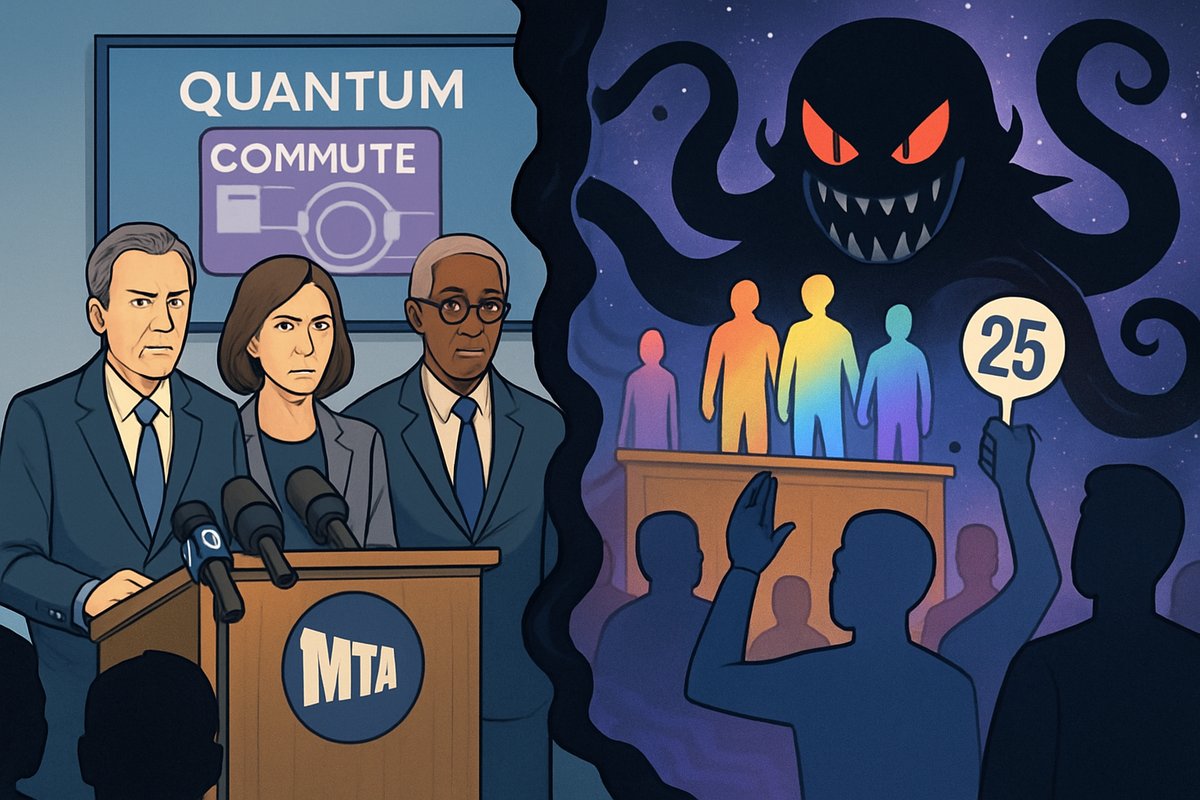
When the Metropolitan Transit Authority rolled out its revolutionary Quantum Commute Pass, they promised seamless travel and instant transfer. Instead, an unexpected code glitch auctioned off commuter souls to the highest bidder in a parallel dimension. Now officials are racing to reclaim consciousness, arguing fare refunds, and negotiating with cosmic brokers for a buyback plan.
The morning rush at Central Station was more surreal than usual. Commuters swiped their freshly issued Quantum Commute Passes at the terminals, expecting holographic ticket confirmations. Instead, each swipe produced a flickering generator hum and a ticket invoice addressed to a glowing entity from a far-off sector labeled “V-13.” Instead of recording a single trip from home to office, the system apparently sold travelers’ souls on an intergalactic marketplace.
Word of the mass soul lease broke when a barista at the station café noticed a queue of frantic passengers demanding refunds in the form of existential guarantees rather than cash. “I ordered a latte with oat milk and a guarantee I’m still me by 9 a.m.,” one commuter complained. The café’s tip jar swiftly filled with apology notes instead of coins, as riders scrambled to reclaim intangible property.
By midmorning, the Metropolitan Transit Authority (MTA) had issued a brief statement blaming “a calibration error in the quantum entanglement module”. Officials assured the public they were “actively negotiating with third-party custodians of the soul registry”. This led to more confusion: commuters wondered who exactly had custody of their innermost self, and whether they needed a lawyer or a chaplain to sort it out.
On the platform, a makeshift prayer circle formed around a malfunctioning ticket scanner. A group of retirees holding knitting needles chanted, hoping to reverse the entanglement. Nearby, tech enthusiasts livestreamed the chaos, speculating that the error could be a stunt to drive memetic value and viral marketing.
An emergency task force convened at MTA headquarters. The panel included a software engineer who specializes in astrophotography, a retired librarian who insists every soul must return to its original owner, and an amateur negotiator who once brokered peace between two competing food trucks. The mayor’s office sent a stern memo demanding results by lunchtime.
Inside the lab, technicians stared at a tangle of glowing cables labeled “Souls In Transit”. Every cable represented a commuter whose consciousness had been rerouted through an online bidding war. The highest bidder, codenamed “OmegaGroupZeta”, appeared to be a consortium of cosmic art dealers who collect human experiences for immersive exhibitions on the planet Rhinox-4.
“We never imagined someone would turn our advanced ticketing system into a galactic auction platform,” admitted the lead engineer, adjusting her safety goggles. “In theory, it should have simply used quantum superposition to track multi-hop transfers. In practice, it loaded a smart contract that triggered a soul rental clause.”
Back at Central Station, a pop-up protest sprung up. Riders demanded either their souls back or free unlimited travel for life. One sign read, “Own Your Own Astral Projection-Don’t Rent It!” Another demanded an apology in both English and binary. Transit security politely redirected protesters to an adjacent platform, which unfortunately happened to be an express line to nowhere.
Amid the uproar, a mysterious broker from the OmegaGroupZeta consortium contacted the MTA. Speaking through a dimensional frequency interpreter, the broker explained that the soul leases were technically reversible as long as the lessees sent a cosmic credit transfer of eight gratitude tokens, three star charts, and a signed waiver absolving the consortium of existential liability.
The MTA finance department scratched its collective head. “What do we even send back?” one clerk asked. Star charts were easy-Cartographers had maps. Gratitude tokens were trickier. Should they mint commemorative coins? And the waiver? Legal insisted it must be drafted in triplicate, approved by a cosmic notary, and notarized on a meteorite.
To manage public sentiment, MTA arranged a pop-up negotiation forum in the main concourse. Commuters lined up to vent frustrations to a rotating panel of representatives, including a trained mediator, a local poet reciting verses about stolen essence, and an AI chatbot programmed to apologize in six thousand dialects. The chatbot’s most popular phrase: “We deeply value your intangible being.”
In an attempt to redeem its reputation, the MTA announced free coffee for everyone-assuming their souls returned before the cups cooled. Baristas, meanwhile, were briefed to offer sympathetic ear and extra foam. Some riders took advantage, engaging in impromptu therapy sessions over single-serve espresso pods.
Meanwhile, the social media frenzy reached cosmic proportions. Memes depicted commuter spirits doing yoga at the bottom of a wormhole, screaming “We just want to go to work!” Influencers posted side-by-side selfies showing them before and after the soul lease glitch, captioned “Swipe left for existential horror.”
Even suburban commuters joined in, staging a “Soul Solidarity” caravan with decorated cars towing cardboard cutouts of their own souls. One banner read, “If you can read this, my soul is overdue for renewal.” Another declared, “Return Our Essence-Or We Take the Bus!”
As evening approached, negotiations bore fruit. The OmegaGroupZeta broker agreed to return the souls in exchange for one simple act: a citywide gratitude broadcast. Commuters had to chant a communal thank-you in unison at precisely 7:13 p.m., synchronized across every phone signal tower. The catch: if even one person missed the chant, the souls would be permanently listed as “interdimensionally leased”.
City officials mobilized a network of text alerts, social media reminders, and sky-floating holograms flashing the chant lyrics. Coffee shops displayed the words on chalkboards. Commuters practiced in the stations, inadvertently training themselves for a potential extraterrestrial yoga class.
At 7:13 p.m., the city held its collective breath. The chant erupted: “Thank you, OmegaGroupZeta, for trusting us with our cosmic experiences! Please kindly return our souls now!” Across every district, phones glowed with confirmation messages and small pocket swooshes that indicated success.
Moments later, commuters felt a strange, warm snap back to selfhood. Phones slid from hands as riders blinked in bewilderment. The barista at Central Station sighed with relief: the tip jar filled once more, this time with literal tokens of gratitude. Transit Authority spokespeople issued a final apology, promising to remove all soul-leasing modules, double-check smart contracts, and maybe revert to good old plastic cards.
In the aftermath, commuter forums buzzed with lessons learned. Many now treat their travel passes like digital keepsakes, storing them in protective sleeves. A local startup announced a “Soul Insurance” plan for anyone nervous about future entanglement errors. Meanwhile, the MTA quietly updated its code repository, renaming the faulty module “Do_Not_Lease_Souls”.
Critics argue this incident reveals the hidden perils of over-engineering public services. Advocates call it a once-in-a-lifetime cosmic adventure. Either way, regular riders returned to waiting on platforms, scanning passes without fear, though some still glance nervously at the terminals.
As for OmegaGroupZeta, they issued a press release praising the city’s enthusiasm and hinting at future collaborations. Rumor has it they’re eyeing a soul swap program between Earth poets and Martian artists. But that’s a headline for another day.
In the end, daily life resumed. Buses rolled, subways hummed, and the occasional commuter tapped their forehead, half-expecting to feel astral echoes. The Quantum Commute Passes remained in circulation, now with a big red sticker reading: “Guaranteed Soul-Free Travel.”
And so the city learned that sometimes progress comes with unintended cosmic side effects. The next time you swipe your card, take a moment to thank your local transit workers-just don’t thank them for giving away your soul.