Location
Mount Vernon, WA 98274

Location
Mount Vernon, WA 98274
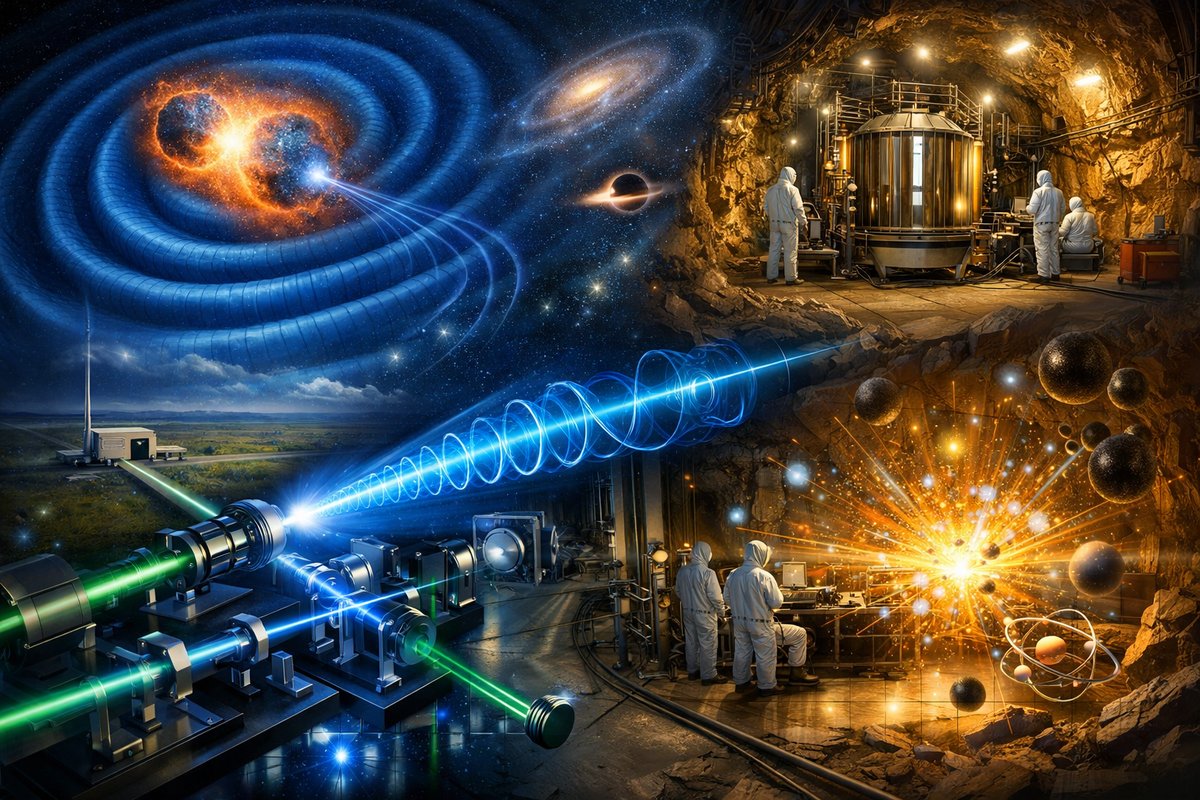
A global network of gravitational-wave observatories has entered a golden era, using quantum-squeezed light to capture ripples in spacetime with record precision. From neutron star collisions to dark matter searches in underground labs, recent advances are redefining our view of the universe at both its grandest and most infinitesimal scales.
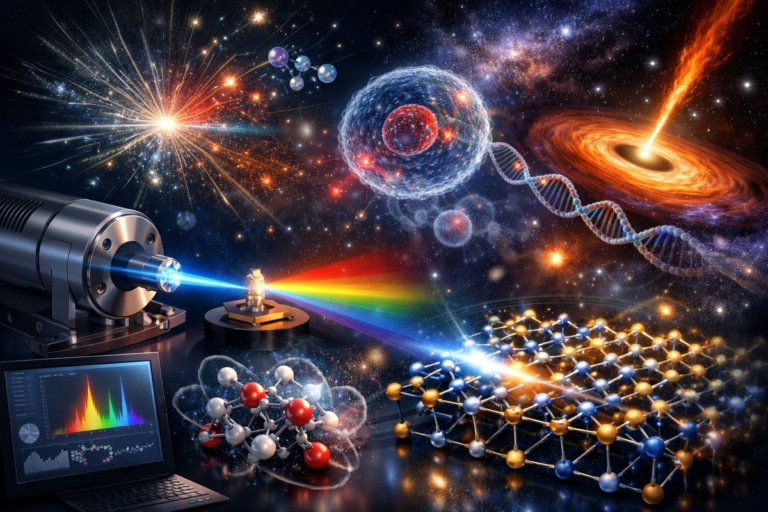
Last month, the combined detectors of the LIGO-Virgo-KAGRA collaboration reported a wave of new gravitational-wave events, many detected with an unprecedented signal-to-noise ratio. Behind this breakthrough stands a quantum technique called squeezed light, which reduces noise in the interferometer’s laser beams. By injecting quantum-engineered states of light into the arms of the observatories, researchers have managed to sharpen their cosmic eavesdropping, unveiling distant black hole mergers and neutron star collisions with clarity never seen before.
These new detections include at least five high-confidence events, ranging from the classic black hole binaries to rarer strikes that hint at intermediate-mass black holes-objects whose origins straddle the boundary between stellar collapse and the supermassive beasts anchoring galactic cores. One standout event, designated GW-H2024, carries the signature of a black hole roughly 200 times the mass of the Sun, reshaping theories about how such midweight behemoths can form in relatively young stellar clusters.
Quantum squeezing isn’t brand new to gravitational astronomy; LIGO first demonstrated squeezed-light enhancement back in 2019. What’s different today is the refinement of those techniques and the seamless integration across all three sites. Small upgrades in the optical components have cut thermal noise, while improved algorithms for controlling quantum fluctuations have doubled the duty cycle of high-sensitivity operation. The result: detectors that spend more time listening for the faint murmurings of spacetime rather than battling their own internal static.
Meanwhile, space-based telescopes have continued to map the aftermath of those distant cosmic cataclysms. An instrument aboard a recent infrared mission provided follow-up observations of an unusual kilonova, revealing unexpectedly heavy elements in the ejected debris. Combining gravitational-wave triggers with electromagnetic follow-up has become routine, illustrating the power of multimessenger astronomy: weaving quantum-enhanced terrestrial observatories with telescopes that peer across the spectrum, from radio to X-rays.
Looking to the next decade, mission planners are pinning hopes on LISA, a spaceborne interferometer that will open a low-frequency gravitational wave window. Scheduled for launch in the early 2030s, LISA’s million-kilometer laser arms will detect mergers of supermassive black holes and the continual hum of white dwarf binaries in our galaxy. Alongside squeezed-light innovations, researchers are exploring quantum sensors aboard small satellites-novel payloads designed to pick up the slightest spacetime ripples without the burden of Earth’s seismic rumble.
Closer to the lab bench, physicists are turning their quantum toolkits toward a very different quest: the identity of dark matter. Experiments such as the Axion Dark Matter eXperiment (ADMX) use superconducting cavities cooled to millikelvin temperatures, scanning for the faintest electromagnetic whispers of hypothetical particles called axions. In parallel, the CASPEr initiative places precision magnetometers near dense samples of spin-polarized nuclei, searching for oscillating fields that would betray the presence of an ultralight dark matter candidate.
These tabletop efforts share a guiding principle with giant astrophysical instruments: exploiting quantum phenomena to probe realms far beyond our direct reach. While LIGO listens to the universe’s most violent dances, ADMX and CASPEr strain to feel the gentle tug of invisible fields that permeate every galaxy. Success in either domain would rewrite textbooks-one by confirming general relativity’s cosmic choreography, the other by solving the century-old puzzle of the universe’s missing mass.
Beyond practical detection, the fusion of quantum physics and cosmology carries profound philosophical weight. Gravitational waves spring from the dynamical curvature of spacetime itself, hinting at how space and time can ebb and flow like a fluid. Quantum mechanics, by contrast, reveals a granular fabric of probabilities and uncertainties. Reconciling the continuous warping of spacetime with the discrete nature of quantum fields remains the Holy Grail of fundamental physics-a challenge as much conceptual as technical.
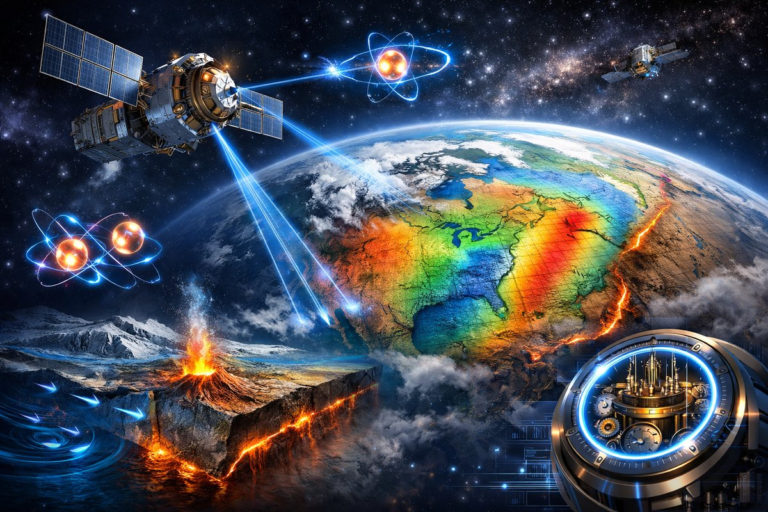
In parallel, advances in quantum timekeeping are enabling new tests of gravity and geophysics. Optical lattice clocks operating with strontium atoms now achieve stability at the 10−18 level-so precise that two clocks separated by just a centimeter in altitude will tick at measurably different rates. Researchers are deploying portable clock arrays to map subtle gravitational gradients across continents and volcanoes, transforming absolute time into a probe of Earth’s hidden structures.
These innovations aren’t confined to ivory-tower labs. Citizen-science initiatives have empowered amateur astronomers to hunt for optical counterparts of gravitational-wave events. Smartphone apps alert stargazers to candidate sky patches, encouraging coordinated observations with backyard telescopes. Some community groups have even organized workshops on building simple Michelson interferometers from off-the-shelf optical components, giving enthusiasts hands-on experience with the same principles that power billion-dollar observatories.
Behind every data point stands an interdisciplinary collaboration: physicists working with engineers to tame quantum noise, mathematicians refining signal-processing algorithms, and software developers building open-source tools for real-time data sharing. Universities and government labs are increasingly partnering with startups on quantum-sensor spin-outs, seeking to translate breakthroughs in vacuum chambers into deployable instruments for exploration, defense, and environmental monitoring.
Looking ahead, some envision a network of quantum satellites that not only communicate securely using entangled photons but also survey Earth’s gravity field with unprecedented resolution. On the ground, arrays of atomic gravimeters could work in concert with terrestrial gravitational-wave observatories, cross-correlating signals to veto local disturbances and push sensitivity ever closer to the quantum limits imposed by Heisenberg’s uncertainty principle.
Ultimately, this convergence of the quantum and the cosmic underscores a timeless human drive: to probe the unknown with both precision and wonder. Each squeezed-light photon, each ticking clock, and each collision echoing across the reaches of space tells a story of ingenuity, collaboration, and an unyielding appetite for discovery. As detectors grow more sensitive and theories grow more daring, we stand on the threshold of revelations that may reshape our place in the cosmos and unlock the deepest secrets of reality itself.