Location
Mount Vernon, WA 98274

Location
Mount Vernon, WA 98274

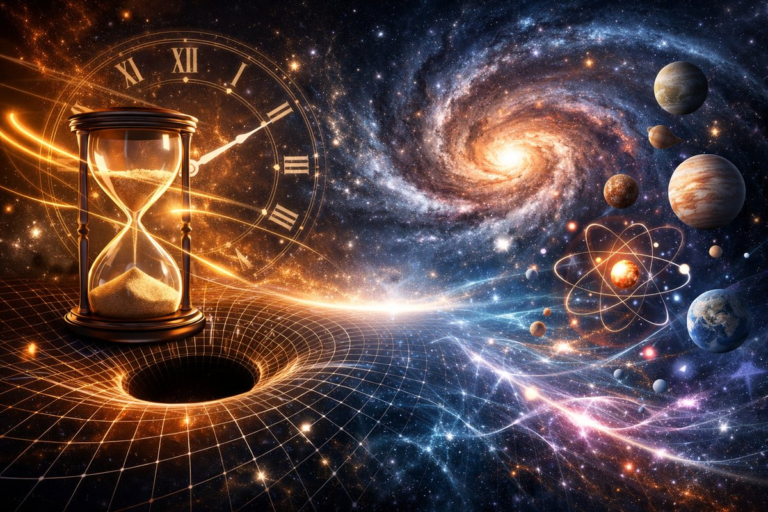
A wave of discoveries-from record-setting optical clocks to fresh gravitational wave signatures and peculiar anomalies in the cosmic microwave background-is transforming how we measure time, understand mass, and confront entropy. These breakthroughs not only reshape our view of the universe's grand design but echo in the rhythms of daily life.
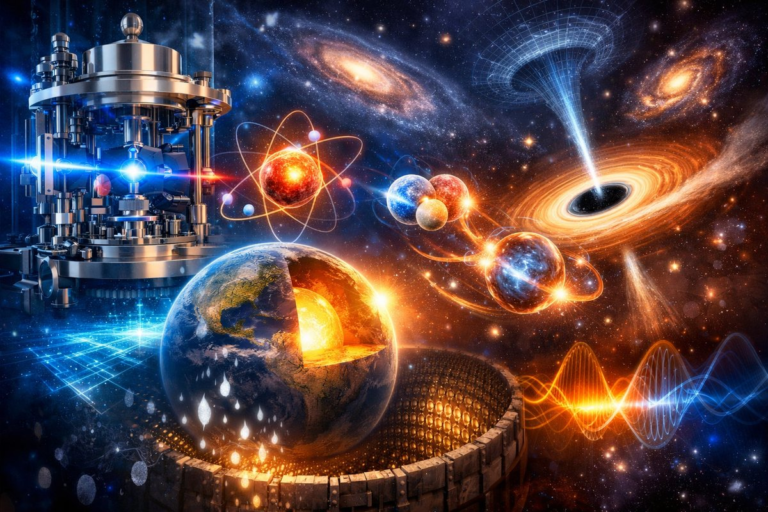
In labs and observatories around the globe, scientists have spent recent months weaving fresh insights into the tapestry of time, matter, and mystery. Three landmark developments-in high-precision timekeeping, gravitational-wave astronomy, and the study of primordial cosmic radiation-now form interconnected threads that challenge conventional boundaries between microscopic experiment and cosmic narrative. As researchers refine the ticking of atomic clocks, capture the reverberations of colliding stellar corpses, and map faint cold spots in the afterglow of the big bang, we’re invited to reconsider not only the universe’s grand scales but the fleeting moments that define our own lives.
At the heart of these revelations lies the relentless pursuit of ever more accurate time measurement. In a recent series of experiments at a major national standards laboratory, physicists pushed optical atomic clocks to unprecedented levels of stability. By harnessing thousands of laser-cooled atoms in an array of ultra-stable lattices and synchronizing them with lasers whose frequency noise has been pared down by cryogenic mirrors and vibration-damping mounts, researchers shaved the uncertainty of time intervals to mere quintillionths of a second. This advance did more than break records-it opened the door to detecting minuscule gravitational time dilation across distances of just a few centimeters.
Such extreme sensitivity stems from Einstein’s insight that gravity not only bends light but also warps spacetime itself. When a timepiece sits at a higher gravitational potential-on a mountain peak, for instance-it ticks slightly faster than its counterpart at sea level. With the new optical clock arrays, scientists monitored this effect in real time within a single lab, sensing shifts in ticking frequency equivalent to changes in height smaller than the thickness of a finger. These tabletop explorations of relativistic time dilation promise applications in geodesy, where pinpoint accuracy could track rising water tables or shifting tectonic plates, and in fundamental physics, where minute discrepancies might hint at new forces or dimensions.
While clocks probe gravity’s gentle tug on time, gravitational-wave observatories are listening for its most dramatic rumbles. In the latest observing run, the global network of detectors captured a rare signal from a neutron star-black hole collision. This cosmic cataclysm generated a distinctive “superchirp” waveform as dense nuclear matter spiraled into an abyss of infinite curvature. By isolating the shape and duration of that chirp, astronomers extracted precise information about the mass and spin of both objects, as well as the energy radiated as gravitational waves.
The merger’s entropy footprint fascinated researchers. In theories of thermodynamics extended to black hole horizons, the event’s immense release of heat and distortion raises profound questions about the arrow of time. When two massive bodies combine, do they simply add their individual entropic inventories, or does the black hole’s own entropy, governed by its surface area, dominate the ledger? Early analyses suggest that the final state’s entropy far exceeds the sum of its progenitors, reinforcing the idea that black holes are nature’s ultimate entropy engines. These insights are not mere abstractions-they influence how simulations of galaxy formation and dark matter behavior are constructed, guiding models that inform cosmology’s grandest predictions.
Meanwhile, a fresh look at the cosmic microwave background-the ancient afterglow of the big bang-has revealed curious cold patches that defy statistical expectation. Using updated data processing techniques on measurements originally collected by a European space mission, cosmologists have mapped temperature deviations across the sky with enhanced resolution. Certain regions appear cooler by a few millionths of a degree, creating spots that may trace back to primordial fluctuations in entropy distribution.
Some theorists argue these cold anomalies hint at processes beyond the standard inflationary picture. Could early quantum vacuum states have imprinted uneven entropic seeds, leading to slightly denser pockets that slowed expansion locally? Or might these irregularities be signatures of gravitational interactions with unseen structures beyond our observable horizon? While competing hypotheses remain under debate, the very existence of these enigmatic cold spots underscores the universe’s capacity to surprise, even in a dataset scrutinized for decades.
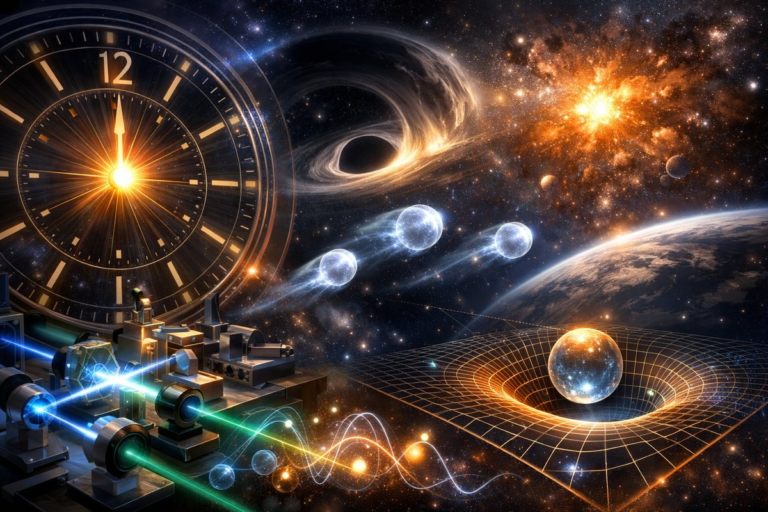
Taken together, the clock experiments, gravitational-wave detections, and microwave background analyses form a trifecta of discovery that unites time, mass, and entropy into a single narrative. In each case, researchers probe how the cosmos governs change: clocks mark the passage of every second, collisions convert mass into waves and heat, and relic radiation preserves the imprint of primordial disorder. Yet these fundamental concepts also resonate deeply with human experience. We age relentlessly, carrying memories whose clarity fades like photons drifting through expanding space. Moments of joy and loss accumulate, raising the entropy of our inner worlds in ways both measurable and profoundly ineffable.
Across disciplines, artists and storytellers are finding inspiration in these scientific milestones. Poets have begun weaving metaphors from gravitational-wave waveforms-comparing the rise and fall of their amplitudes to the crescendos and lulls of emotional tides. Painters experiment with shifting color palettes that mirror the cosmic microwave background’s mottled sky, evoking the tension between order and randomness. Even composers are collaborating with physicists to translate data streams from optical clock oscillations into minimalist musical pieces, blurring the line between mathematical precision and aesthetic expression.
Beyond their poetic allure, these breakthroughs carry practical implications for everyday life. Next-generation navigation systems may one day integrate optical clock networks for centimeter-level positioning, transforming fields from autonomous vehicles to deep-sea exploration. Enhanced models of Earth’s gravitational field could improve climate forecasts by tracking ice mass loss and ocean currents with fine-grain accuracy. And in fields like telecommunications and high-frequency trading, where nanoseconds can mean millions of dollars or missed opportunities, more reliable clocks promise to synchronize systems with unprecedented fidelity.
Meanwhile, as gravitational-wave astronomy matures, its revelations will refine our understanding of how heavy elements form in the universe. Neutron star mergers are factories for precious metals like gold and platinum, and improved detection rates pave the way for direct observation of these cosmic alchemy events. With each new waveform, scientists sketch a clearer picture of the cosmic chemical pantry that seeded planets, moons, and, ultimately, the building blocks of life itself.
Yet for all the progress, profound mysteries endure. Why does the arrow of time march forward rather than backward, driven by entropy’s relentless growth? How did the universe’s initial low-entropy state emerge from the quantum fog of the big bang? And what unseen forces or particles might lurk beyond current detectors, swaying the cosmic balance of mass and energy? These open questions remind us that science is an ongoing narrative, where each answer spawns fresh puzzles and where the distinction between reality’s fabric and our own stories grows ever more porous.
As we integrate these discoveries into broader frameworks-uniting quantum mechanics, general relativity, and statistical physics-the threads of time, matter, and mystery will continue to guide us toward deeper insights. Whether peering through a telescope, listening for spacetime’s faintest tremors, or tuning an atomic clock to the edge of precision, researchers are storytellers at heart. They chart the chronicles of change, crafting a cosmic saga that stretches from the tiniest quantum fluctuation to the vast expanse of intergalactic voids-and from the first moment of cosmic inflation to the next tick of your watch.