Location
Mount Vernon, WA 98274

Location
Mount Vernon, WA 98274
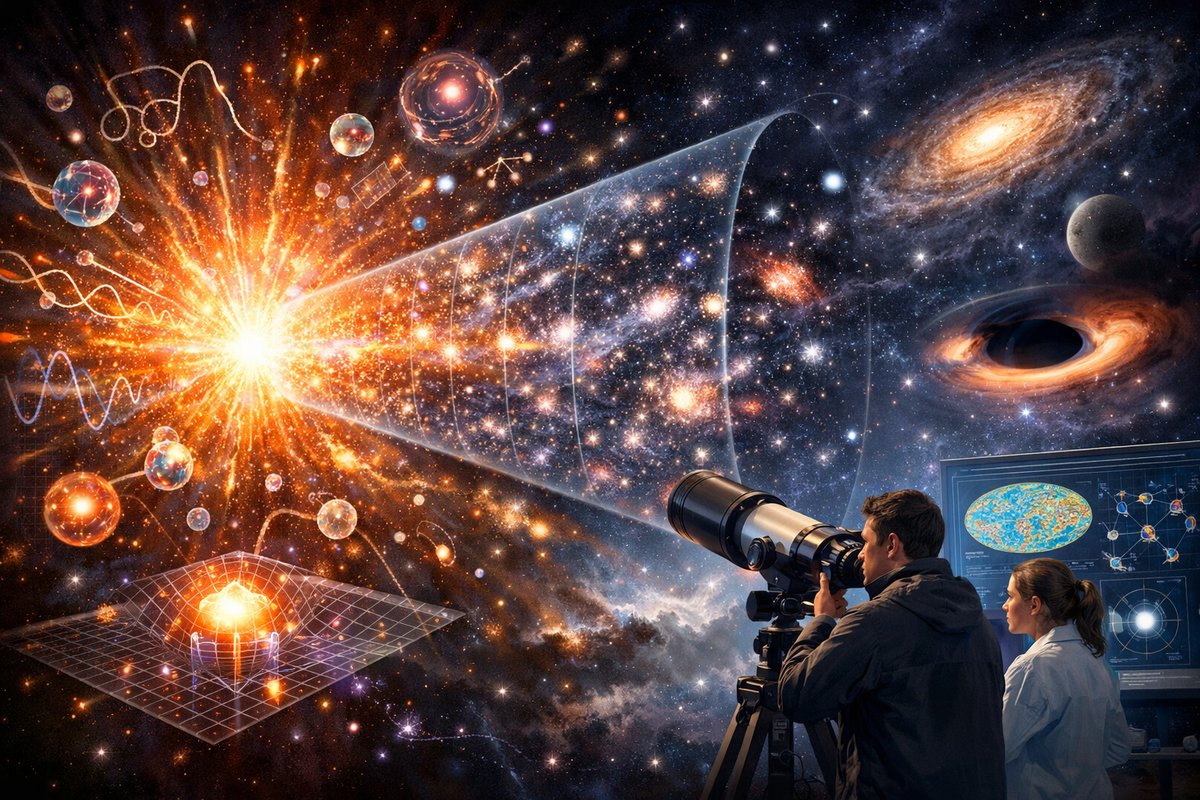
Scientists are piecing together the universe's earliest moments through a blend of cutting-edge observations and ground-breaking theory. From subatomic fluctuations to the vast tapestry of galaxies, new insights are revealing how the fundamental forces forged everything we know-and hinting at mysteries still to unravel.
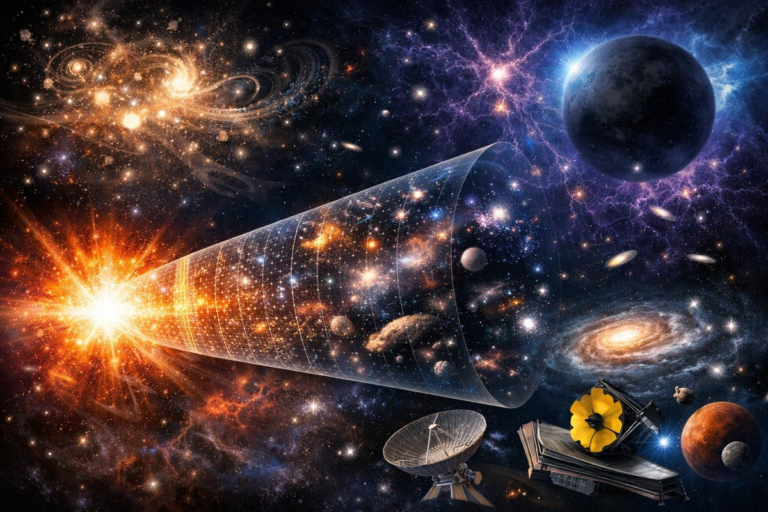
At the dawn of time, an unfathomably hot, dense nexus blossomed into everything we can perceive today. Modern telescopes, particle accelerators, and theoretical breakthroughs are illuminating that first fleeting heartbeat of the cosmos. Researchers are combining data from deep-space observatories with earthbound experiments to build a continuous narrative-from quantum fluctuations born in the Planck epoch, through inflation’s explosive growth, to the smooth glow of the cosmic microwave background radiation. Each revelation guides us closer to answering one of humanity’s oldest questions: where did it all begin?
In recent months, the latest data streamed from a premier space observatory has refined our portrait of the early universe. By probing infrared light emitted more than thirteen billion years ago, astronomers have detected subtle patterns of temperature variation in the primordial plasma. These ripples correspond to density differences that later seeded the formation of stars and galaxies. Meanwhile, terrestrial labs are smashing particles at energies previously reserved for nature’s most extreme environments. Teams at a major European collider have measured rare decay modes of fundamental bosons, refining the values of key interaction strengths that governed the young cosmos.
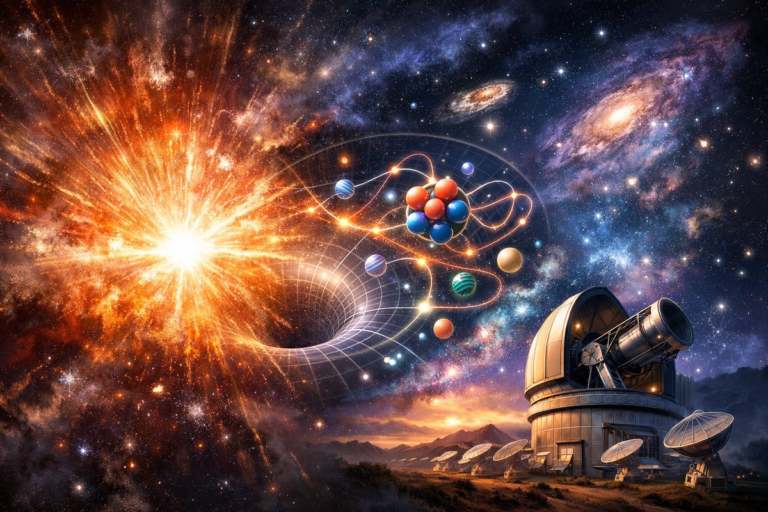
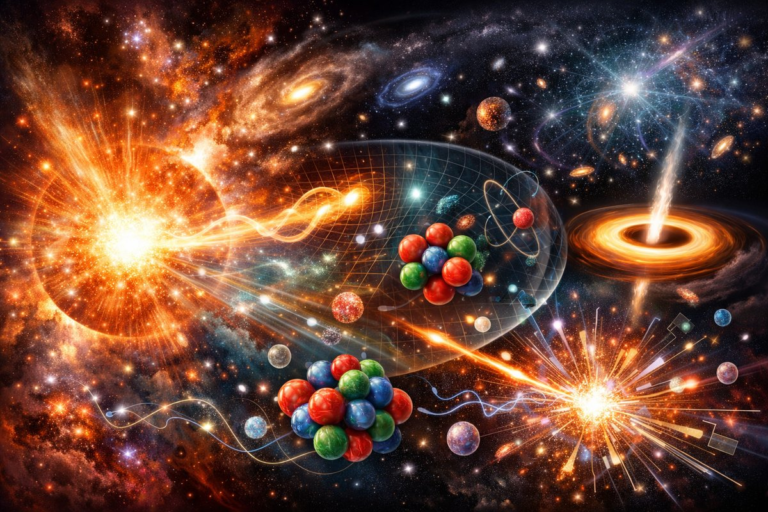
The interplay of the four known forces-gravity, electromagnetism, and the strong and weak nuclear forces-holds the secret to cosmic history. Gravity’s gradual pull sculpted large-scale structure but remained negligible during the universe’s first instants. Instead, the strong nuclear force bound quarks into protons and neutrons mere microseconds after the initial expansion. The weak nuclear force drove rapid transformations between particle species, while electromagnetism governed the coupling between charged particles and photons. Tracing how these forces unified, separated, and left their fingerprints in today’s particle masses and interaction rates is a frontier of research in high-energy physics.
One of the most enduring puzzles is why matter prevailed over antimatter. Theory predicts that the Big Bang should have created equal parts of both. Yet our universe is dominated by matter. Precision experiments are now probing charge-parity violations in subatomic decays, searching for the slightest asymmetries that could tip the balance. Early findings hint at effects beyond the current theoretical framework, suggesting new particles or interactions might have influenced the primordial imbalance. If confirmed, these studies could rewrite textbooks and illuminate the mechanism of baryogenesis-the process that left us with stars, planets, and life itself.
Parallel to experiments, theoretical physicists are grappling with the horizon and flatness problems. Cosmic inflation-a brief epoch of superluminal expansion-appears to solve both, stretching space so rapidly that different regions share common properties despite never having been in causal contact. However, the precise cause of inflation remains elusive. Hypotheses range from scalar fields with exotic energy potentials to quantum gravity corrections arising at the Planck scale. Upcoming observations of primordial gravitational waves could provide smoking-gun evidence, as these ripples in spacetime would have been generated during inflation’s most violent phases.
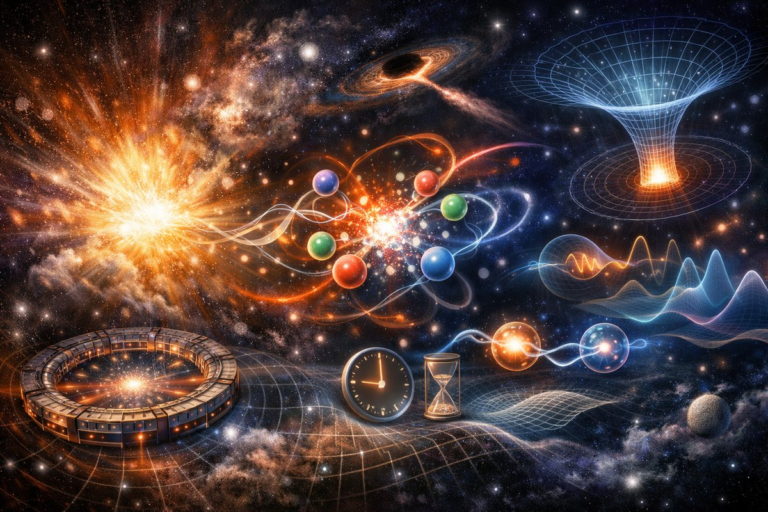
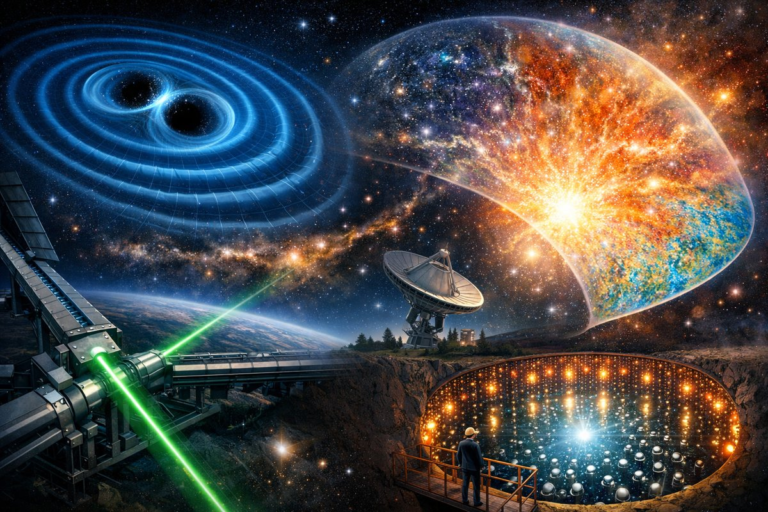
As we peer deeper into the cosmic past, we also confront conceptual paradoxes. Black hole information loss challenges the coherence of quantum mechanics and general relativity. The holographic principle proposes that the information content of a volume of space can be described by data on its boundary, hinting at a radically different underlayer of reality. If this principle holds for our entire universe, then the birth of space and time might be encoded in a more fundamental two-dimensional framework. Such ideas are no longer the sole domain of philosophers; emerging research programs are seeking observational signatures of holographic noise in gravitational wave detectors and interferometers.
Meanwhile, dark matter and dark energy continue to dominate cosmic evolution, comprising roughly 95 percent of the total energy budget. Efforts to directly detect dark matter particles in underground laboratories have set increasingly stringent limits on interaction cross-sections. Space-based surveys chart the large-scale distribution of galaxies, offering indirect constraints on dark matter clustering and behavior. On the dark energy front, astronomers measure the accelerating expansion rate via supernovae and baryon acoustic oscillations. The discovery that cosmic acceleration began relatively recently challenges our understanding of vacuum energy and quantum field theory. Could a dynamic, evolving field be driving this expansion, or does it point to a need for modified laws of gravity?
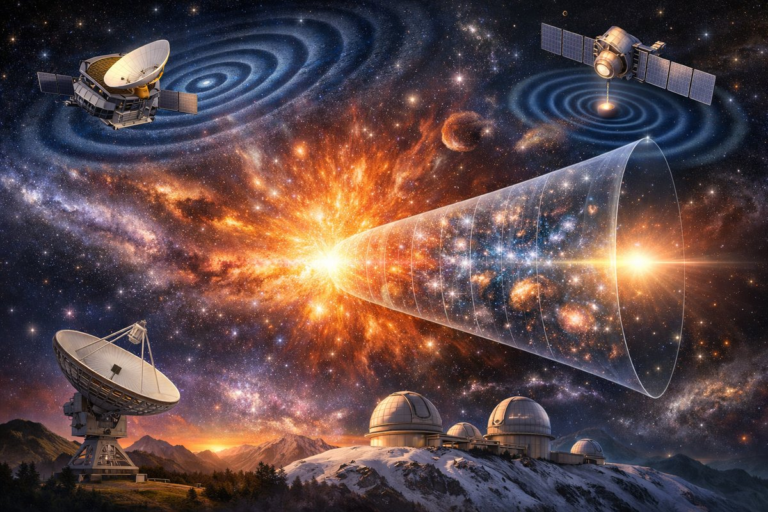
Recent technological advances are empowering multi-messenger astronomy, where light, gravitational waves, neutrinos, and cosmic rays combine to paint a richer cosmic picture. The observation of a high-energy neutrino coincident with a distant galaxy merger confirmed theories about particle-acceleration sites. Future detectors, leveraging new materials and quantum sensor technology, aim to record signals from the universe’s first seconds. By correlating information from different messengers, researchers hope to resolve ambiguities and tease out subtle fingerprints left by early-time physics.
Public engagement in these grand investigations has never been higher. Amateur astronomers capture transient events-like gravitational wave counterparts-providing crucial data points that complement professional facilities. Citizen-science platforms are enlisting thousands of volunteers to sift through terabytes of sky survey images, identifying potential high-redshift galaxies or gravitational lensing arcs. This distributed approach accelerates discovery and fosters a deeper connection between society and the cosmos.
Looking ahead, the next generation of experiments promises to push boundaries even further. Proposed colliders with record-breaking energies will recreate conditions close to those fractions of a second after the Big Bang. Space missions equipped with advanced spectrometers and wide-field telescopes will survey billions of galaxies across vast epochs. And projects exploring quantum gravity aim to bridge the conceptual gulf between the quantum realm and the curvature of spacetime.
Yet, for all the sophisticated machinery and abstract models, the essence of this quest remains profoundly human. Each theoretical conjecture, each faint signal detected from billions of light-years away, brings us closer to understanding our place in the tapestry of existence. The journey from Planck-scale fluctuations to the formation of consciousness on a pale blue dot is a story of emergence, resilience, and wonder.
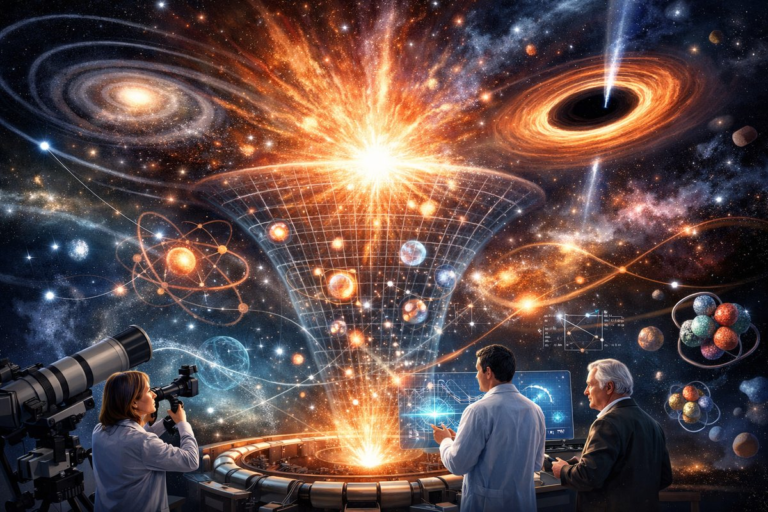
In our laboratories and observatories, in pencil-scrawled equations and glowing computer simulations, we trace the invisible threads of our cosmic origin. By illuminating how forces intertwined and particles danced, scientists are mapping a grand narrative that spans everything from the smallest quark to the largest cluster of galaxies. And as fresh data continues to pour in, we stand ready to rewrite our cosmic origin story once more, embracing every paradox, every hint of the unknown, and every revelation that deepens our sense of awe at the universe’s unfolding mysteries.