Location
Mount Vernon, WA 98274

Location
Mount Vernon, WA 98274
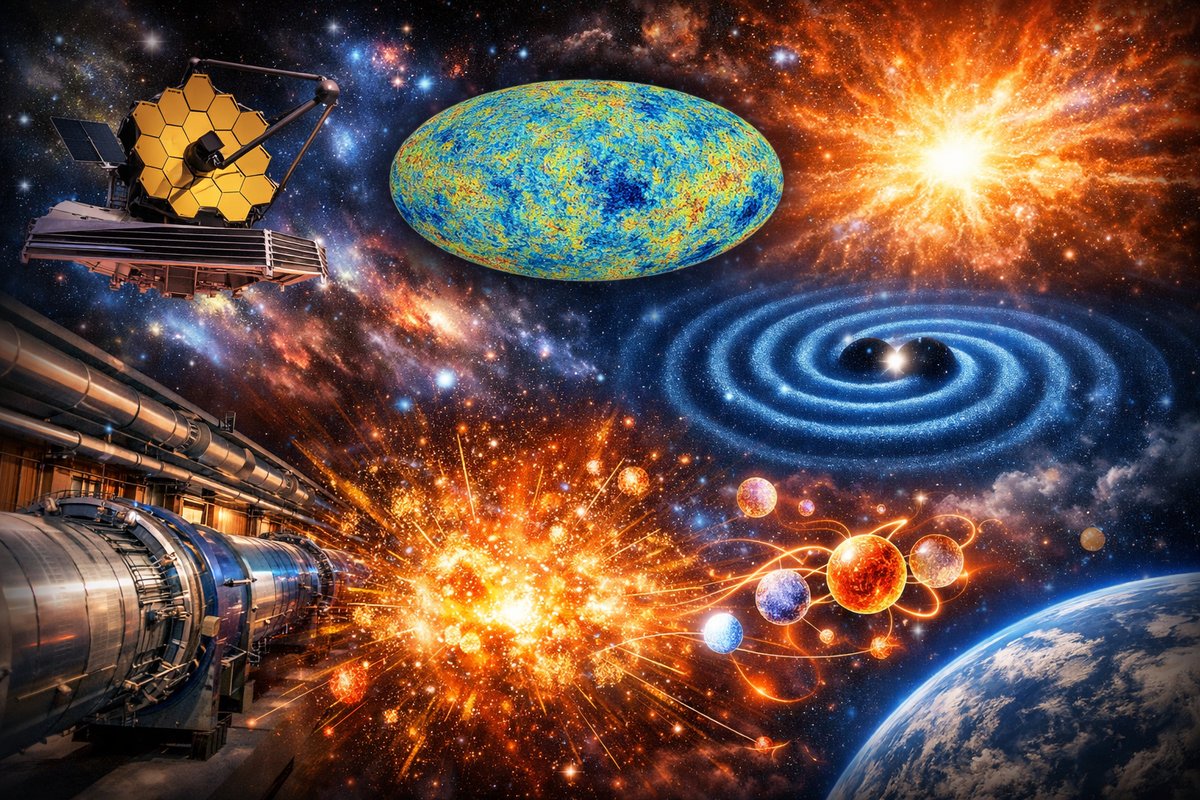
Scientists are combining data from space telescopes, particle colliders, and gravitational wave observatories to trace the forces and particles that emerged in the universe's infancy. New findings-from subtle ripples in the cosmic microwave background to microseconds of quark-gluon plasma-are sharpening our picture of how everything sprang into being.
Peering ever deeper into the cosmos and into the fabric of matter, researchers are assembling the most detailed portrait yet of the universe’s first instants. Across continents and instruments-from orbited infrared telescopes to subterranean particle accelerators-teams are chasing the faint signals and fiery echoes of processes that unfolded in the universe’s first trillionths of a second. Those fleeting moments set the stage for galaxies, stars, and planets, and ultimately for life itself.
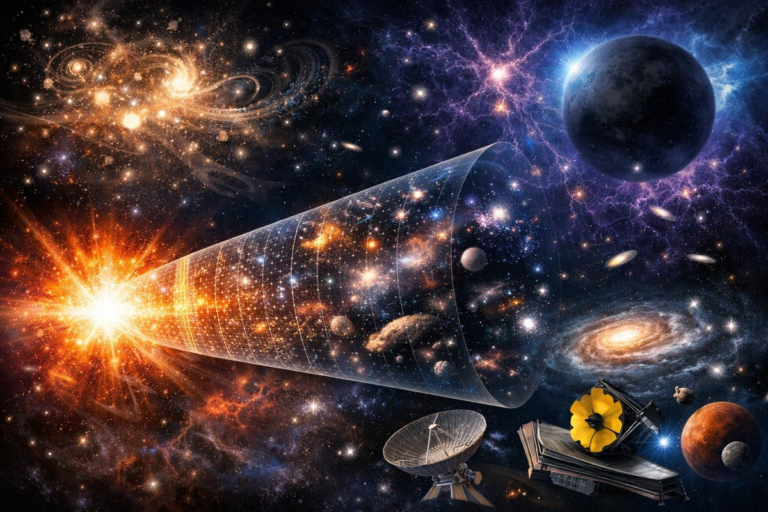
At the forefront of observational cosmology, an infrared space observatory has delivered stunning images of galaxies forming just a few hundred million years after the Big Bang. By studying the light from those primordial structures, astronomers measure how rapidly hydrogen and helium coalesced and how the first stars ignited. Their observations also constrain the rate of cosmic inflation-the blistering expansion that stretched quantum fluctuations into the seeds of galaxy clusters. Recent analyses reveal subtle anomalies in the distribution of early galaxies, hinting at patches of space where inflation may have momentarily faltered or accelerated.
Simultaneously, ground-based arrays are mapping the cosmic microwave background (CMB) with unprecedented precision. This faint afterglow of the Big Bang carries temperature variations at the microkelvin level, encoding information about the density and pressure of the primordial plasma. Researchers working on dedicated telescopes in high-altitude deserts have refined measurements of tiny polarizations in the CMB pattern. Early reports suggest a barely perceptible swirl consistent with primordial gravitational waves, though confirmation will require cross-checks with complementary projects across polar observatories.
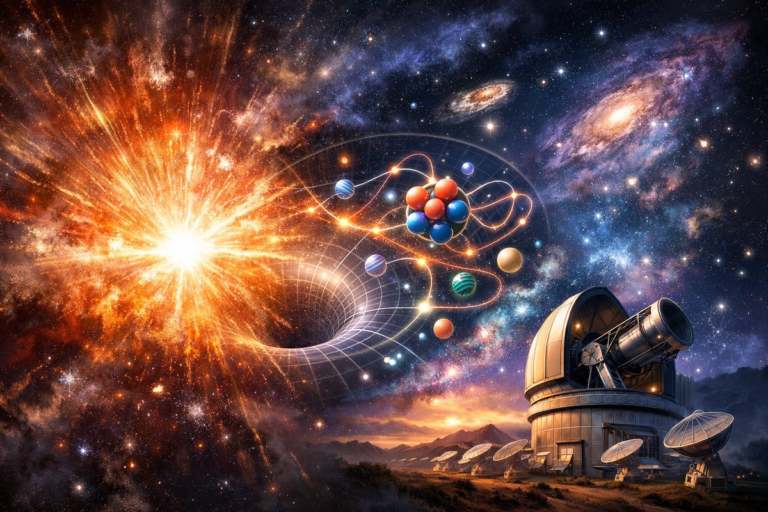
In a parallel quest, physicists at a massive underground accelerator facility recreate the universe’s first moments in miniature. By colliding heavy ions at near-light speed, they generate a quark-gluon plasma-an ultra-hot soup of fundamental particles thought to exist only microseconds after the Big Bang. Detectors record the plasma’s expansion and cooling, revealing how quarks coalesced into protons and neutrons. These experiments also test the limits of the strong nuclear force, illuminating the transition from particle soup to stable matter. Recent upgrades to accelerator magnets and beam injectors have boosted collision energies, allowing teams to observe subtle phase transitions in the plasma that may mirror early-universe dynamics.
Yet the narrative of origins is also spiced with paradoxes. Black holes, for instance, challenge traditional notions of information conservation. When matter plunges past an event horizon, what becomes of its quantum information? Physicists are probing this puzzle through tabletop experiments that simulate Hawking radiation using ultra-cold atoms and optical analogues. Although these analogues are far removed in scale from astrophysical black holes, they provide a testbed for theories that aim to preserve quantum coherence even as particles evaporate from a horizon.
Meanwhile, a network of radio telescopes monitoring the timing of distant pulsars has reported correlated variations consistent with a stochastic background of gravitational waves. Some theorists propose that these ripples hark back to cosmic strings-hypothetical cracks in spacetime produced during symmetry-breaking phase transitions in the universe’s youth. If confirmed, such a background would offer a direct window onto energy scales trillions of times higher than those probed in particle colliders today.
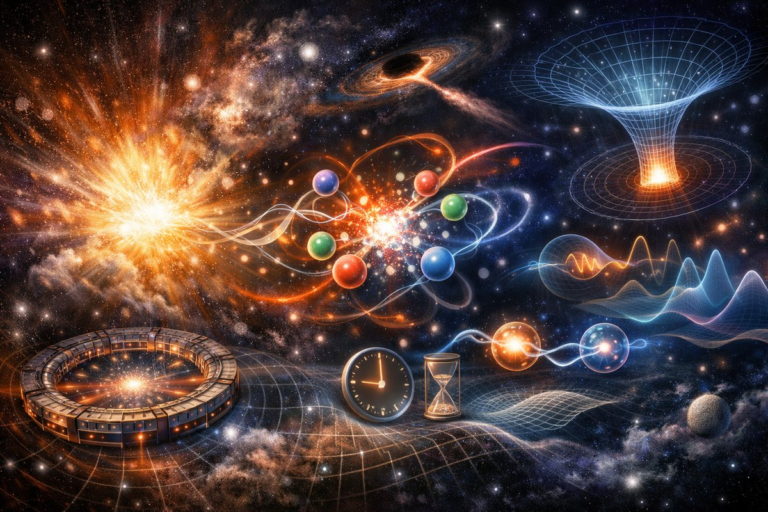
The pattern emerging from these diverse experiments is one of extraordinary complexity and coherence. Forces that appear distinct at low energies-the electromagnetic, weak, and strong interactions-may have once been unified under a single, more symmetrical framework. Supersymmetry and other grand unified theories remain unconfirmed, but upcoming runs at even higher collision energies could reveal fleeting particles that bridge the known forces. Should such particles be found, they would reshape our understanding of how the early universe cooled and crystallized into the forms we observe now.
Amid this scientific drama, new data from neutrino observatories deep beneath polar ice and mountain peaks are providing complementary clues. Neutrinos barely interact with matter, so they can escape dense environments-like the core of a collapsing star or the universe’s infant plasma-and carry pristine information across cosmic time. By measuring the energy and arrival direction of high-energy neutrinos, researchers hope to distinguish those born in cosmic accelerators from a diffuse relic component potentially generated in the early universe. Future upgrades to optical sensors and data acquisition systems promise to increase detection rates by an order of magnitude.
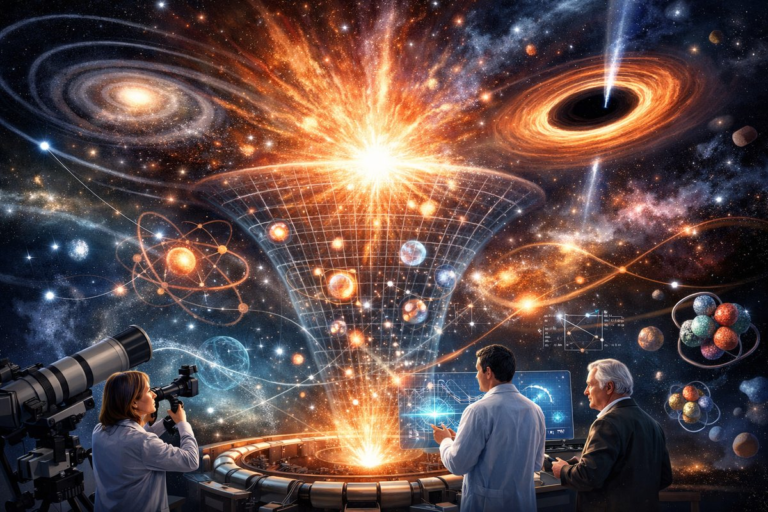
All of these efforts converge on a profound question: how did a universe initially dominated by ultra-hot, ultra-dense fields give rise to the cold, structured cosmos we inhabit? To answer it, cosmologists marry observations with advanced numerical simulations. Supercomputers churn through millions of equations, evolving quantum fields alongside expanding spacetime. New machine-learning frameworks accelerate these calculations, identifying patterns and anomalies that human intuition might miss. In some simulated scenarios, tiny quantum fluctuations grow, collapse, and rebirth in cyclical phases, offering speculative alternatives to a singular birth event.
While the standard picture of a single Big Bang remains the paradigm, these simulations remind us that other mathematically consistent scenarios exist. Some early-universe models predict a “bounce” prior to expansion; others posit a multiverse, where countless pocket universes bubble off from a primordial foam. Though such ideas border on the philosophical, they inspire fresh experimental proposals: searches for bubble-collision signatures in the CMB, or novel gravitational wave detectors sensitive to ultra-low frequencies.
The current decade promises a flood of new data. Next-generation space observatories will survey the infrared sky to unprecedented depth. An array of terrestrial telescopes will sharpen the CMB’s polarization map. Advanced neutrino detectors and underground accelerators will push energy scales higher than ever before. Each of these instruments is a time machine, reaching back across eons to chart the universe’s evolution from an opaque fireball to a transparent tapestry of stars and galaxies.
For the public, these breakthroughs ignite wonder and spark philosophical reflection. What does it mean to witness processes that occurred before any observer existed? How do fundamental symmetries shape the emergence of complexity, from atoms to aware life forms? Educators and science communicators are working to translate the technical jargon into stories that resonate-stories of cosmic tides, particle dances, and the universality of physical laws.
Investments in science infrastructure and international collaboration underpin these advances. From remote mountaintops to equatorial deserts, researchers endure bitter cold and thin air to install cutting-edge instruments. Deep beneath the Earth’s surface, engineers carve out caverns to house particle detectors safe from cosmic ray interference. Such efforts illustrate a collective drive to peel back layers of cosmic history.
As we refine our portrait of the universe’s origin, new mysteries inevitably emerge. Why is dark matter five times more abundant than ordinary matter? What mechanism drives the current accelerated expansion? Could undiscovered forces lurk beyond our experimental reach? The journey to the beginning, it seems, is also a journey outward-to realms both infinitely large and inconceivably small.
In the coming years, the synergy between observational campaigns and laboratory experiments will only deepen. When a subtle imprint in the microwave sky lines up with a rare decay event in a particle detector, or when a neutrino arriving from a distant galaxy cluster carries signs of early interactions, the disparate threads of cosmology and quantum physics will weave into a more unified narrative. Each new data point is a word in a cosmic memoir-one scientists and curious readers alike can help author.
Ultimately, the quest to understand the forces, particles, and paradoxes of the universe’s birth is more than an academic pursuit. It is an exploration of origins-of matter, energy, space, and time themselves. And it reminds us that our place in the cosmos, though tiny in scale, is suffused with the same elements forged in that first furnace. Every atom in our bodies has traversed that ancient fireball. In decoding those early moments, we come to know not only the universe’s past, but our own.