Location
Mount Vernon, WA 98274

Location
Mount Vernon, WA 98274
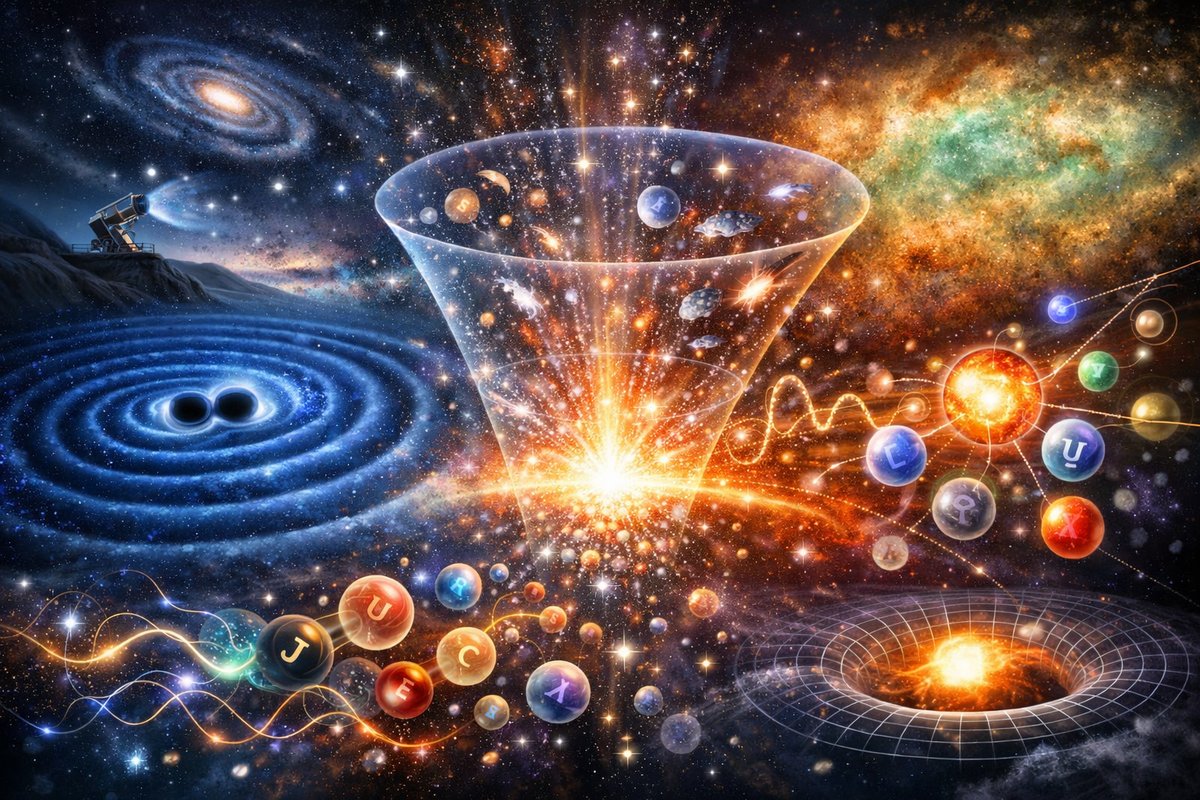
An influx of recent observations-from gravitational wave ripples to faint whispers of primordial light-has reignited the quest to understand how our universe sprang into being. Scientists are piecing together the forces, particles, and paradoxes that shaped everything we know and everything we've yet to imagine.
Since the first light pierced the darkness nearly 14 billion years ago, humankind has sought to unravel the story of our cosmic origins. In the past year alone, a cascade of discoveries has pushed the boundary of what we can observe, simulate, and theorize about those earliest instants. From hints of primordial gravitational waves to new limits on elusive dark matter particles, researchers are assembling a mosaic of phenomena that may reveal how space, time, and matter emerged from an almost unfathomably hot and dense state.
In March, an international collaboration operating one of the world’s most sensitive dark matter detectors announced its latest results. Deep beneath the Alps, a tank filled with ultra-pure xenon registered no signals above background. While null results may sound disappointing, the experiment has in fact halved the permissible range for one leading dark matter candidate-weakly interacting massive particles (WIMPs). That narrowing has theorists retooling models of particle physics beyond the Standard Model, exploring alternatives such as axionlike fields and dark photons.
Meanwhile, high above Earth’s atmosphere, infrared images from the space observatories have revealed galaxies forming just a few hundred million years after the Big Bang. These fledgling star cities display surprisingly mature structures-massive central cores and swirling disks-forcing a reexamination of how quickly matter cooled and collapsed under gravity. Simulations of cosmic evolution are being updated to account for more efficient gas cooling, perhaps aided by unknown processes in the primordial plasma.
Yet perhaps the most tantalizing breakthrough comes from the realm of gravitational waves. In late winter, the network of ground-based interferometers recorded a faint, broadband signal consistent with a background hum of spacetime ripples. If confirmed as primordial, this would amount to direct evidence of quantum fluctuations stretched to cosmic scales during inflation, the proposed exponential expansion that smoothed and flattened the newborn universe. Although still at low significance, the finding has prompted interior discussions at observatories around the globe, setting the stage for next-generation detectors designed specifically to search the stochastic background.
Adding another piece to the puzzle, neutrino telescopes have tracked ghostlike particles from distant supernovae and active galactic nuclei, offering a glimpse into the processes that forged heavy elements and energized cosmic jets. Since neutrinos interact so weakly with matter, they carry unadulterated information from sources that would otherwise be obscured. Combined with electromagnetic telescopes and gravitational wave observatories, they form a multi-messenger network that brings astrophysical events into sharper focus-and also hints at conditions thousands of times hotter than the cores of ordinary stars.
Still, key paradoxes remain. Matter and antimatter should have emerged in equal abundance, canceling each other out in a flash of pure energy. Yet our universe appears dominated by matter, with virtually no primordial antimatter to be found. Experiments recreating the earliest microseconds in particle colliders have yet to pinpoint the mechanism that introduced this asymmetry. Researchers are planning new runs at higher energies and luminosities to test whether subtle violations of fundamental symmetries gave matter the upper hand.
Then there’s dark energy-the mysterious force driving cosmic expansion to accelerate rather than slow down under gravity. Is it a property of space itself, as Einstein’s cosmological constant suggests, or does it evolve over time through a dynamic field? Surveys mapping the large-scale distribution of galaxies are refining measurements of how expansion has changed over billions of years. Instruments due to come online in the next few seasons will extend these surveys and may finally distinguish between rival theories.
At the same time, precision measurements of the cosmic microwave background (CMB)-the faint afterglow of the Big Bang-continue to surprise. Small temperature fluctuations and polarization patterns carry imprints of acoustic waves and magnetic fields in the early plasma. Last winter’s data release highlighted a puzzling hemispheric asymmetry in CMB temperature variations. Could this be a statistical fluke, or does it point to physics beyond the simplest inflation models? The debate is intensifying, driving teams to propose novel observational strategies for upcoming CMB telescopes.
Amid these empirical advances, theorists are exploring more radical ideas. Some suggest that our universe is just one bubble in a vast multiverse, each with its own laws of physics. Others posit that space and time themselves emerge from entangled quantum bits, a concept at the heart of quantum gravity research. While these proposals remain speculative, they offer pathways to reconcile general relativity and quantum mechanics-the twin pillars of modern physics that break down when pushed to the extremes of the Big Bang.
Despite the technical challenges, the quest for cosmic origins has never been more vibrant. Large particle accelerators are gearing up for new collision campaigns. Gravitational wave observatories are iterating on mirror coatings and suspension systems to reach unprecedented sensitivity. Space missions are being designed to probe polarization in the CMB with exquisite accuracy, and large sky surveys will chart billions of galaxies across cosmic time.
For amateur stargazers and science enthusiasts, this revolution in our understanding of the universe’s infancy invites a more personal connection to the cosmos. Backyard telescopes are capturing images of ancient galaxies; citizen-science platforms are enlisting volunteers to classify astronomical objects; and public data archives allow anyone with an internet connection to explore raw recordings from cutting-edge detectors.
In the end, the quest to understand the universe’s first moments is about more than particles and forces-it’s a journey to the frontier of human knowledge. Each experiment, each observation, peels back a layer of mystery, revealing deeper questions about existence itself. The forces that sculpted our universe, the particles that formed its building blocks, and the paradoxes that defy our intuition are all chapters in a grand narrative that continues to unfold. As new instruments come online and theories sharpen, the next decade promises to bring us ever closer to answering the age-old question: Where did it all begin?
The cosmic dawn remains shrouded in secrets, but with every detector tuned, every telescope pointed skyward, and every equation refined, we step further into the unknown. The story of origins is far from complete-and perhaps that is its most thrilling chapter yet.