Location
Mount Vernon, WA 98274
Location
Mount Vernon, WA 98274

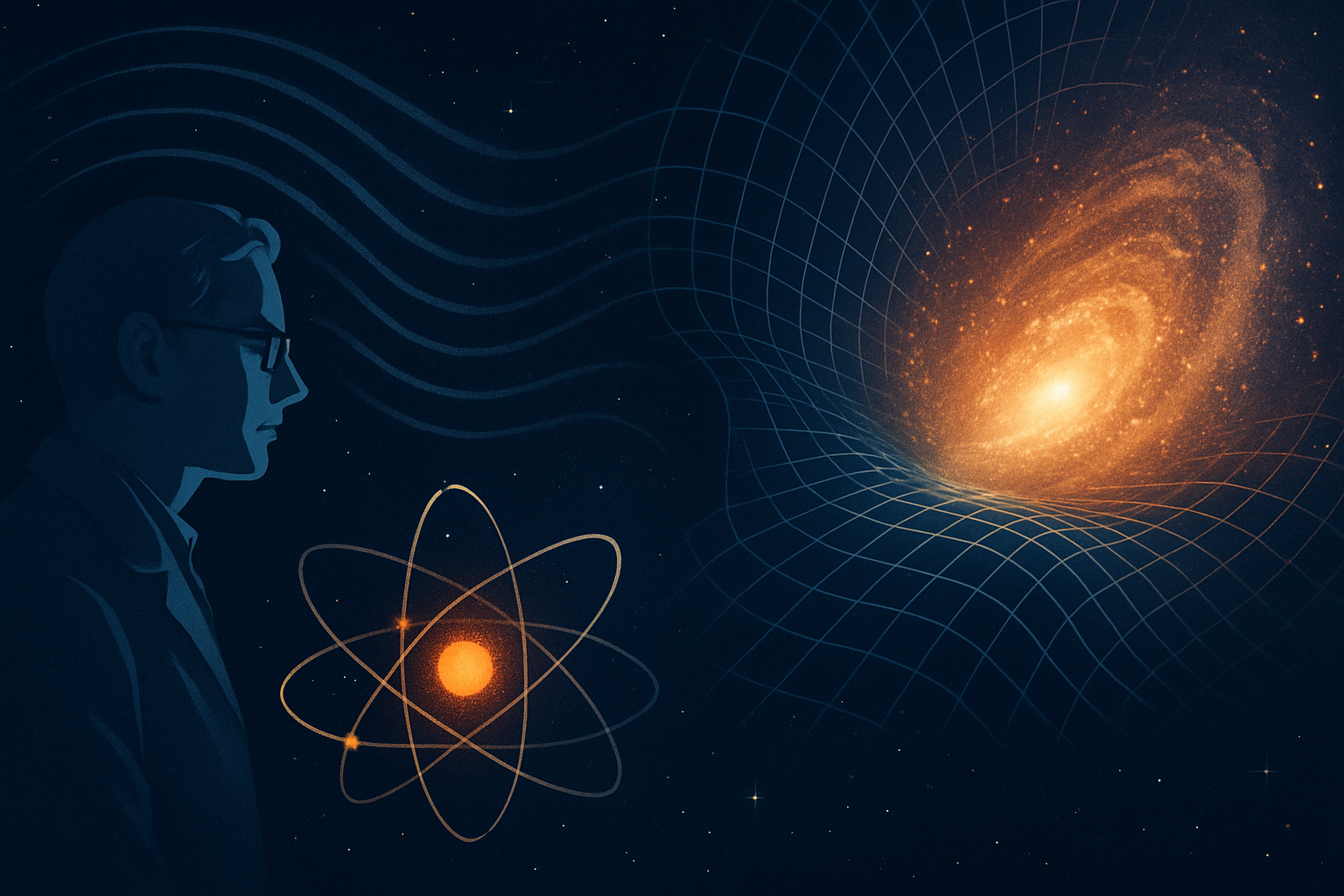
Scientists are weaving quantum mechanics, gravitational waves, and advanced simulations into a richer narrative of how our cosmos emerged from an infinitesimal point. By listening to the faintest echoes and modeling the earliest instants, researchers are revealing unexpected connections between the subatomic realm and the grand cosmic tapestry.
Our understanding of the universe’s birth continues to evolve as telescopes, detectors, and supercomputers deliver ever more detailed views of space and time. Far from a static framework, the cosmos reveals itself as a dynamic interplay of energy, matter, and the unseen laws that govern both. Modern observatories capture relic radiation, map out faint ripples in spacetime, and chart the distribution of galaxies billions of light-years away. Each dataset offers a new piece of the puzzle, inviting us to reimagine how everything-from clusters of galaxies to subatomic particles-traces back to the earliest instants of existence.
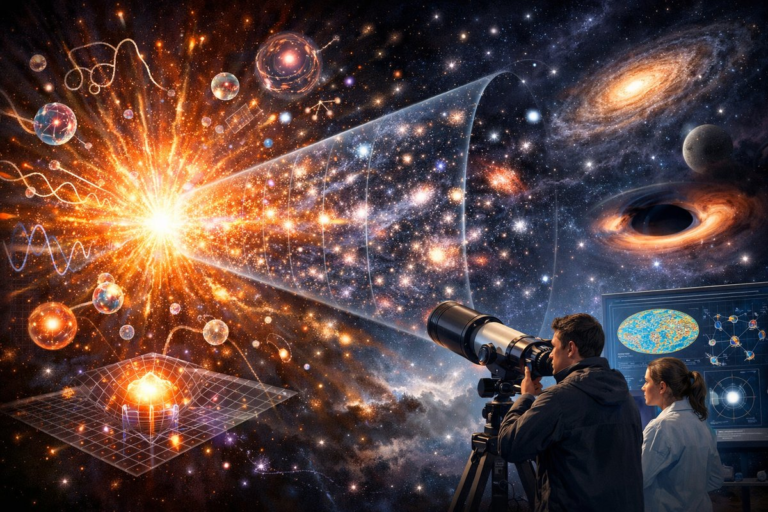
At the heart of origin theories lies the concept of quantum fluctuations. In the vacuum of spacetime, particle-antiparticle pairs briefly flicker into existence and vanish again. During an exponential expansion phase called inflation, theorists propose that tiny variations in these fluctuations were stretched to cosmic scales, sowing the seeds of all structure. Regions that were ever so slightly denser than average attracted more matter under gravity, eventually collapsing into stars, galaxies, and clusters.
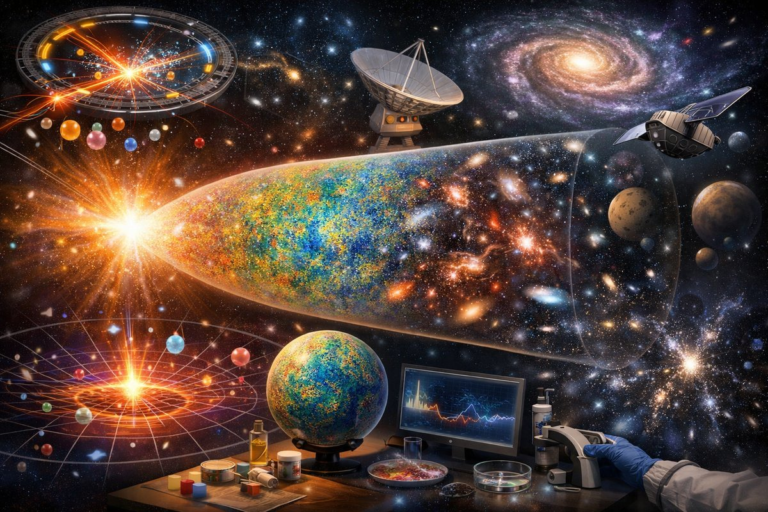
Recent progress in tabletop quantum experiments has begun to probe analogues of this inflationary mechanism. By cooling atoms to near absolute zero and using laser fields to simulate expanding spacetime, laboratory teams can observe how quantum jitters evolve into wave patterns that mirror those predicted in cosmology. Although scaled down billions of times, these analogues allow researchers to test subtle predictions about the spectrum of primordial fluctuations, a critical factor in validating inflationary models.
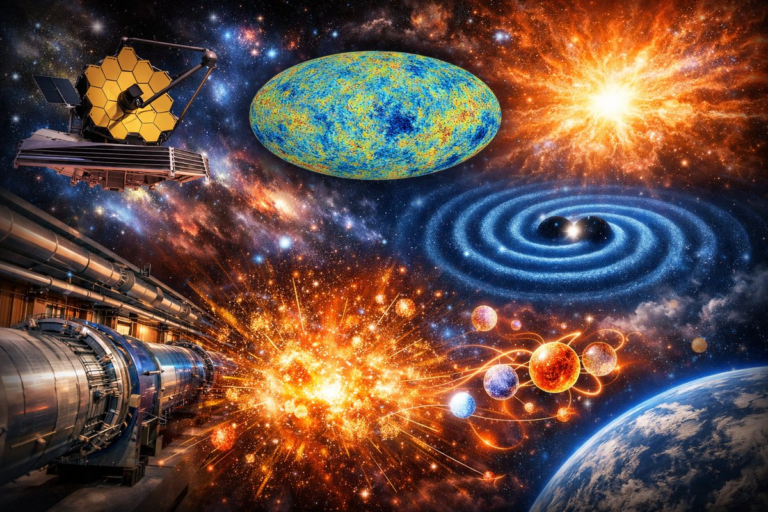
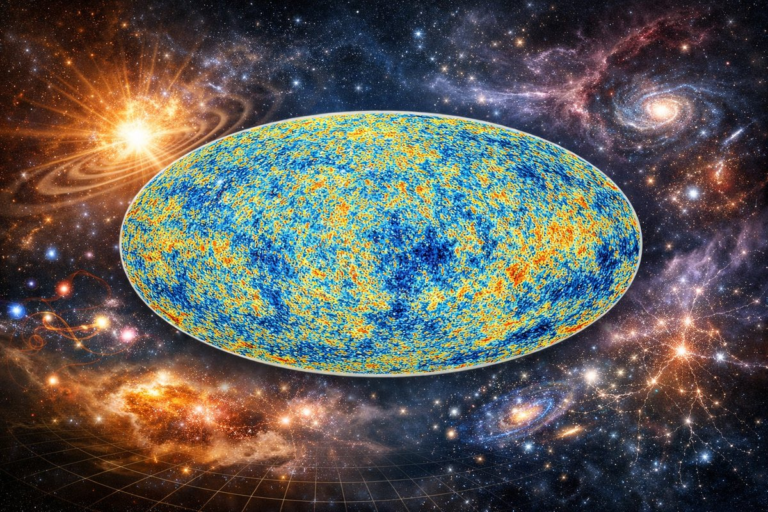
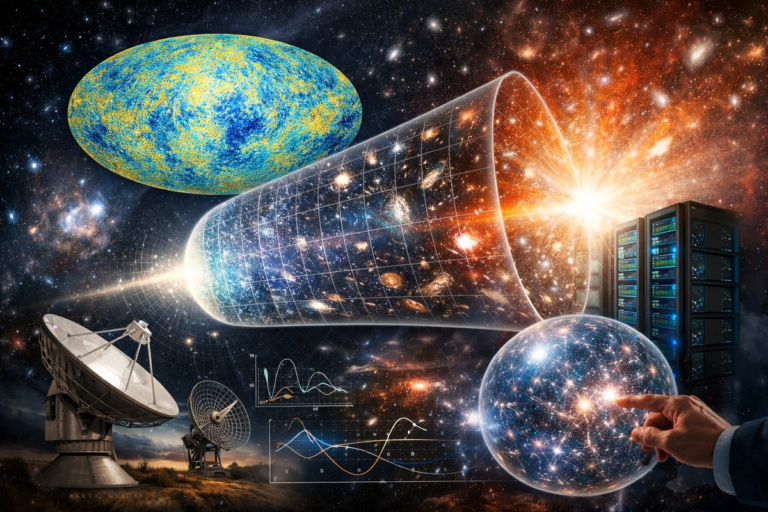
Beyond optical telescopes and infrared surveys, scientists employ an array of detectors attuned to the faintest murmurs of cosmic history. The cosmic microwave background (CMB) is a nearly uniform glow left over from when the universe cooled enough for protons and electrons to combine, about 380,000 years after the putative birth event. Tiny temperature variations across the CMB map encode information about the density fluctuations that later grew into galaxies.
More recently, collaborations focusing on gravitational waves have added a new sense. Pulsar timing arrays-networks of rapidly spinning neutron stars-measure minuscule changes in arrival times of their radio pulses, as ripples in spacetime pass by. While the first direct detection of high-frequency gravitational waves came from colliding black holes, the hunt now extends toward a persistent background signal. Such a background, formed by countless early-universe processes or by merging supermassive black holes in merging galaxies, could carry imprints of physics at energies far exceeding any particle accelerator.
Computational cosmology has surged forward in recent years, propelled by both hardware advances and algorithmic breakthroughs. Simulations now integrate dark matter, normal matter, radiation, and feedback effects from the first generations of stars. These virtual universes evolve from initial conditions derived from CMB measurements, allowing researchers to test how different physical assumptions-like the nature of dark energy or subtle non-Gaussian features in the primordial fluctuations-affect the large-scale distribution of cosmic structures.
One notable effort uses machine learning to accelerate and refine these simulations. By training neural networks on existing high-resolution runs, scientists can predict the outcome of parameter sweeps more efficiently, guiding observational campaigns toward the most discriminating tests. This synergy between AI and physics not only speeds up discovery but also opens the door to uncovering hidden patterns in complex datasets that might otherwise go unnoticed.
While inflation and relic radiation remain cornerstones of modern cosmology, alternative or complementary ideas continue to attract attention. Concepts such as bouncing or cyclic universes, emergent spacetime from quantum entanglement, and multiverse scenarios push the boundaries of testable science. Each framework suggests distinctive observational signatures-subtle anomalies in the CMB, unexpected gravitational wave backgrounds, or rare events in deep-space surveys.
Future facilities promise to sharpen our vision. Next-generation radio arrays will map neutral hydrogen across the epochs when the first galaxies ignited. Space-based interferometers will hunt for low-frequency gravitational waves. Ultra-sensitive sensors may one day reveal the direct imprint of quantum gravity effects. Together, these tools will help us peel back successive layers of cosmic history, approaching the moment when space, time, and the known laws of physics emerged in unison.
The quest to understand our origins combines cutting-edge observations, innovative experiments, and bold theoretical leaps. As quantum analogues in laboratories, gravitational-wave observatories, and AI-driven simulations converge, a more intricate picture of the universe’s birth is coming into focus. Each advance deepens our sense of wonder and challenges us to refine our models. In the tapestry of spacetime, the threads of quantum mechanics and cosmology weave together to tell a story that extends from the smallest fluctuations to the grandest cosmic structures.