Location
Mount Vernon, WA 98274
Location
Mount Vernon, WA 98274


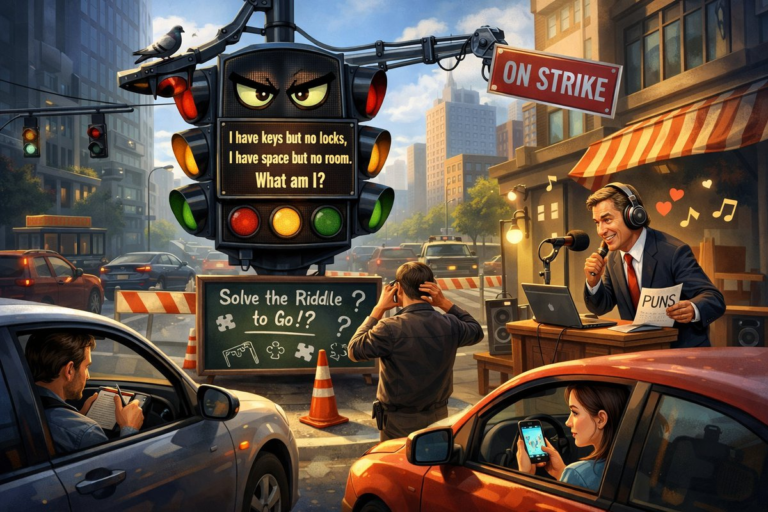
A suburban resident stunned city hall by proposing that traditional red, yellow and green signals be replaced with live dance performances. What started as a tongue-in-cheek pitch has escalated into a full-blown pilot program complete with auditions, rehearsals, and a surprisingly enthusiastic city council.
It began as a tweet that landed in the inbox of every municipal staffer: Why not ditch those boring traffic lights and let performers signal road safety with carefully choreographed moves? What sounded like a late-night social media prank quickly transformed into a high-profile proposal reviewed by the city council this week. The mastermind behind the idea, a self-described traffic enthusiast and part-time improv comedian, outlined a plan to replace inanimate color-coded lights with dynamic, five-minute flash mob routines at major intersections.
During Monday’s council meeting, the proposer-who insisted on being referred to only as “The Signalator”-delivered a presentation brimming with energy. Armed with a wireless microphone and slides of dancers in neon spandex, he argued that performance-based signals would not only entertain commuters but also foster community involvement. “Red means stop with arms extended like a statue, yellow becomes a tango teaser, and green is a full-on celebratory shimmy,” he proclaimed. Council members leaned forward, some struggling to suppress smiles, as the Signalator played videos of neighborhood volunteers rehearsing impromptu salsa and jazz routines in a parking lot.
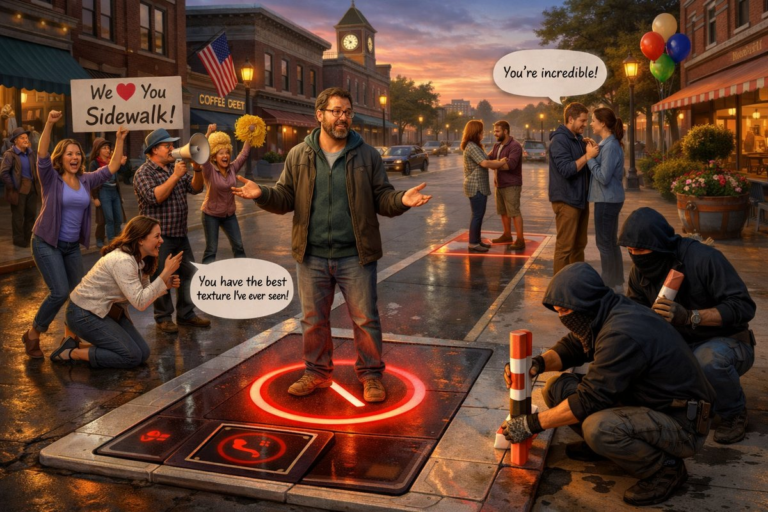
Skeptical at first, the council asked for a demonstration. By Thursday, a pop-up audition took place at the busiest four-way intersection downtown. Countless curious onlookers snapped photos while auditionees shuffled awkwardly, attempted pirouettes and flailed like startled seagulls before finally landing on a routine that combined mild hip-hop with the grace of someone who once attended Zumba class in 2011. Traffic inched forward as drivers tried to interpret the difference between “stop and wave” versus “slow down and moonwalk.” A handful of motorists applauded, while others leaned on their horns in bewilderment.
City traffic engineers, initially mortified by the concept, grudgingly admitted that the live performances attracted more attention than traditional lights. According to a tally provided by the transportation department, the audition event saw a 42 percent increase in pedestrian engagement, and local cafés reported a 17 percent spike in foot traffic as people lingered longer at corners waiting for the next dance cue. “We never imagined a utility could become such a spectacle,” said one engineer, who asked not to be named. “Maybe we’re onto something-though we’re also rewriting every safety manual in the book.”
The public response has been both absurdly enthusiastic and hysterically critical. A petition in favor of the project amassed over 3,000 signatures overnight, while a rival petition arguing that clumsy moves might trigger more collisions garnered 2,847 names within 24 hours. Opponents warned that elderly drivers or those prone to motion sickness could struggle to keep pace with boogie signals, turning rush hour into a flashback to college dorm dance-offs gone awry.
Amid the chaos, city staffers have had to rethink schedules, budgets and even the legal definition of a “traffic control device.” The finance director sheepishly confessed that the pilot program’s $15,000 budget would cover dancer stipends, portable sound equipment and emergency backup generators-just in case the sun goes down and the routine has to shift from daylight jazz hands to moonlight interpretive street theater.
Meanwhile, local dance studios see an unexpected boon. One owner of a contemporary dance school reported that her beginner workshop filled up in under an hour once word got out about the auditions. She describes teaching a “Signalator Standard,” a mashup of Broadway-inspired steps and slick safety hand signals. “It’s exhilarating,” she enthused. “Suddenly everyone wants to learn how to pivot a traffic stop into a pas de deux.” Quarterly enrollment figures are up by nearly 30 percent, and some students even travel from neighboring towns for specialized crosswalk choreography classes.
As the pilot week kicks off next Monday, a team of six local performers will take turns activating the corner at Elm and Main Streets. Each day focuses on one traffic directive: “Red Hand Sculptures” on Monday, “Cautionary Chair Swing” on Tuesday, “Green Grand Finale” on Wednesday, and so on. The Signalator insists that the routines adhere to strict timing, with a tolerance of plus or minus two seconds per cycle, to avoid pandemonium. To keep spectators informed, volunteers wearing reflective vests will hand out color-coded flyers explaining the day’s moves.
But not everyone is convinced this is a stroke of genius. The chief of police raised concerns about possible distractions and liability. “If someone trips during a pirouette or crashes while trying to record the routine, who’s at fault?” he asked. Organizers have responded by beefing up medical first-aid stations at each corner and arranging for quick-response teams of paramedics armed with ice packs and anti-inflammatory gel.
On social media, the phenomenon has taken on a life of its own. The hashtag #DanceYourWayHome trended regional‐wide after an amateur video of a delivery driver struggling to park between performances went viral. Memes depict confused pedestrians breaking into spontaneous freestyle sessions during red-light stops, while stop-motion enthusiasts have reinterpreted every step of the Signalator’s choreography in less than fifteen seconds of animated loop.
Despite the skepticism, local businesses along the pilot route are gearing up for a tourism bump. One diner has already announced a “Flash Mob Breakfast Special,” complete with cinnamon buns shaped like tiny jazz hands. A nearby bookstore plans to host a weekend event called “Crosswalk Ballet and Book Sales,” combining literary readings with dance recitals on the sidewalk. The chatter has even caught the attention of a regional news station, which plans an on-site broadcast next week to capture live reactions.
Away from the spectacle, some traffic safety experts view the experiment as a valuable case study in behavioral compliance. A transportation psychologist at a nearby university admitted that traditional static signals suffer from “inattentional blindness” during peak hours, when drivers become so familiar with light patterns that they tune them out. “A dynamic, human element might reset the brain’s perceptual filters,” she explained. “It’s unorthodox, but the data could reshape our approach to urban mobility.” Her team plans to measure variables including compliance rate, pedestrian wait times and overall accident risk during the flash mob intervals.
Over in city hall, the debate has shifted from “Is this legal?” to “Should we expand beyond one intersection?” Enthusiasts propose rolling out themed routines-Latin nights featuring salsa spins for evening traffic, retro disco mornings complete with mirror-ball pom-poms, and silent yoga signals for late-night deliverers who sock away too much caffeine. Critics warn that themed days risk confusing habitual commuters who develop muscle memory for specific steps.
As the countdown to kickoff begins, the Signalator remains calm and oddly optimistic. He envisions a world where downtown crosswalks double as pop-up stages and where drivers learn to groove between pedal and brake. “In the end, traffic safety is about anticipation and cooperation,” he says with a flourish. “Why not make it memorable?”
Whether this patchwork of applause, footwork and occasional near-misses will emerge as the future of urban planning remains to be seen. For now, residents are simply invited to stand on the corner, watch the show and maybe lend a hand with the formations. One thing is certain: traffic control has never looked quite this entertaining-and probably never will again.
Next Thursday’s rehearsal will take place at 5:30 p.m. at Elm and Main. Spectators are encouraged to bring folding chairs, water bottles and an open mind. Strobe lights are strictly discouraged.
As city staffers prepare to hit play on the world’s quirkiest version of “go, slow, stop,” one can’t help but wonder: will this be a fleeting dance craze or the dawn of a graceful new era in traffic management? Stay tuned for our next installment when we chronicle the first full day of coordinated choreography at rush hour.