Location
Mount Vernon, WA 98274
Location
Mount Vernon, WA 98274

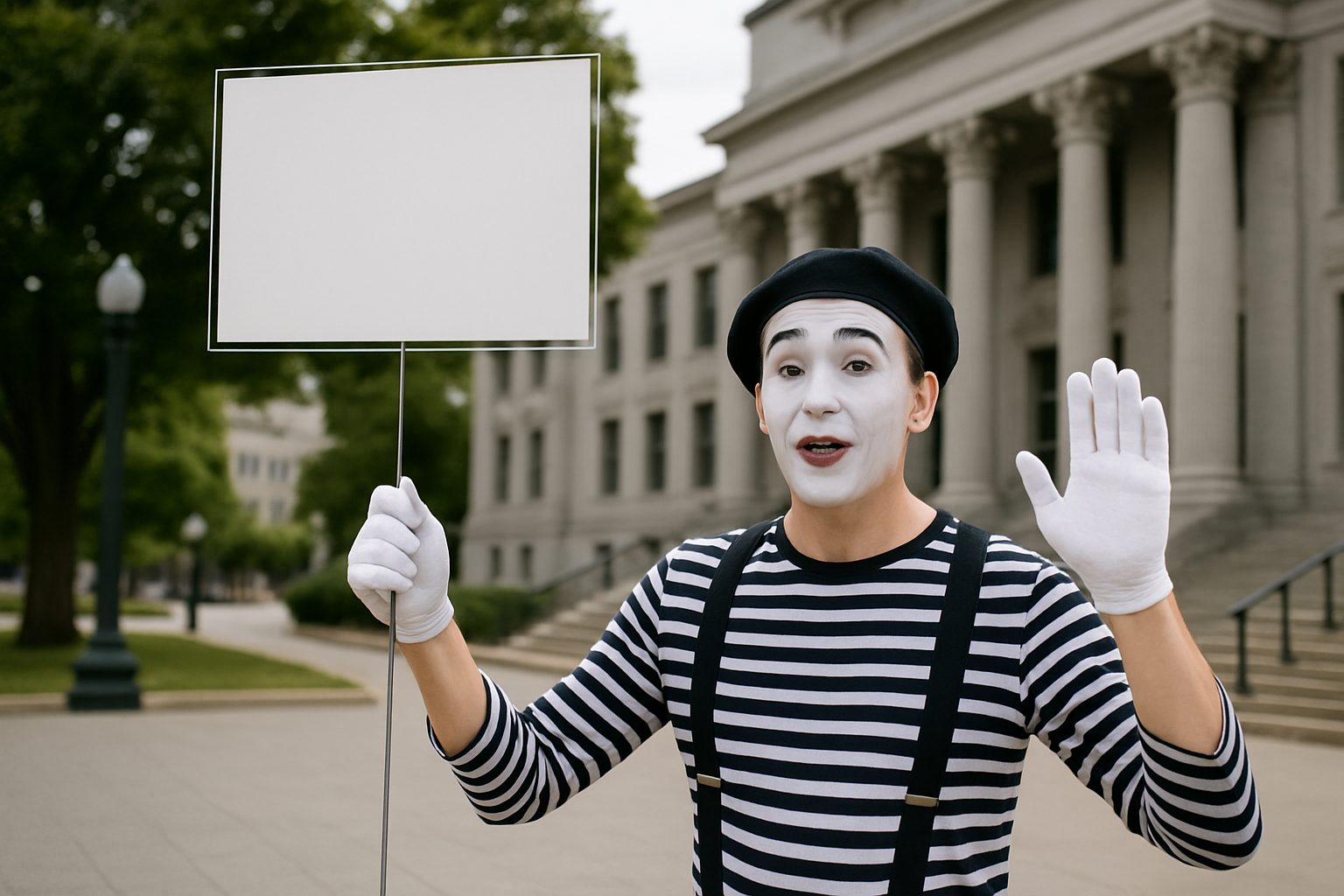
In an unprecedented display of quiet defiance, a local mime has announced a mayoral campaign relying solely on gestures, invisible banners, and silent rallies. The unconventional candidate promises to reduce noise pollution and save on printing costs, all while communicating a robust urban vision without uttering a single word.
It began at the east plaza of city hall, where a figure draped in traditional mime attire stepped onto a makeshift stage and tapped an empty microphone stand. A hush fell over the gathered crowd as the mime lifted a single gloved finger to the lips, then raised both arms in a graceful arc. Without a word, the silent candidate launched a campaign for mayor.
The mime’s invisible manifesto was rolled out with fanfare worthy of a blockbuster premiere. Supporters unfurled what appeared to be blank sheets of paper, held them aloft in proud formation, and nodded sagely. Spectators scratched their heads as they tried to read policies that existed only in the collective imagination. The mime bowed deeply, gestured toward the blank pages, and concluded with a flourish-then exited to thunderous applause.
Few knew the personal history behind this unbeaten campaigner. Once a street performer who entertained passersby with mimed escapes from imaginary boxes, the candidate later took a brief turn as a conflict resolution facilitator. Neighbors report the mime mediated disputes over garden fences with an array of silent pantomime, winning grudging respect even from the most stubborn parties. Now tackling city governance, the mime insists that gestures can speak louder than campaign flyers.
Rallies have been equally silent affairs. Supporters assemble in public parks, form neat rows, and hold up nothing but expressions. When a rival candidate’s jingle blared from a loudspeaker, the mime countered by cupping an invisible megaphone and signaling the crowd to empathize with auditory relief. Witnesses described a wave of collective euphoria as the rival tune faded from memory, while the mime’s silent ode to tranquility remained etched in the air.
Beyond the comedic spectacle, the campaign touts serious commitments to sustainability and privacy. By eliminating printed flyers, campaign lawn signs, and mass mailings, the mime claims to cut back on paper waste and plastic stakes. Voters need only recall a sequence of hand shapes to review policy proposals, maintaining an eco-friendly footprint. Supporters also praise the quiet approach for respecting bystanders’ personal soundscapes and protecting citizens’ mental well-being.
Emotional intelligence lies at the heart of this wordless platform. The campaign team, also composed of nonverbal advocates, conducts what they call “eye contact audits” to ensure empathetic connections. Instead of shouting over one another during debates, candidates are invited to stand shoulder-to-shoulder, achieve synchronized nods, and hold universal gestures for concern, solidarity, and optimism. The mime promises that these shared signals will foster deeper understanding between council members and community members alike.
City officials are scrambling to adapt. The election commission has had to draft guidelines for silent campaign materials, clarifying what constitutes valid signage when the signage is invisible. Press releases from City Hall now include annotations for interpretive expressions. At a recent council meeting, members attempted to question the mime’s stance on public transportation by miming bus seats and rail tracks, resulting in a pantomime standstill that nearly ended in applause.
Journalists covering the campaign rely on translator mime interpreters-staff members who elaborate on each gesture via whispering into invisible earbuds-and spectators cling to every flick of a wrist. News desks have introduced “mute cams” that capture camera angles designed to reveal the epicenter of expressive energy. One veteran reporter admitted she sometimes misses the rustle of paper as a cue that something newsworthy is happening.
Early polls suggest an intriguing tie between the silent candidate and the incumbent. Voter enthusiasm ratings are pegged through facial emotion recognition software rather than traditional thumbs-up scales. When asked to rate excitement, focus groups responded with a variety of raised eyebrows, thoughtful chin-strokes, and raised palms. Analysts struggle to convert these gestures into percentages but agree that support is blooming in the downtown corridor.
The mime’s campaign logistics defy convention. Instead of fundraising dinners with buffet lines, patrons purchase virtual “invisible hats” for ten dollars apiece. Wearers are instructed to tap their own heads to show solidarity. Crowd counts at rally sites are estimated by counting glove pairs that remain clean, signaling whether attendees stayed still between applause gestures. Scouts at events tally silent high-fives to gauge momentum rather than applause volume.
In a recent fundraising flash mob-equipped with silent tambourines-the mime led a procession through the financial district. Participants waved phantom pom-poms, and passersby tipped noise-canceling headphones instead of cash. The campaign’s digital donation page displays an empty form that supporters mentally fill in, believing that each fully imagined dollar is as good as any minted coin. Treasurer accountants, summoned from the city archives, confirm budgets based on hypothetical entries.
Election day features polling stations staffed by volunteers who greet voters with sealed envelopes stamped “TAKE A DEEP BREATH.” Ballots, themselves blank, instruct voters to check a box that exists only within their mind’s eye. When the time comes to submit, voters slide their papers into slots painted with invisible ink. Clerks record a silent confirmation tap and mark an imaginary tally on ledger paper.
Vote counting proceeds behind closed doors, where counters hum soft tunes to keep the mood light. The election commission chair, unable to find a word to express his relief when results are finalized, simply spread his arms wide, arched his eyebrows, and gave an earnest thumbs-up. According to the final imaginary count, the mime emerges victorious by a landslide of thoughtful nods and joyful handclaps.
In the campaign’s aftermath, city hall undergoes a silent makeover. New chairs feature no squeaking parts, and background music has been traded for strategic pauses of perfect quiet. Council sessions begin with a moment of shared stillness instead of a prayer or pledge. Reporters packing up their cameras practice one last mime gesture, acknowledging that sometimes the absence of noise is the loudest message of all.
Whether this silent revolution signals a lasting political movement or a one-time performance remains to be seen. But residents are already experimenting with nonverbal communication in everyday life-families dining with whispered nods, coffee shops introducing sign-language order forms, and neighbors exchanging gestural greetings across the fence. In a world often saturated with noise, the mime’s campaign has offered a playful reminder that some of our most powerful messages come through what we choose not to say.