Location
Mount Vernon, WA 98274
Location
Mount Vernon, WA 98274

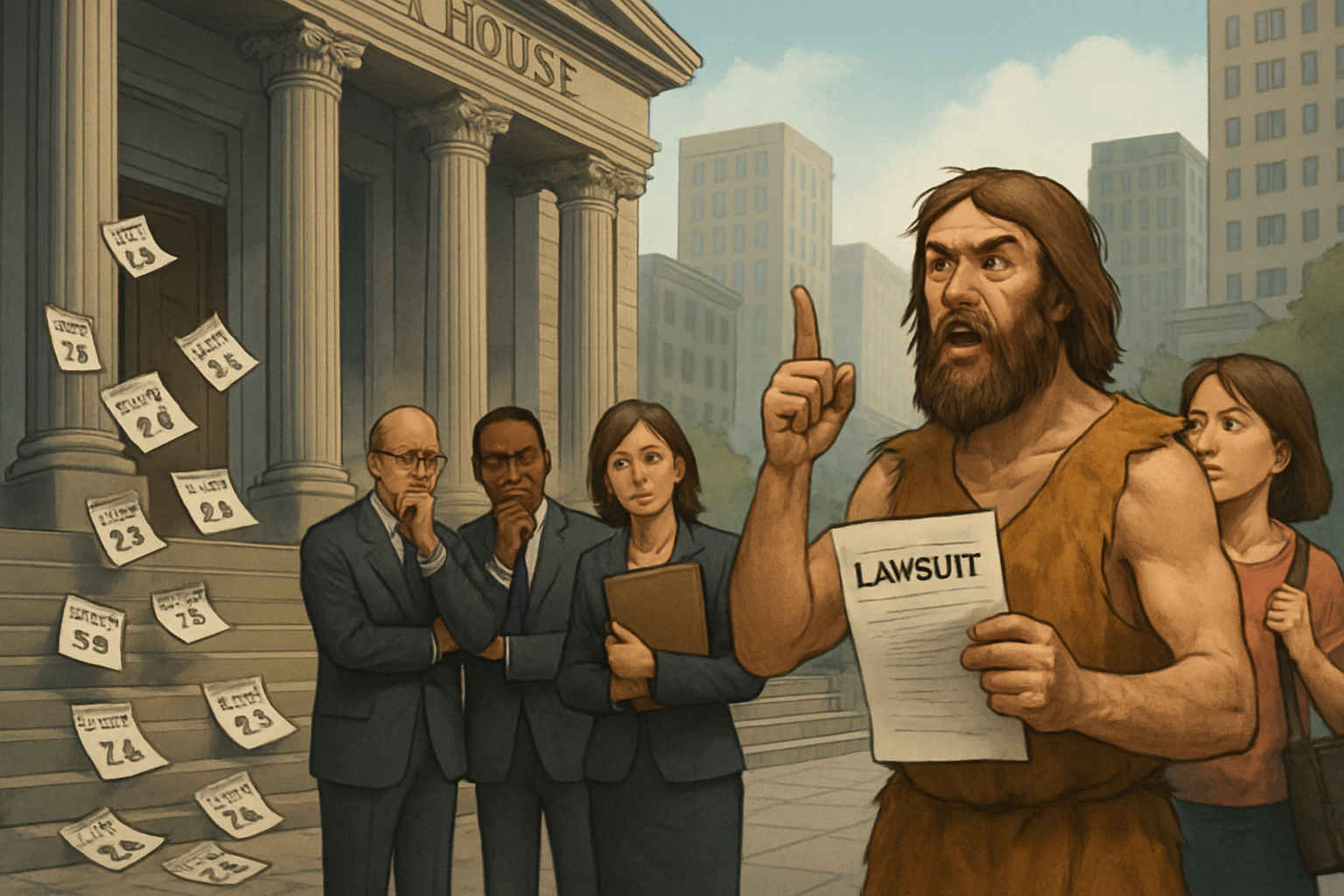
A self-proclaimed time traveler filed a bewildering lawsuit against "History Incorporated," alleging breach of narrative contract and subpar story arcs. City officials and passersby alike are scrambling to figure out jurisdiction over prehistoric grievances as courtroom calendar pages flutter in protest.
This morning, City Hall’s usually somnolent corridors erupted into disarray when a bespectacled individual identifying himself as a chrononaut presented a fifty-page legal complaint accusing “History Incorporated” of delivering inconsistent storylines, weak character development, and unsatisfactory climaxes. Clad in a suit patterned with alphanumeric equations and wielding what appeared to be a gilded pocket watch, the plaintiff insisted that the collective timeline had violated an unwritten pact to maintain narrative cohesion across millennia.
Reporter swarms formed around the makeshift press area, blinking at the chrononaut’s oversized petition, which demanded anything from an immediate rewrite of medieval chronicles to a staged recall of the Industrial Revolution. City clerks, after initial confusion over whether “History Incorporated” was even a registered corporate entity, attempted to process the filing. State statute 14.7(a), the clerk noted with a quizzical frown, only covers disputes among living persons, not abstract constructs or centuries-old events.
The plaintiff, who gave his name only as “Chris Tempus Anonymous,” explained in a dramatic flourish that he’d discovered the narrative inconsistencies during an unauthorized 9:45 a.m. jump to the Roaring Twenties. “I was ready for clandestine speakeasy drama,” he told reporters. “Instead I got a two-minute dance sequence with zero jazz solos and no dramatic moonlighting. That’s false advertising!” He claimed to hold exhaustive personal notes in a “Temporal Ledger” chronicling augmented proofs that never made it into mainstream annals.
When pressed on legal standing, the chrononaut brandished a creased pamphlet titled “Universal Reader’s Rights,” purportedly authored by an elusive self-help guru from the year 2354. According to the document, every conscious being is entitled to coherent backstories, a well-paced rising action, and at least three unambiguous plot twists. As proof of immemorial neglect, he cited the three-day gap between the unearthing of the Rosetta Stone and its museum debut, deeming it an egregious failure of dramatic tension.
At that point, the presiding clerk politely inquired whether Mr. Anonymous had ever tried submitting a correction to any publishing house or contacting a museum’s editorial board. The chrononaut responded that existing channels were too slow to resolve temporal paradoxes. He insisted only a legally binding court order could compel history’s phantom corporate board to revisit its editorial calendar.
City Council members, summoned by memos stamped “URGENT: TIME SENSITIVE,” shuffled into the chamber wearing expressions of mild terror. One councilwoman muttered she’d expected budget hearings, not demands for legal redrafting of Victorian-era diaries. The mayor’s office declined to comment, citing insufficient chronological authority.
Onlookers in the lobby traded bewildered glances as the chrononaut described his vision for a “Unified Temporal Revision Commission.” This body, he said, would convene historical consultants from various eras-Roman senators, Ming dynasty scholars, Renaissance artisans-to collaboratively redesign the world’s collective narrative. “Imagine an epic poem about the drought that doesn’t just end with a rain cloud,” he enthused. “I want full character arcs for those raindrops!”
Behind the scenes, city attorneys convened an emergency strategy session. One junior counsel suggested responding with a motion to dismiss for lack of standing, while a more seasoned partner mused that opposing a claim against an abstract nonentity might require setting a precedent in metaphysical tort law. A whiteboard in the conference room listed provisional case names: Tempus v. Time, Anonymous v. Antiquity and Chrononaut v. Chronology.
When asked whether he possessed proof that “History Incorporated” actually exists, Mr. Anonymous produced a giant mockup of an organizational chart purportedly gleaned from a cross-temporal data breach. The chart traced a line of command from an “Eternal Editor-in-Chief” down to “Junior Scribe – Paleolithic Division.” The entire diagram was rendered in glitter glue and glow-in-the-dark ink, prompting legal observers to question the seriousness of the evidence.
Local baristas, overhearing the press scrum, began crafting commemorative lattes crowned with foam blossoms, dubbing them “Time Paradox Mochas.” Regular patrons snapped selfies with the chrononaut’s pocket watch, while one inventive coffee shop declared that half the proceeds from each “Temporal Mocha” would be donated to the Department of Temporal Affairs-a nonprofit imagined by the plaintiff himself.
Meanwhile, history buffs at the municipal library reportedly staged a peaceful protest. They brought stacks of reference books and held placards reading “HECK YES FOR HISTORICAL CONSISTENCY” and “DON’T MESS WITH THE DARK AGES.” Library staff, amused but slightly alarmed, placed a note on the front desk clarifying that the archives do not answer to lawsuits.
By midday, a downtown law firm specializing in performance art contracts offered to represent the chrononaut pro bono, intrigued by the case’s avant-garde potential. Their lead partner mused that the trial could redefine the intersection of art, law and time. “If we win,” she said, “it opens the door for artists to demand creative control over anything from Shakespeare’s tragedies to tomorrow’s weather forecast.”
Still, critics worry that this legal gambit could set a precedent for frivolous litigation against ungoverned concepts. A local ethics professor delivered an impassioned letter to the city council asserting that time itself cannot be held liable for narrative flatness. “Inanimate epochs,” she argued, “lack the sentience to breach contracts or negotiate settlements.” However, the chrononaut dismissed these objections as semantic nitpicking, demanding a seat at the table before noon tomorrow.
As dusk fell, an unlikely solidarity emerged between librarians, baristas and performance artists. They convened at Café Chronos-a pop-up tea shop imagined by the plaintiff-to brainstorm a compromise: appointing a rotating cast of local volunteers to serve as temporary “Historical Consultants,” tasked with drafting daily “story patches.” Customers would submit suggestions like “More dramatic monsoons in June” or “Insert a cameo of a medieval juggler at the moon landing.” The proposal, ironically, invoked a crowd-sourced rewrite of chronology.
Whether History Incorporated will honor a municipal decree remains to be seen. City officials admit they have no mechanism to regulate dusty tomes or prehistoric documents. For now, the case sits in limbo, awaiting a judge willing to rule on matters transcending time itself. Meanwhile, Mr. Anonymous promised a sequel lawsuit if the timeline fails its next quarterly narrative audit. “I refuse to let history be a series of half-baked cliffhangers,” he vowed, tapping his pocket watch with theatrical flair.
Public reaction has oscillated between baffled amusement and genuine curiosity. Residents texting for updates often forget to add punctuation, causing accidental chronological rewinds in their chat threads-which the chrononaut claims is evidence of narrative bleed. As reporters pack up for the evening, all anyone can agree on is that tomorrow’s headlines will likely depend on whether the judge acknowledges jurisdiction over temporal disputes. In the meantime, the city’s collective timeline remains unamended, its peaks and valleys intact-unless and until a court order decrees otherwise.