Location
Mount Vernon, WA 98274
Location
Mount Vernon, WA 98274

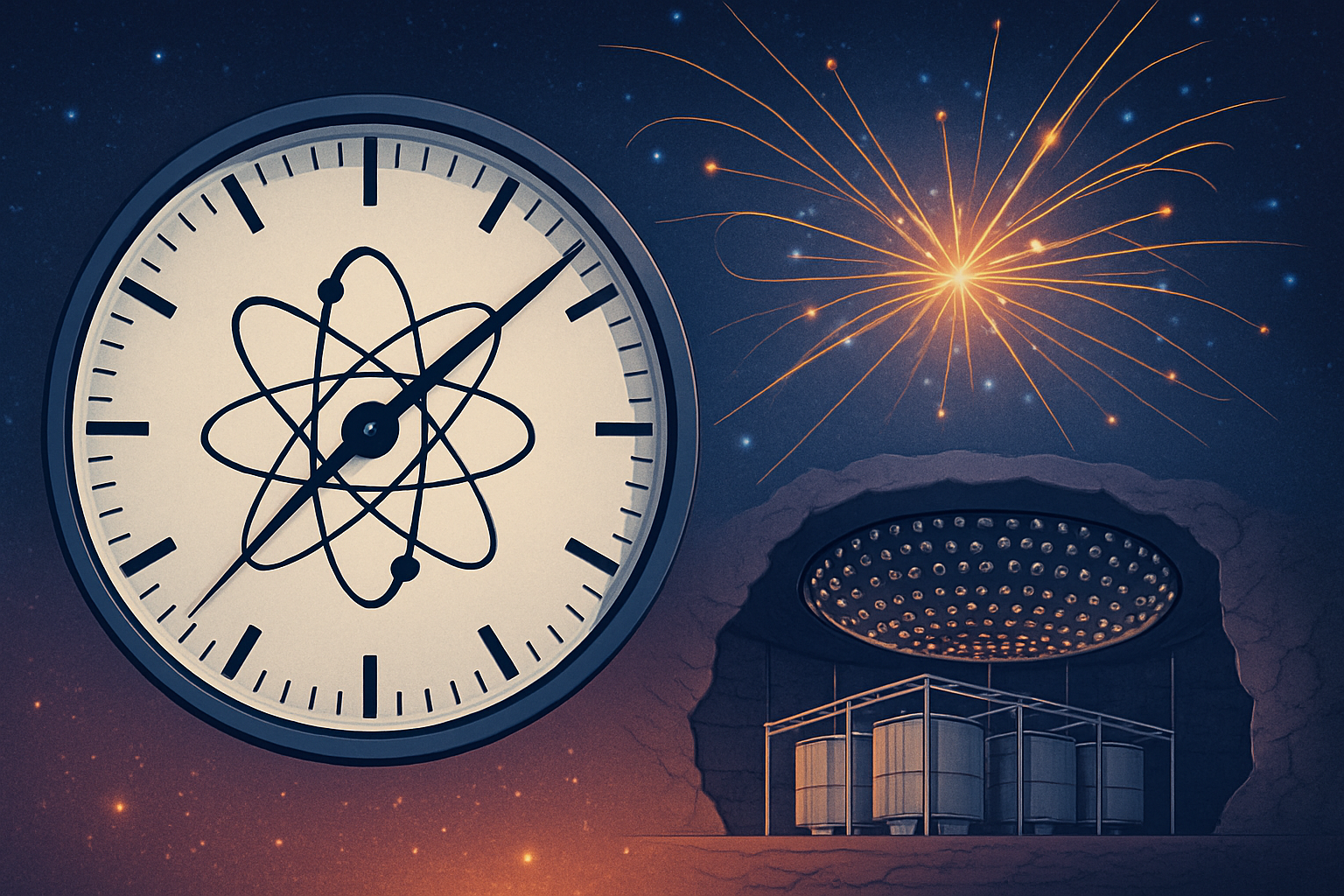
Advances in timekeeping and particle detection are converging to peel back the universe's deepest secrets. From atomic clocks achieving unprecedented precision to subterranean detectors hunting dark matter, researchers are orchestrating a symphony of experiments that may redefine our understanding of reality.
A new chapter is unfolding in the human quest to comprehend the cosmos. In laboratories from underground caverns in Italy to ultracold chambers in North America, scientists are refining instruments that probe the very fabric of existence. By pushing timekeepers to their limits and smashing particles at ever-higher energies, researchers hope to illuminate the forces that shaped the universe from its first instant. This coordinated assault on the pillars of physics promises fresh insights into how time flows, how matter behaves, and what unseen phenomena may lie beyond our current models.
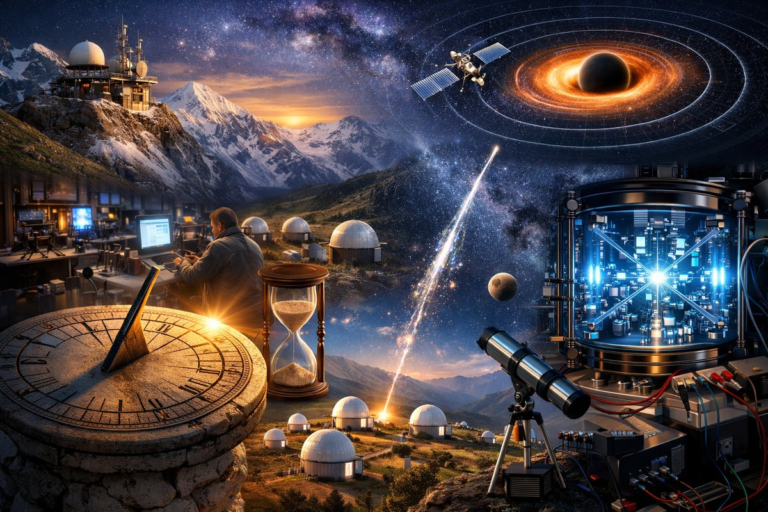
On the frontier of chronometry, atomic clocks are achieving accuracies that would neither lose nor gain a second over the age of the universe. State-of-the-art optical lattice clocks using strontium atoms have reached fractional uncertainties near one part in 10^18. These marvels are housed in vibration-isolated chambers and interrogated with ultra-stable lasers, allowing scientists to test whether fundamental constants shift over time. Such precision opens possibilities for new tests of general relativity in Earth’s gravitational field and could eventually improve global navigation systems. As these clocks become more compact and rugged, they may even find use in deep-space probes seeking to map gravitational anomalies.
Beyond the confines of national laboratories, chip-scale atomic clocks are emerging as tools to explore time dilation at human scales. Researchers have begun sending portable optical clocks on high-altitude flights and across mountain ranges, measuring minute differences in tick rates predicted by Einstein’s theory. Meanwhile, experiments using long coils of optical fiber woven into city infrastructure aim to detect passing gravitational waves through transient shifts in light travel time. These tabletop investigations dovetail with grander missions and underscore a democratic trend: timekeeping once reserved for metrology institutes is migrating into university labs and startups worldwide.
While clocks refine our grasp of time, particle colliders continue to reveal matter’s hidden layers. At the Large Hadron Collider’s latest run, teams are recreating conditions moments after the Big Bang, generating jets of quarks and gluons that briefly form a seething plasma. Careful study of this primordial soup is shedding light on how the strong nuclear force binds particles and how mass itself emerges from quantum fields. Simultaneously at Fermilab, precision measurements of the muon’s magnetic moment have reignited debates about physics beyond the Standard Model-tiny deviations from theory that could hint at undiscovered particles or forces.
In parallel, laboratories working with ultracold atoms are creating exotic states of matter at temperatures near absolute zero. Bose-Einstein condensates, in which particles coalesce into a single quantum wave, provide simulations of phenomena from superconductivity to black hole analogues. Portable vacuum systems and compact laser assemblies now allow this frontier to expand outside specialized facilities. As these condensates become more accessible, they empower tabletop tests of quantum entanglement, coherence, and emergent behavior that inform both fundamental physics and next-generation sensors.
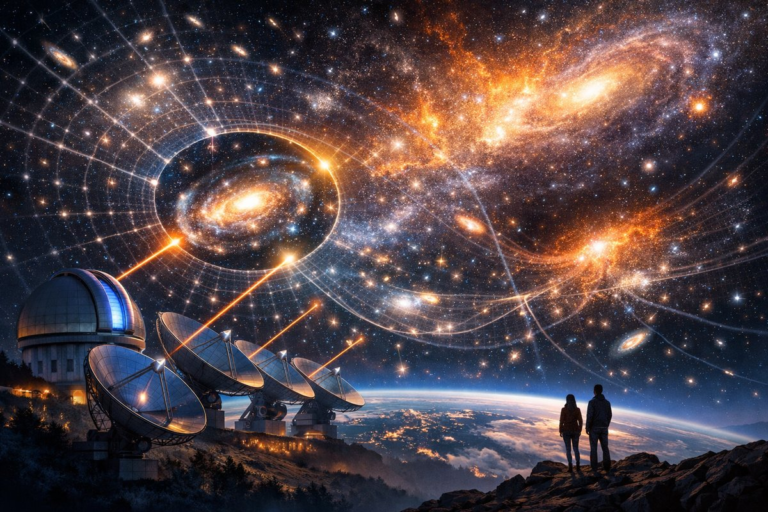
Celestial observatories are also playing a critical role in this odyssey. The James Webb Space Telescope’s infrared vision has unveiled galaxies forming just a few hundred million years after the Big Bang, offering clues about the first heavy elements forged in stellar furnaces. By comparing these observations with theoretical models, astronomers refine their understanding of how matter coalesced into stars, planets, and ultimately life-bearing worlds. Ground-based arrays equipped with adaptive optics continue to survey the universe at multiple wavelengths, complementing spaceborne instruments and anchoring time-stamped records of cosmic evolution.
Meanwhile, the hunt for dark matter-the elusive substance making up roughly 85 percent of the universe’s mass-intensifies beneath our feet. In deep underground laboratories shielded from cosmic rays, experiments like XENONnT and LUX-ZEPLIN use ultra-pure noble liquids to catch the faintest collisions between hypothetical dark matter particles and atomic nuclei. The lack of events so far has tightened constraints on popular theories, driving physicists to explore new candidates and interaction channels. Each null result narrows the field, guiding theoretical creativity and inspiring novel detector concepts that blend cryogenics, photonics, and advanced materials science.
On the opposite front, surveys of the large-scale structure of galaxies are scrutinizing dark energy, the mysterious force driving the accelerating expansion of the cosmos. Instruments like the Dark Energy Spectroscopic Instrument map the three-dimensional distribution of millions of galaxies to trace subtle patterns in how structures grow over time. Complementary missions slated for launch in the coming decade promise even sharper views, aiming to distinguish between competing models and perhaps reveal whether our universe’s destiny is governed by a constant cosmological term or something more exotic.
Gravitational wave astronomy has added another dimension to this effort. Detectors such as LIGO, Virgo, and KAGRA have already recorded mergers of black holes and neutron stars, confirming predictions about warped spacetime and offering new ways to measure cosmic distances through “standard sirens.” The success of the LISA Pathfinder mission has cleared the path for a space-based observatory capable of sensing lower-frequency waves, unlocking events from supermassive black hole collisions and early-universe processes. By listening to these ripples, scientists hope to probe epochs inaccessible to light, bridging time and matter in a unified narrative.
Deep beneath Antarctic ice and the Mediterranean Sea, neutrino telescopes add a final layer to this multifaceted approach. Facilities like IceCube and KM3NeT detect ghostly neutrinos born in distant astrophysical accelerators, providing insights into the most energetic phenomena in the universe. These particles traverse vast stretches of space and matter without significant interactions, serving as pristine messengers from cosmic corners that even photons struggle to reach. Observing neutrinos alongside gravitational waves and electromagnetic signals is forging the era of multimessenger astronomy, where time-stamped detections across carriers unlock new windows on astrophysical engines.
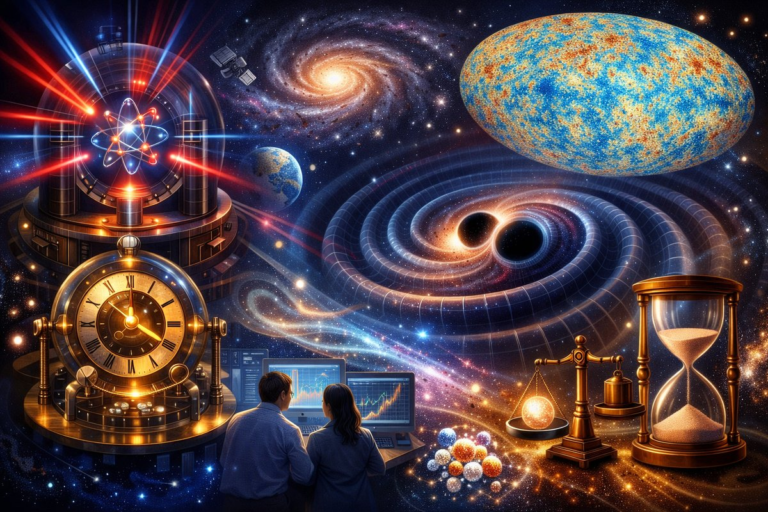
Collectively, these endeavors are weaving a tapestry that binds timekeeping and matter exploration into a coherent picture of reality. Precision atomic clocks and gravitational wave detectors test the laws that govern spacetime itself, while particle colliders and dark matter hunts probe the building blocks composing everything we see. Observatories at all scales-from quantum simulators to deep-space telescopes-calibrate one another, ensuring that no anomaly goes unnoticed. The interplay between theory and experiment accelerates as data streams grow richer, prompting swift updates to our cosmic blueprint.
Yet at this moment of triumph, profound questions endure. Is time an emergent phenomenon arising from quantum correlations? Could discoveries in exotic matter challenge our notions of locality and causality? What if dark energy actually signals new physics at cosmological scales? Researchers in theoretical physics are diving into proposals such as emergent spacetime from entanglement networks, holographic dualities linking gravity and quantum field theories, and novel symmetries that might unify forces under a single framework. While experimental verification remains challenging, these ideas spark curiosity and fuel the next generation of instruments.
Looking ahead, collaboration will be key. International consortia are already synchronizing measurements between atomic clocks continents apart, sharing data from gravitational wave alerts in real time, and coordinating telescope time to follow up transient phenomena. Plans for future accelerators, detectors, and space missions are being drafted with an eye toward interdisciplinary synergy. As budgets tighten and technical hurdles multiply, the science community recognizes that pooling resources and expertise offers the best chance to unlock the universe’s hidden chapters.
The tapestry of time, matter, and mystery continues to unfold. Each tick of an optical clock, each collision in a collider ring, and each faint glimmer from a distant galaxy carries a piece of the grand puzzle. While our current models have stood remarkable tests, the universe still holds secrets that beckon the curious. By pushing the boundaries of measurement and imagination in parallel, scientists are charting a course toward answers that may redefine our place in the cosmic story. As new data arrive and theories evolve, one thing remains certain: the journey has only just begun.