Location
Mount Vernon, WA 98274
Location
Mount Vernon, WA 98274

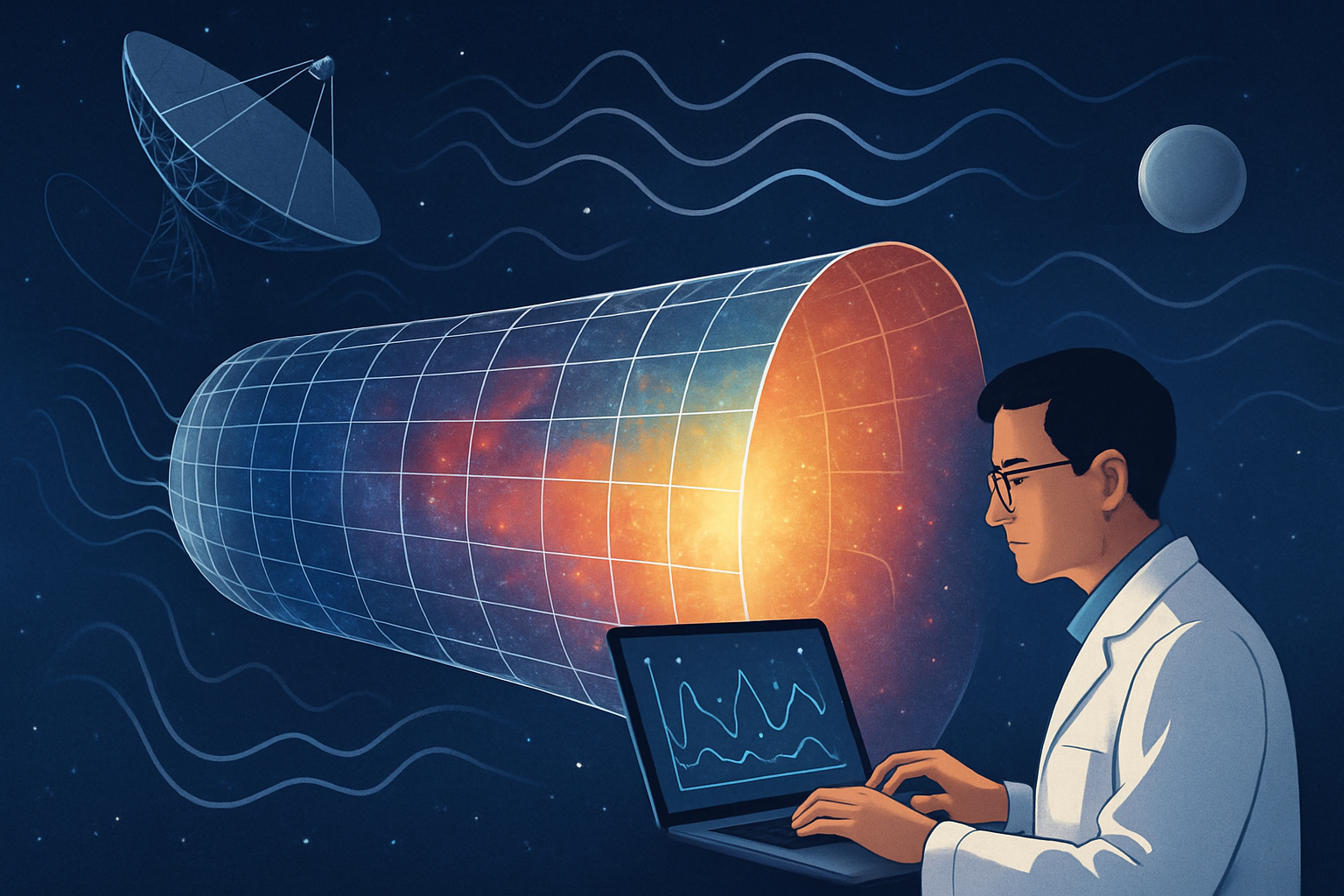
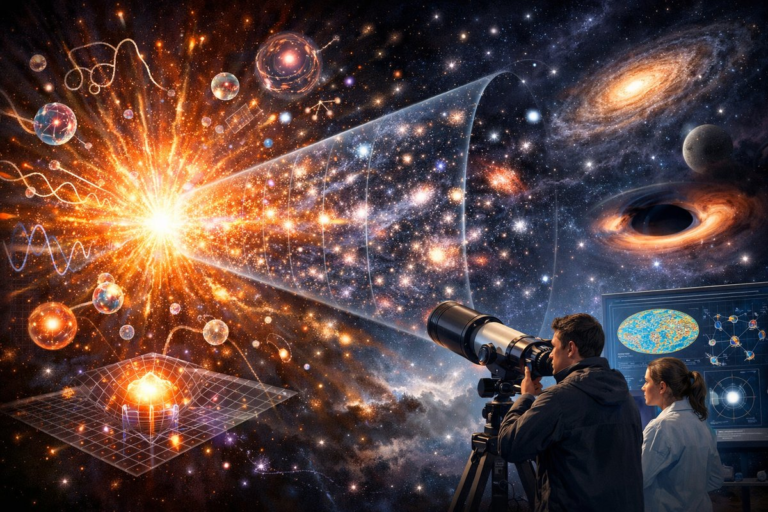
Scientists are harnessing new observational techniques and experimental data to probe the infant universe, combining faint electromagnetic signals, primordial gravitational ripples, and elusive neutrinos into a unified picture of cosmic genesis. Emerging instruments and theoretical breakthroughs are opening unexpected windows onto how space, time, and matter first sprang into being.
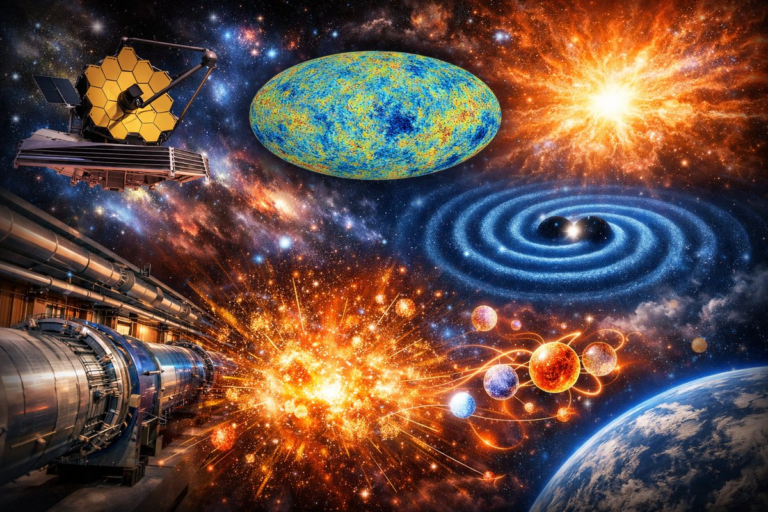
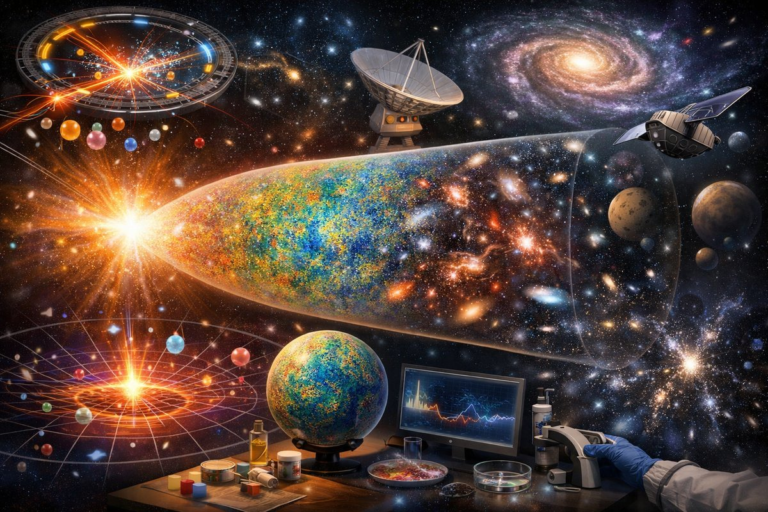
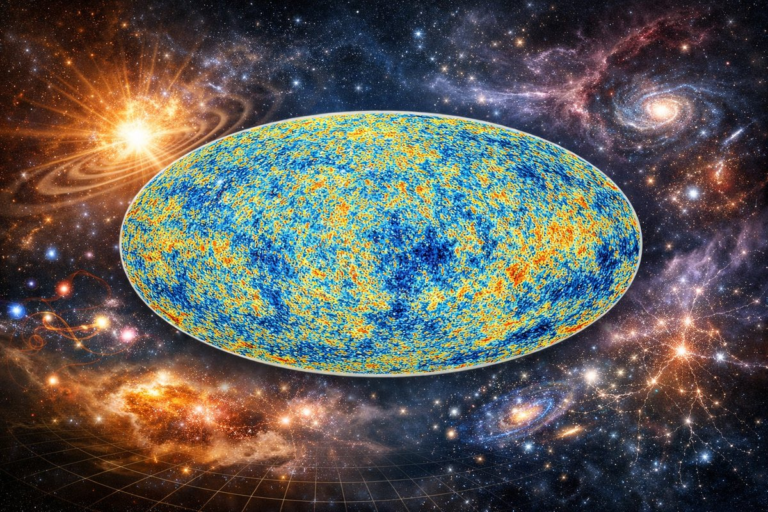
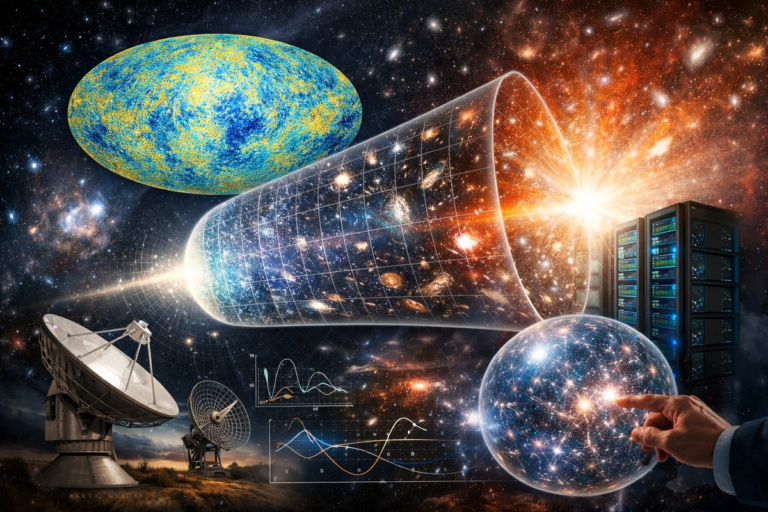
A wave of recent studies is reshaping our understanding of the universe’s birth by blending multiple lines of evidence that once stood alone. For decades, the cosmic microwave background-a faint afterglow of radiation permeating all of space-served as the cornerstone for reconstructing the early universe. Now researchers are layering on data from ground-breaking neutrino detectors and next-generation gravitational wave observatories to assemble an integrated narrative of cosmic origins.
At the heart of this effort lies a reanalysis of the faintest fluctuations in the microwave background. Using enhanced algorithms and advanced calibration techniques, teams have peeled back contaminating signals from our galaxy and distant radio sources with unprecedented precision. The result is a clearer map of temperature and polarization irregularities imprinted just 380,000 years after the Big Bang. Subtle patterns in this map hint at a more complex series of events in the first fraction of a second, including potential traces of exotic physics beyond the standard cosmological model.
Simultaneously, neutrino observatories buried deep underground or embedded in polar ice are capturing ghostly particles that traversed the cosmos virtually unimpeded since their creation. These ultralight messengers carry direct information from the earliest fireball, escaping the dense primordial plasma far earlier than photons ever could. Recent data releases show a slight excess of high-energy neutrinos whose origin may lie in the first cosmic instants. If confirmed, these findings could reveal details about the behavior of fundamental forces at energy scales unreachable by any terrestrial collider.
Meanwhile, a new class of gravitational wave detectors is coming online, designed to tune into the lowest possible frequencies. Unlike the mergers of black holes and neutron stars that current facilities detect, these instruments aim to sense the faint tremors from quantum fluctuations amplified by cosmic inflation. The challenge is immense: the predicted signals are billions of times weaker than those already observed. Yet in laboratory chambers isolated from seismic noise and thermal distortions, scientists are pushing sensitivity to unprecedented levels. Early test runs have hinted at a telltale background hum-still buried in noise but tantalizingly close to the expected signature.
Bridging these observational streams is an effort in theoretical modeling that has become increasingly interdisciplinary. Cosmologists, particle physicists, and condensed matter specialists are collaborating on simulations that span the enormous range from subatomic scales to cosmic expanses. By coupling quantum field theory with large-scale structure formation codes, they can trace how quantum fluctuations evolved into the network of galaxies we see today. Recent simulations incorporating a hypothesized phase transition in the dark sector predict distinctive features in both the neutrino and gravitational wave backgrounds, offering concrete targets for upcoming observations.
Adding another dimension, laboratory experiments are seeking analogues of cosmic phenomena in controlled settings. Ultracold atomic gases trapped in magnetic chambers can mimic expanding spacetime, allowing researchers to watch “particle creation” in real time. Similarly, high-power lasers colliding with electron beams recreate conditions akin to the early radiation-dominated universe. Insights from these table-top setups are beginning to inform large-scale cosmological models, closing a loop between the microscopic and the astronomical.
Despite this progress, fundamental puzzles endure. The nature of dark matter and dark energy remains elusive, and questions about the very mechanism of inflation are still open. Did a single scalar field drive a smooth exponential expansion, or were there multiple interacting components? Could features in the cosmic background radiation be the remnants of a bouncing cosmology rather than a singular beginning? Each new dataset seems to raise as many questions as it answers, fueling a dynamic debate and pointing to the necessity of ever more precise measurements.
In this context, upcoming missions and facilities are poised to play a decisive role. Space-based observatories with advanced infrared detectors will peer deeper into the redshift frontier, surveying the formation of the first stars and galaxies and mapping their imprint on the background light. New deep-sea neutrino arrays and next-generation gravitational wave networks will scan the cosmos for the faintest whispers of primordial activity. Meanwhile, a proposed lunar observatory could escape the noise of Earth’s atmosphere entirely, offering a pristine venue for cosmic background studies.
Beyond the technical achievements, this surge of insight carries profound philosophical weight. Uncovering the universe’s origin story challenges us to rethink concepts of time, causality, and the nature of existence itself. Are we witnessing the aftermath of a unique event, or part of a much grander multiverse tapestry? As experimental boundaries erode, the line between empirical science and speculative philosophy grows thinner, inviting both awe and humility.
For the broader public, these discoveries ignite curiosity and a sense of wonder that few other fields can match. Across social media and streaming platforms, amateur stargazers and science enthusiasts are following live feeds of telescope data, participating in citizen science projects that classify faint galaxies or identify neutrino events. Outreach programs in schools are weaving cosmic origin stories into art and literature classes, nurturing the next generation of cosmologists, engineers, and dreamers.
Yet the journey ahead is as much about technological innovation as it is about human collaboration. Building detectors that can sift through cosmic noise, designing algorithms that can reveal hidden patterns, and forging international partnerships to fund giant experiments all exemplify how collective effort propels our understanding forward. In an era marked by complex global challenges, the quest to trace the universe’s birth stands as a powerful reminder of what humanity can achieve when curiosity and cooperation unite.
The coming decade promises to be a golden age for cosmic archaeology. As each new dataset arrives, it will be layered onto the mosaic of evidence that has been accumulating for nearly a century. From the flicker of the oldest light to the faintest neutrino track and the tiniest ripple in spacetime, every piece has a story to tell. Together, they might finally reveal the symphony of events that set the cosmos in motion, offering an ever-richer appreciation for the world we inhabit and the deep past from which it emerged.
In charting these new frontiers, scientists are not merely observers but active participants in an unfolding drama that plays across the vastness of space and time. The cosmological dawn, once hidden in shadows, is now coming into sharper focus. Each discovery illuminates a piece of that primeval tapestry, bringing us closer to answering the age-old question: how did everything begin?