Location
Mount Vernon, WA 98274
Location
Mount Vernon, WA 98274

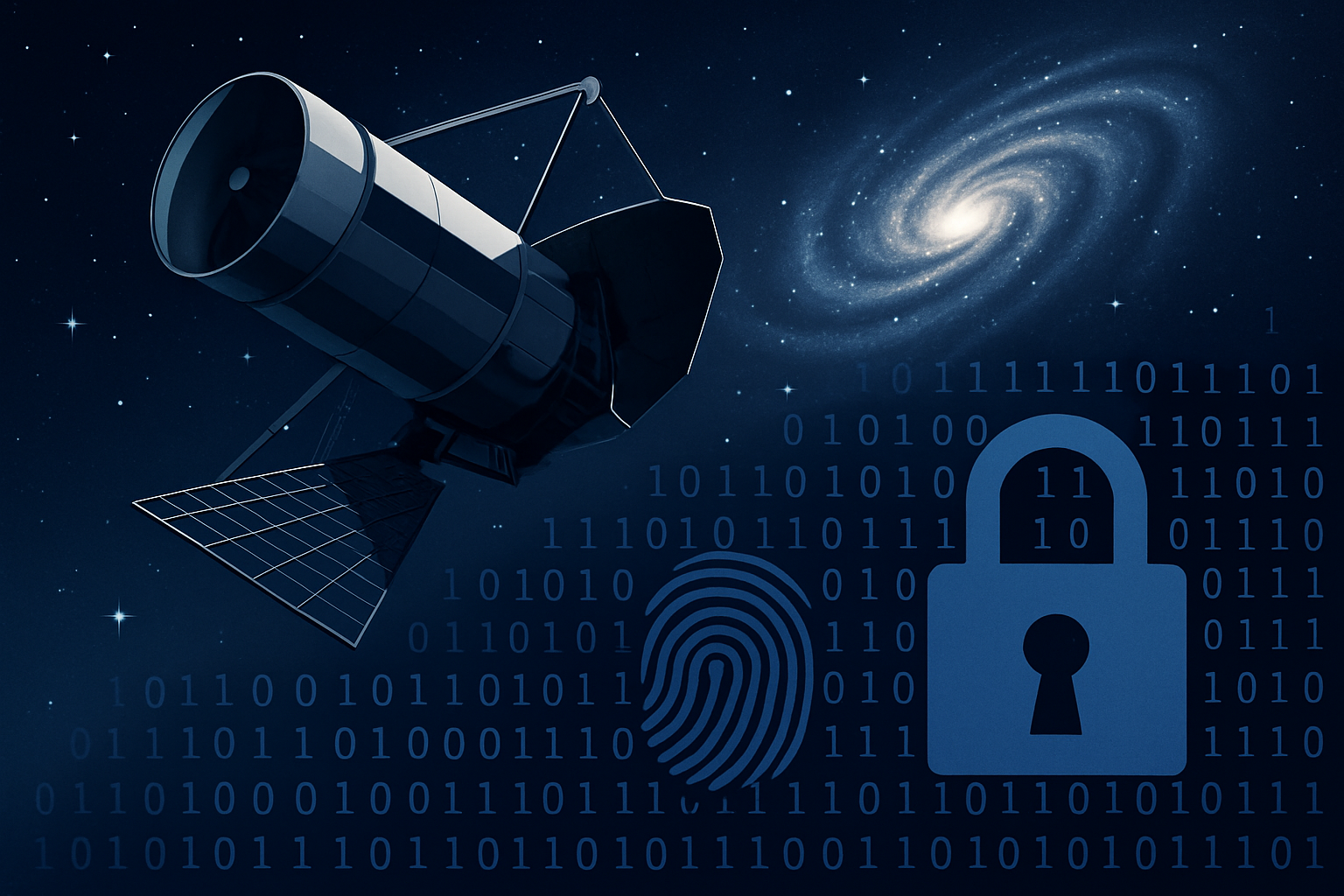
As humanity peers deeper into the fabric of space-time, new scientific instruments promise unparalleled insights into cosmic mysteries. Yet these advances bring pressing questions about surveillance, data rights, and the threat of malicious code leaking from orbit. Researchers and policymakers are racing to craft frameworks that secure both our cosmic knowledge and individual privacy.
The era of probing distant galaxies and mapping the subtle ripples of space-time has arrived, powered by sensor arrays launched into orbit and quantum instruments tuned to detect the faintest cosmic hum. Yet, as satellites beam back petabytes of raw data and gravitational wave observatories filter cosmic signals, an undercurrent of concern has begun to stir: what if these systems, designed to reveal the secrets of the universe, also become vectors for surveillance, data breaches, or malicious interference?
In the last decade, initiatives like a global network of low-frequency radio arrays and next-generation gravitational wave detectors have transformed our view of the cosmos. Instruments once confined to isolated laboratories now ride on small satellites equipped with atomic clocks so precise they lose only a second over billions of years. These clocks help synchronize measurements across continents, enabling scientists to triangulate signals from exploding stars and colliding black holes. But with every leap in sensitivity and coverage comes a corresponding challenge: protecting the streams of data from prying eyes on Earth.
Space agencies and private companies alike have launched fleets of “cubesats” to survey Earth and deep space, gathering everything from atmospheric readings to dark matter maps. Many operate under open-data mandates, sharing telemetry freely with researchers worldwide. Yet some carry classified payloads for defense or commercial intelligence, raising alarm among privacy advocates. The same antennas that chart solar winds could, in theory, intercept civilian communications or monitor ground movements with millimeter precision.
This dual-use nature of space-based sensors has spurred collaborations between astrophysicists, cybersecurity experts, and ethicists. A recent workshop convened by an international consortium on space law explored “privacy by design” for orbital platforms. Participants debated embedding homomorphic encryption directly into sensor firmware, allowing raw observations to stay encrypted until they reach authorized analysts. Others proposed differential privacy techniques-injecting controlled noise into datasets-so that individual activities on Earth or aboard spacecraft remain unidentifiable while preserving aggregate scientific value.
Meanwhile, the risk of spyware and malware infecting space systems has moved from sci-fi speculation to genuine concern. In 2018, a fleet of research satellites experienced sporadic command anomalies traced to a sophisticated backdoor in a third-party communication module. Engineers wrote emergency patches and rebuilt ground stations with stricter code audits, but the incident underscored how vulnerabilities in supply chains can ripple through critical science infrastructure. Today, global efforts are underway to standardize secure boot processes for satellite avionics and establish continuous monitoring for anomalous firmware behavior.
On the ground, cybersecurity teams developing detection tools leverage techniques born in the corporate sector. Network traffic analysis, packet inspection, and behavior-based heuristics now support early warning systems against unauthorized uplink or downlink commands. In one field test, researchers deployed machine learning models at a ground station to flag deviations in signal patterns that might indicate a hijacked telemetry channel. When paired with threat intelligence feeds, these systems can quarantine suspicious data and trigger automated rollback procedures, preserving the integrity of ongoing experiments.
While the technical safeguards evolve, legal frameworks struggle to keep pace. The Outer Space Treaty, drafted seven decades ago, offers broad principles on peaceful use but lacks specificity on data governance. In contrast, terrestrial laws like the General Data Protection Regulation (GDPR) articulate strict rules on personal data processing-but jurisdiction over signals captured from orbit remains murky. Does a European satellite that inadvertently records private communications over another continent trigger cross-border privacy statutes? Debates in international law circles aim to clarify these gray areas, balancing scientific openness with individual rights.
Digital rights activists argue for equitable treaties that guarantee transparency and accountability. They envision a “Space Data Bill of Rights” outlining citizen access, consent mechanisms, and redress procedures for misuse. Open-source hardware advocates push for modular spacecraft designs with visible supply chains, so any component can be audited for backdoors. Grassroots coalitions encourage space missions to publish threat models, disclose third-party dependencies, and adopt privacy-enhancing technologies by default.
Ethical tech principles also play a central role in guiding next-generation missions. As quantum sensor networks promise to map gravitational waves across unprecedented scales, scientists grapple with the prospect of embedding AI-driven analytic systems onboard satellites. Autonomous anomaly detectors can spot cosmic transients in real time, but they may also misinterpret benign environmental noise as significant events-or worse, as targets for unintended data collection. Principles of transparency, fairness, and human oversight are being codified into development roadmaps, ensuring that machine decisions remain interpretable and reversible.
Beyond cosmic science, the lessons learned in orbit feed back into Earth-bound privacy debates. Techniques refined for protecting exoplanet imagery inform strategies for safeguarding medical scans and smart city data. Conversely, privacy innovations from the smartphone ecosystem-secure enclaves, biometric locks, encrypted messaging-find new applications in spacecraft consoles and ground station interfaces. This cross-pollination fosters a virtuous cycle, where cosmic curiosity drives stronger privacy norms, and ethical standards developed on Earth fortify our cosmic ambitions.
As the global space community prepares an ambitious slate of missions-probing Jupiter’s icy moons, deploying interferometers between lunar orbiters, and establishing deep-space gateways-the stakes could not be higher. Collaborative science thrives on shared data, but the safeguards must evolve alongside capabilities. Policymakers, engineers, and ethicists agree on one thing: cosmic exploration and privacy protection are not mutually exclusive goals. They are intertwined quests demanding equal measures of ingenuity, transparency, and moral rigor.
Looking forward, initiatives such as the United Nations’ Workshop on the Long-term Sustainability of Outer Space Activities are expected to draft binding guidelines on data provenance, encryption standards, and incident reporting protocols. Parallel efforts in the private sector aim to certify “ethical spacecraft” with digital seals attesting to privacy-respecting designs. Research into zero-trust architectures for satellite constellations promises to minimize the trust placed in any single node, making global networks more resilient against supply-chain threats.
Ultimately, the drive to understand space-time’s deepest secrets must respect the fundamental rights of individuals here on Earth. The cosmos may hold the answers to questions that have puzzled humanity for millennia, but the methods we use to seek them will reflect our values. If we ascend to the stars with open eyes and a commitment to privacy, surveillance abuse, and spyware detection, we will secure not only our scientific legacy-but also the digital rights that define a free society.