Location
Mount Vernon, WA 98274
Location
Mount Vernon, WA 98274

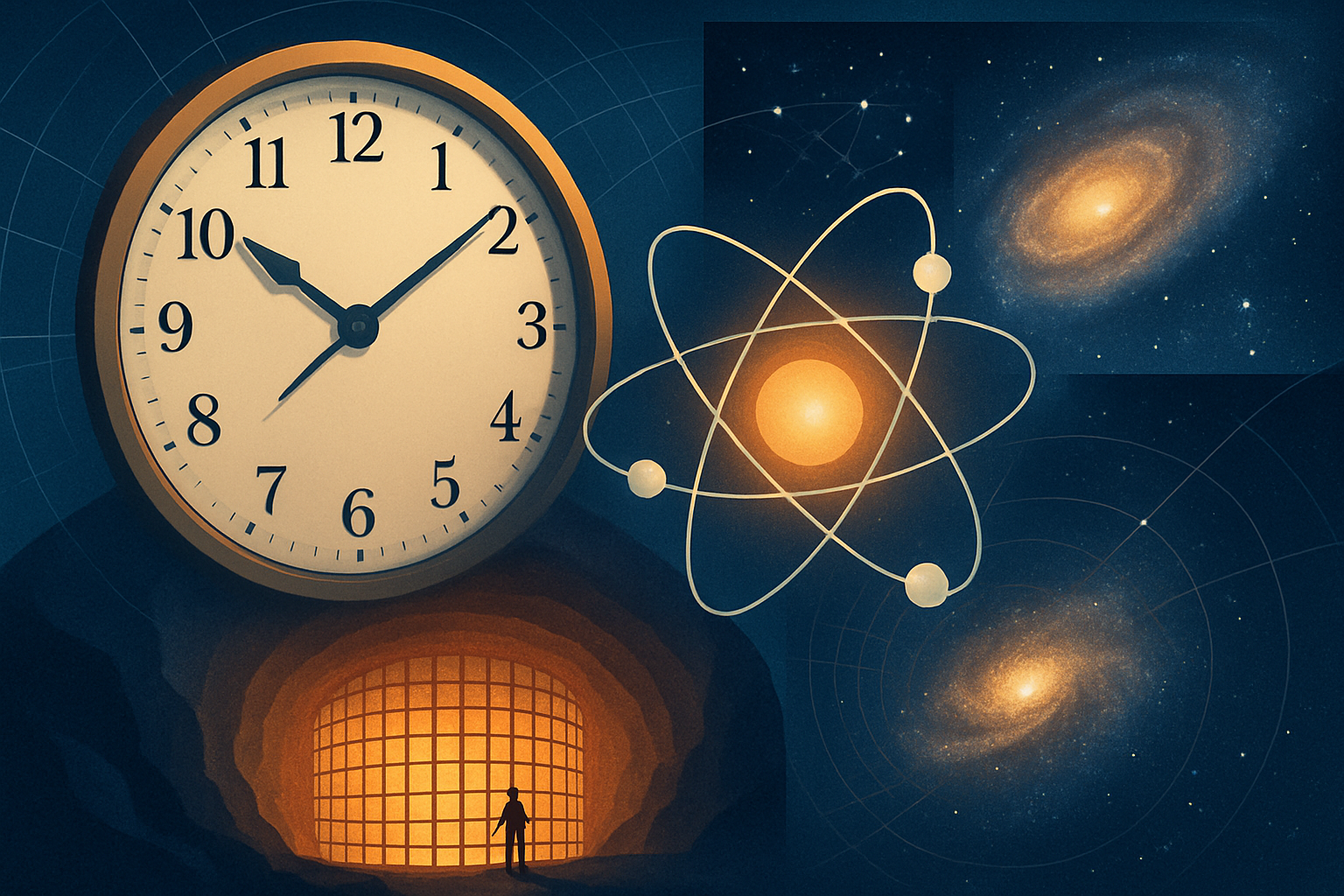
In a wave of groundbreaking experiments spanning from ultrafast clocks to subterranean detectors, researchers are rewriting the rules of how we perceive time, track elusive particles, and chart the universe's hidden fabric. This investigation explores recent advances that bridge fundamental physics and real-world applications while highlighting the enduring wonder that fuels our quest.
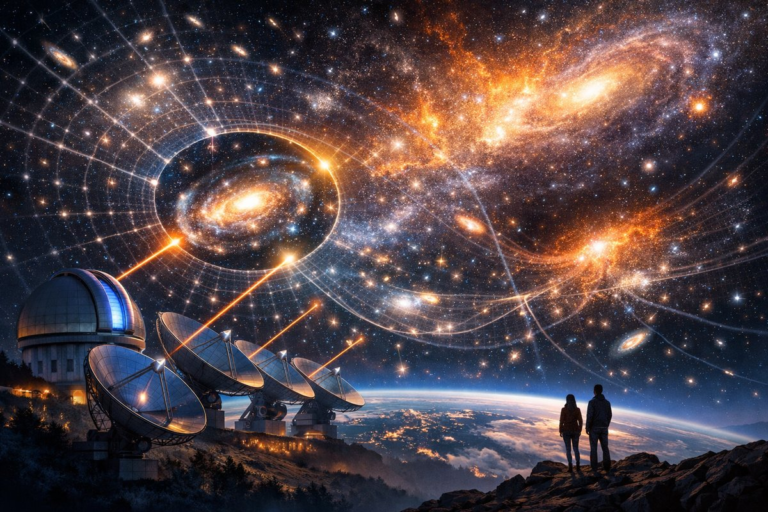
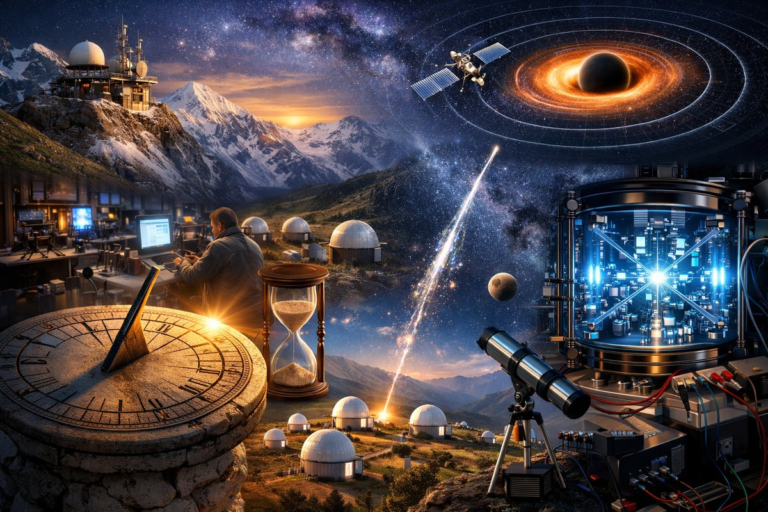
In underground caverns, on high-altitude observatories and aboard orbiting platforms, scientists are orchestrating a grand symphony of instruments to probe the intimate connection between time and matter. Once considered abstract curiosities of theoreticians, phenomena like atomic oscillations and ghostly subatomic particles are now measurable with unprecedented precision. As these initiatives converge, they reveal not only surprising insights into the cosmos but also practical spinoffs that could reshape navigation, communication and even our sense of reality.
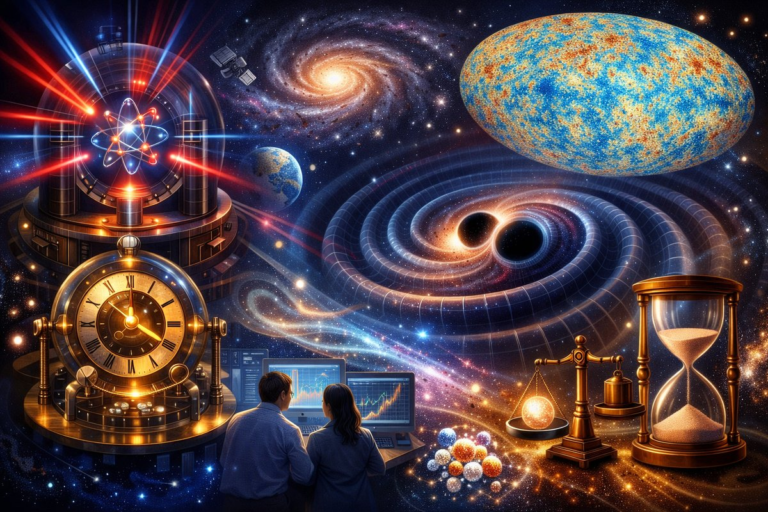
The race to refine atomic clocks has accelerated thanks to the rise of optical lattice technology. By trapping thousands of atoms in a grid of laser light, researchers have reduced uncertainties to parts in 10^18-equivalent to losing less than a second over the age of the universe. Recent upgrades to these setups have enabled clocks to detect gravitational redshift signals from height changes of just a few centimeters. Such sensitivity opens the door to mapping underground water reservoirs, monitoring tectonic shifts and providing hyperaccurate timing for global positioning systems. Laboratories around the world now share timing signals via fiber-optic networks, showcasing how precision timekeeping is no longer isolated to ivory-tower physics.
Simultaneously, gravitational wave facilities are tuning their detectors to capture ever fainter tremors in spacetime. Instruments like LIGO, Virgo and the more recent KAGRA network have notched dozens of detections of black hole and neutron star mergers. Each ripple brings fresh data on matter under extreme pressure and the expansion rate of the universe. Engineers are exploring cryogenic mirror suspensions and quantum squeezing techniques to further suppress noise. Beyond astrophysics, these innovations promise to enhance seismic monitoring, offering early alerts for earthquakes and volcanic unrest. By listening to the echoes of cosmic collisions, scientists are building tools with terrestrial benefits.
Deep beneath mountain ranges, colossal vats filled with liquid xenon or argon hunt for dark matter particles that refuse to interact with light. The latest generation of detectors boasts record-low backgrounds, thanks to advanced shielding, radiopure materials and novel veto systems that tag stray radiation. While the elusive candidate has yet to make a definitive appearance, each null result refines theoretical models and guides the design of even more sensitive experiments. Collaboration across continents ensures data is cross-checked and environmental footprints are carefully managed. As subterranean observatories grow in scale, they demonstrate how harmony between cutting-edge science and ecological stewardship is achievable.
Amid these searches, condensed-matter physicists are crafting time crystals-exotic phases that break time-translational symmetry and oscillate interminably without energy input. First realized in driven quantum setups, these constructs may one day serve as stable references for new kinds of clocks or qubits in quantum computers. By studying how time crystals form, researchers gain deeper insight into non-equilibrium systems, a frontier that spans materials science, biology and cosmology. Though still at a proof-of-principle stage, the concept of structures oscillating in time hints at radical revisions to our understanding of order in the universe.
Looking skyward, plans are afoot to deploy quantum clocks and particle detectors on satellites and deep-space probes. Aboard the International Space Station, early tests of microwave linkups with ground stations have begun. In a few years, networks of clocks in orbit could synchronize worldwide sensor arrays and enable relativistic geodesy-measuring Earth’s gravity field with extreme accuracy. Meanwhile, neutrino detectors embedded in Antarctic ice and Mediterranean waters are charting the trajectories of ghost-like particles from distant supernovae and the sun’s core. These extraterrestrial platforms extend our reach into both time and matter, reminding us that the cosmos itself is the ultimate laboratory.
Critical to all these ventures is the marriage of big data analytics and machine learning. Petabytes of timing logs, waveform records and detector images pour into cloud clusters every day. Artificial-intelligence algorithms sift through noise, flag anomalies and even propose new event templates. Teams of computer scientists and physicists co-design these pipelines to ensure transparency and guard against algorithmic bias. Open-source frameworks promote collaboration, allowing educational institutions and citizen scientists to download real data, run analyses and contribute fresh ideas. This democratization of discovery underscores a core value: science thrives when knowledge is shared and scrutinized.
The ripple effects of time-and-matter research extend beyond labs into practical realms. Advanced clock networks are already improving synchronization for financial transactions and telecommunications. Enhanced sensor arrays support precision agriculture by mapping soil moisture and predicting frost events. High-speed timing also plays a role in autonomous vehicles, where split-second decisions can mean the difference between safety and disaster. By transforming abstract principles into tangible technologies, the field continues to inspire innovators across industries.
Yet as these powerful methods proliferate, concerns about sustainability and resource use come into focus. Large-scale experiments demand substantial energy for cooling, laser operation and data processing. In response, several research centers are integrating renewable energy sources, optimizing cooling cycles and repurposing waste heat for campus heating. Green certification programs are being piloted for scientific infrastructure, tracking carbon footprints from construction through decommissioning. By aligning curiosity-driven exploration with environmental responsibility, the community is forging a model for future generations of researchers.
Equally important are the ethical questions raised by these capabilities. High-precision timing and particle tracking can be adapted for surveillance, raising privacy considerations. The possibility of uncovering unknown particles or fields prompts dual-use discussions: could new physics enable unforeseen military applications? To address these concerns, governing bodies are revisiting international agreements and updating codes of conduct. Workshops now include sessions on research ethics and public policy, ensuring that breakthroughs serve humanity equitably rather than exacerbate inequalities.
For those outside the ivory tower, the mysteries of time and matter can feel remote-but many enthusiasts are finding hands-on entry points. Citizen-science portals invite volunteers to classify cosmic-ray tracks, examine gravitational wave triggers or contribute to star-mapping projects. Home astronomy clubs are hosting star-parties armed with affordable telescopes, while online communities share tips on building backyard detectors for meteors or solar activity. Physics outreach programs collaborate with artists to create immersive installations, turning abstract theories into visceral experiences. These initiatives forge emotional connections, reminding us that curiosity is a universal trait.
Looking ahead, the horizon brims with tantalizing possibilities. Next-generation neutrino beams aim to reveal whether antimatter behaves differently from matter, shedding light on why our universe is matter-dominated. Space-borne interferometers hope to directly detect gravitational waves from primordial sources, offering a glimpse of the Big Bang’s aftermath. Compact quantum sensors, powered by tabletop lasers, could soon be deployed on autonomous drones to probe geological faults or search for underground structures. Each new milestone promises to deepen our grasp of reality while unveiling fresh enigmas.
In an age where questions often outpace answers, the interplay of time, matter and mystery stands as a testament to human ingenuity. From the silent dance of atoms to the thunderous collisions of black holes, our instruments are increasingly attuned to the universe’s subtle rhythms. As we refine our measurement tools and expand our theoretical frameworks, we remain guided by one enduring principle: every advance brings both insight and new wonder. The journey into the cosmos is far from over-and each discovery beckons us to look beyond the known horizon with both rigor and humility.
By nurturing interdisciplinary collaboration, embracing responsible practices and inviting public participation, the scientific community is charting a path that honors both curiosity and conscience. In doing so, it keeps alive the spirit of exploration that has driven civilizations across time, ensuring that the mysteries of matter and the fabric of time remain not barriers but inspirations for generations to come.