Location
Mount Vernon, WA 98274
Location
Mount Vernon, WA 98274


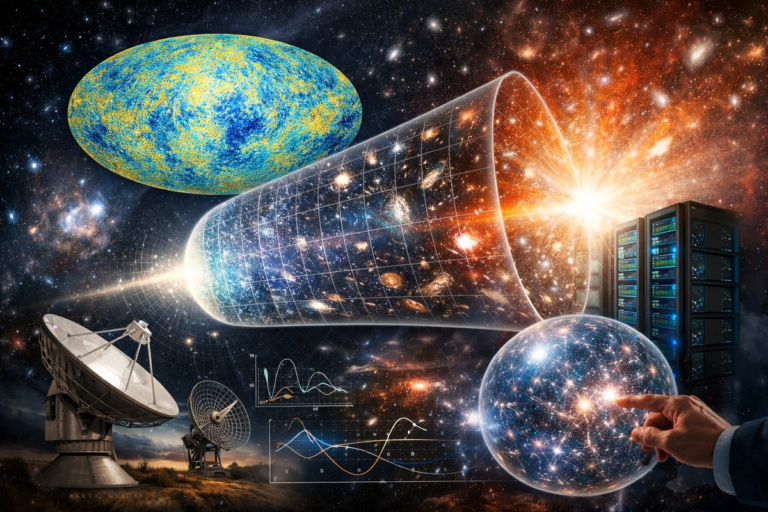
Recent advances in telescopes, detectors, and simulations are peeling back the veil on the universe's earliest moments. From faint echoes in the cosmic microwave background to ultra-sensitive neutrino detectors, scientists are piecing together a narrative of the cosmic dawn that enriches and challenges our understanding of existence.
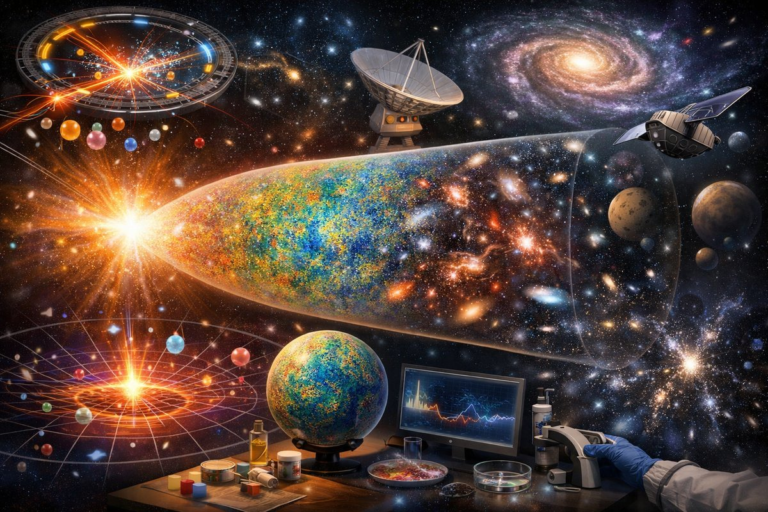
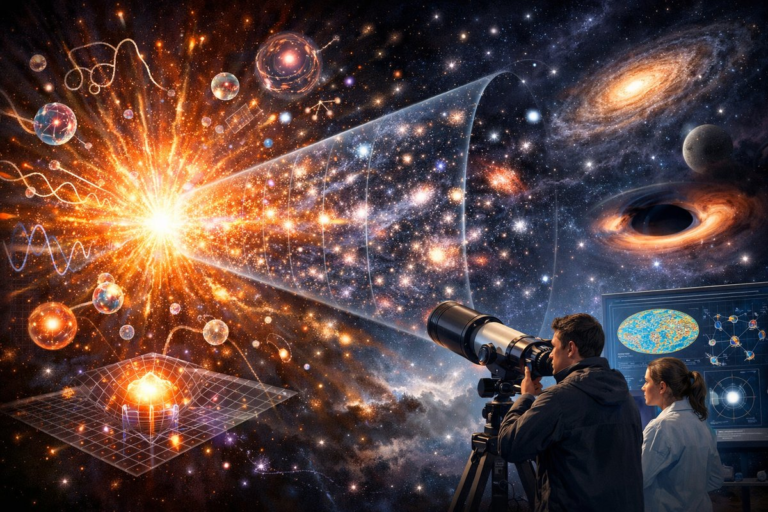
For millennia, humans have gazed skyward and wondered how everything began. Mythologies offered creation tales, and philosophers debated the nature of the infinite. In the last century, scientific breakthroughs revealed that our universe sprang from an unimaginably hot, dense state. Yet despite incredible progress, many questions remain about what triggered the initial expansion and how the first structures emerged. Today, a fleet of cutting-edge observatories and instruments-both on Earth and in space-is converging to probe the universe’s birth with unprecedented sensitivity. By combining infrared light, microwaves, neutrinos, gravitational ripples, and supercomputer simulations, researchers are starting to assemble a layered portrait of the cosmic dawn. This emerging portrait not only refines our picture of the first hundred million years after the Big Bang but also nudges us toward deeper puzzles about the nature of space, time and matter.
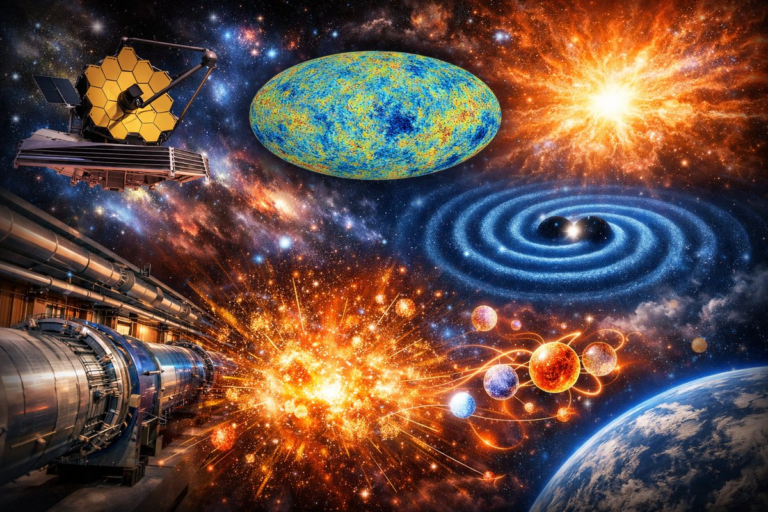
An infrared space telescope launched in recent years has allowed astronomers to see galaxies forming just a few hundred million years after the Big Bang. Clouds of primordial gas collapsed under gravity, igniting the first stars and setting off waves of radiation that ionized the surrounding medium. These early galaxies are faint and rare, but by peering at long wavelengths that slip through dust and gas, the telescope has identified dozens of candidates at record-breaking distances. Each new detection pushes the frontier farther back in time, revealing how rapidly gravity wove matter into complex structures. The distribution of these nascent galaxies, combined with their light signatures, offers clues about the speed of early expansion, the influence of dark matter’s scaffolding and the role of exotic processes like primordial black hole formation or particle decay in seeding fluctuations.
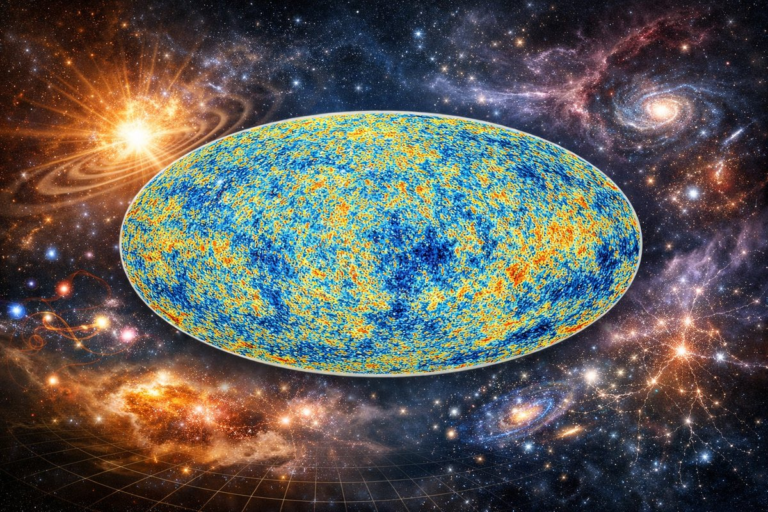
Meanwhile, on the cold Antarctic plateau, a suite of telescopes tuned to the cosmic microwave background (CMB)-the afterglow of the Big Bang-has begun to map its faint polarization patterns. Tiny “B-mode” twists in the CMB’s polarization could encode the imprint of gravitational waves generated during an inflationary burst in the universe’s first instants. Instruments that scan multiple frequency bands are isolating this delicate signal from foreground dust and galactic emissions. Early results hint that the B-mode polarization is within reach, though distinguishing primordial ripples from astrophysical noise remains a formidable challenge. If confirmed, such a detection would constitute direct evidence for inflation, constraining models of how the cosmos ballooned from subatomic scales to astronomical dimensions in a fraction of a second.
Beyond photons, high-energy neutrinos offer another messenger from the universe’s youth. A large detector array buried beneath polar ice has already captured neutrinos from powerful cosmic accelerators, but its next-generation upgrade aims to sense even lower-energy neutrinos-potentially those that decoupled seconds after the Big Bang. Detecting this cosmic neutrino background would open a new window on the early universe’s thermodynamic conditions, complementing information from the CMB and filling in a missing chapter before nuclei formed. The challenge lies in teasing out a faint, diffuse signal from a sea of background noise. Yet with improved sensor arrays and refined calibration techniques, physicists are optimistic they can measure the relic neutrinos’ spectrum and density, providing a unique probe of physics at energies unreachable by any terrestrial collider.
Gravitational waves, ripples in spacetime itself, have already been observed from black-hole and neutron-star mergers. But scientists also seek a stochastic background of gravitational waves from the early universe-perhaps generated by first-order phase transitions or cosmic strings. Space-based gravitational wave missions under development will scan low-frequency bands inaccessible from the ground, potentially capturing waves produced microseconds after the Big Bang. Such a detection would illuminate processes tied to fundamental forces and symmetries in particle physics. On the ground, third-generation observatories plan to enhance sensitivity across a broad range of frequencies. Together, these facilities could map the gravitational universe’s soundtrack from the cosmic dawn to the present day, offering a holistic view of how matter and spacetime coevolved.
Parallel to observational efforts, computational cosmology has entered a golden age. Supercomputer simulations now model structure formation from the universe’s initial conditions through billions of years of gravitational collapse, star formation, feedback and galactic interactions. Teams compare these simulated universes to real surveys, adjusting parameters tied to dark energy, dark matter properties and radiation processes. Discrepancies between simulated predictions and actual data often reveal hints of missing physics-such as self-interacting dark matter or subtle modifications to gravity on large scales. By weaving together observational probes and theoretical models, cosmologists refine the laws that governed the universe’s earliest chapters.
These advances carry profound implications beyond astrophysics. Questions about how time and space originated touch on philosophical and even spiritual inquiries about human existence. Discoveries at the cosmic dawn shape our perspective on life’s emergence, the potential habitability of distant worlds and the ultimate fate of the universe. Interdisciplinary collaborations between physicists, philosophers and computational scientists are exploring how to interpret these findings in broader cultural contexts. Educational programs are bringing cosmic origins research into classrooms, fostering curiosity and critical thinking in the next generation of explorers.
Looking ahead, the synergy of multi-messenger astronomy promises to transform our understanding of the universe’s birth. By uniting light, neutrinos and gravitational waves with ever more powerful simulations, researchers are forging a cohesive narrative of cosmic origins. Each new insight leads to fresh questions: What triggered inflation? Do relic neutrinos carry imprints of unknown forces? Could dark matter interact in ways we’ve yet to imagine? As instruments come online and data accumulate, we stand at the threshold of a deeper cosmic identity. The story of the universe’s origin continues to unfold, inviting us to revisit familiar questions with sharper tools and boundless wonder.