Location
Mount Vernon, WA 98274
Location
Mount Vernon, WA 98274

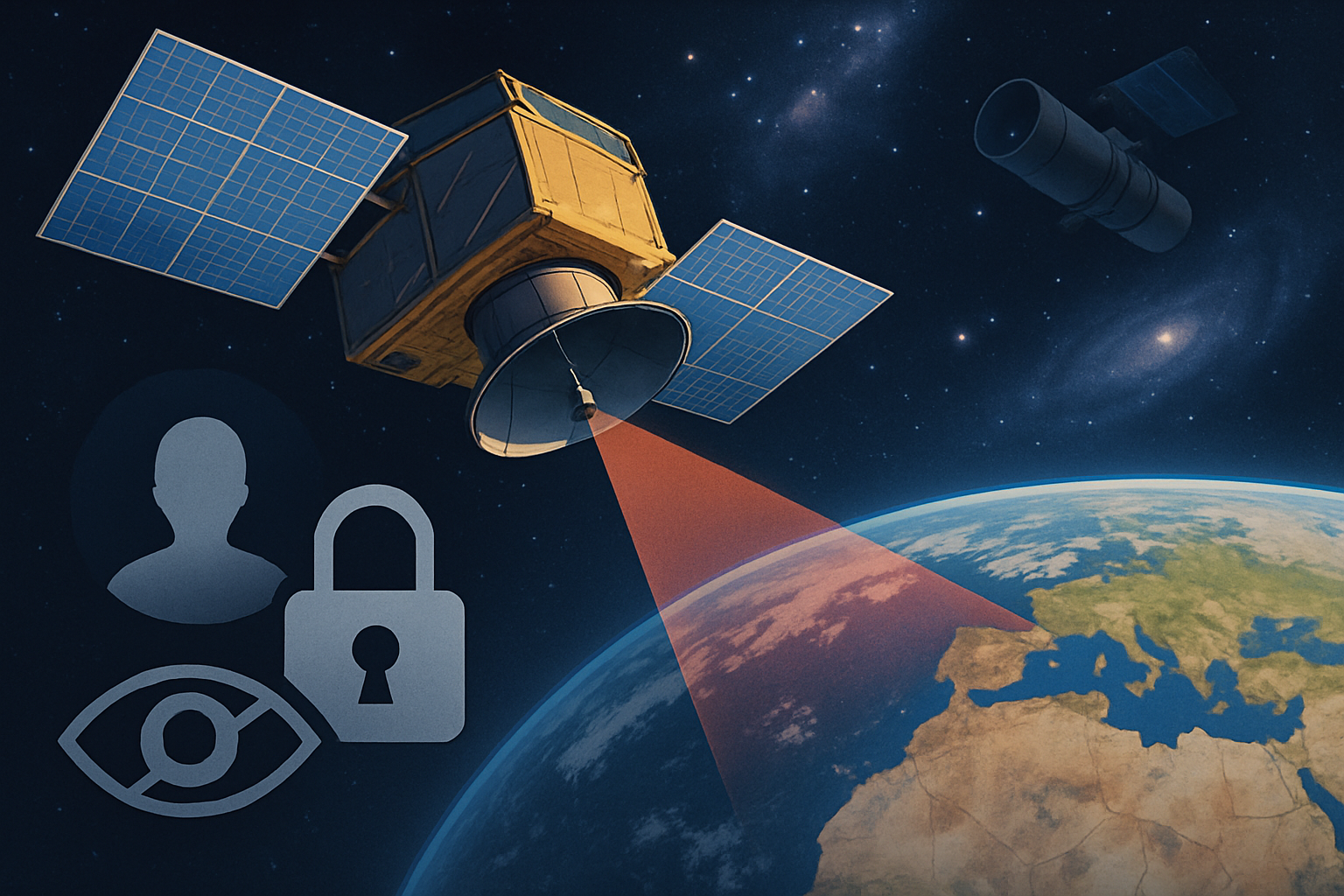
As new generations of satellites and space telescopes gather ever more detailed data about our planet and the wider universe, a collision is brewing between scientific ambition and personal privacy. From hyperspectral Earth-observation sensors to gravitational wave detectors, the same technologies that enrich our understanding of space also carry the potential for surveillance and data abuse. Bridging this divide calls for rigorous spyware detection, robust digital-rights frameworks, and an ethical-tech approach to keep the heavens-and our lives-free from intrusive oversight.
When a constellation of hyperspectral satellites launched last year began transmitting terabytes of data each day, researchers celebrated a leap in Earth-observation science. By analyzing reflected light across hundreds of spectral bands, these sensors can detect subtle shifts in vegetation health, ocean chemistry, and even the thermal footprint of human infrastructure. Yet this extraordinary vista from space has a shadow side: the same detailed imagery can reveal patterns of daily life on the ground, from vehicle movements to the outlines of private properties.
As astronomy and Earth sciences hurtle forward, space-based instruments are no longer content to gaze only at distant galaxies or black holes. Their gaze is increasingly cast downward-capturing footprints on Antarctic snowfields, night-time heat signatures of remote villages, and infrastructure changes in dense urban centers. That dual gaze-outward to the cosmos and inward to our planet-has forced scientists, policy makers, and privacy advocates into uneasy partnership. Can we safeguard individual rights and digital freedoms while preserving the open flow of cosmic data that fuels discovery?
Beyond visual imagery, space science is expanding into realms once thought immune to surveillance. Gravitational wave observatories record minute ripples in space-time; magnetometers on orbiting spacecraft track the Earth’s fluctuating magnetic field; hypersensitive radio telescopes monitor electromagnetic signals from across the galaxy. Each dataset opens new windows on fundamental physics and astrophysics, but also presents fresh vectors for data interception or misuse. In the wrong hands, encrypted streams of cosmic measurements could be tapped to infer locations of sensitive installations or detect clandestine activity hidden beneath camouflage.
This risk has spurred a wave of innovation in spyware detection and cybersecurity for space systems. Advanced anomaly-detection algorithms now monitor telemetry feeds in real time, flagging deviations that hint at packet snooping or unauthorized command uplinks. Machine-learning models trained on years of baseline data can spot the slightest shift in encryption routines, alerting operators to potential breaches before mission-critical sensors are compromised. Some researchers are even experimenting with quantum key distribution between satellites and ground stations, aiming to render interception physically impossible.
Yet technological safeguards alone are not enough. A patchwork of digital-rights laws governs terrestrial data-ranging from privacy-by-design provisions in Europe’s data protection regulations to surveillance-limit rules in select U.S. states. Space-based data, however, often falls through legal cracks. Satellites orbit above national jurisdictions, and data is processed by multinational consortia. Without clear international treaties or ground rules, private imagery of sensitive sites could be sold, repurposed, or leaked with minimal accountability.
Advocates for space ethics argue that we need a new covenant for cosmic data: one that explicitly extends digital-rights principles into orbit. Under such a framework, personal identifiers-like recognizable vehicle license plates or an individual’s routine movements-would be automatically blurred or encrypted before distribution. Data would be classified by sensitivity, with high-resolution ground-views subject to stricter access controls. Public datasets meant for environmental research would exclude personally identifiable information, preserving the scientific value while upholding privacy.
Several organizations are already laying the groundwork. A coalition of astrophysicists, cybersecurity experts, and privacy lawyers drafted a set of voluntary guidelines for ethical-tech in space. They recommend “privacy-preserving pipelines” where raw telemetry is processed onboard satellites through edge computing modules designed to strip out personal data before transmission. These modules use homomorphic encryption to perform calculations directly on encrypted data, ensuring that even ground stations cannot reconstruct sensitive details without additional keys held under strict custodial oversight.
International bodies such as the Committee on the Peaceful Uses of Outer Space have begun discussions about harmonizing these voluntary measures into binding protocols. Proposed amendments to existing treaties would require signatory nations to prohibit the unauthorized sale or dissemination of high-resolution imagery below a specified spatial threshold. Non-compliance could trigger sanctions or exclusion from joint scientific missions. While these measures respect national security concerns, they also aim to empower individuals and communities harmed by unchecked surveillance.
On the technical front, spyware-detection specialists are adapting familiar tools to the unique challenges of space. Payload engineers now integrate intrusion-detection sensors that mirror those used in corporate data centers-deep-packet inspection modules, behavioral-analytics engines, and real-time log auditing. Ground-station networks employ sandboxed simulation environments where every software update is tested against known malware signatures and fuzz-tested for hidden vulnerabilities. This rigorous vetting has prevented several would-be hacks that sought to hijack observation satellites for clandestine monitoring.
But not all dangers come from outside. As commercial entities enter the space arena, data-sharing agreements between governments and private companies raise questions about internal misuse. A private analytics firm could repackage government-funded satellite imagery into consumer apps, offering hyper-local intelligence on foot-traffic trends or real estate lease valuations-potentially exposing individual habit patterns without consent. To counter this, ethical-tech guidelines call for transparent data-licensing terms, independent audits of data-usage policies, and “right to forget” provisions that let individuals petition for the removal of their personal footprints from archived space imagery.
The human dimension remains central. Indigenous communities in the Arctic and remote island groups have voiced concerns that unfiltered satellite monitoring infringes on cultural practices and communal privacy. Environmental NGOs worry that ecological research could be weaponized by poachers or illegal miners tracking endangered species’ habitats. In response, participatory governance models are emerging, giving local stakeholders a seat at the table when determining data-access thresholds and anonymization standards.
Ultimately, the unfolding dialogue at the intersection of space science and privacy is a test case for the digital age. It challenges us to extend the protections we demand online into the vast frontier overhead. By weaving ethical-tech principles into every stage-from sensor design to data processing, from legal treaties to community governance-we can ensure that the next wave of cosmic discovery enriches humanity without eroding fundamental rights.
As telescopes continue to peer into the depths of space and satellites hover above, the promise of new knowledge brings with it the duty to tread carefully. Science thrives on openness, but openness must not become a loophole for surveillance. The tools exist-privacy-by-design architectures, advanced spyware detection, transparent digital-rights frameworks, and participatory governance. What remains is the collective will to adopt them, forging a future where our quest to understand the universe remains as free as the space through which our satellites glide.