Location
Mount Vernon, WA 98274
Location
Mount Vernon, WA 98274

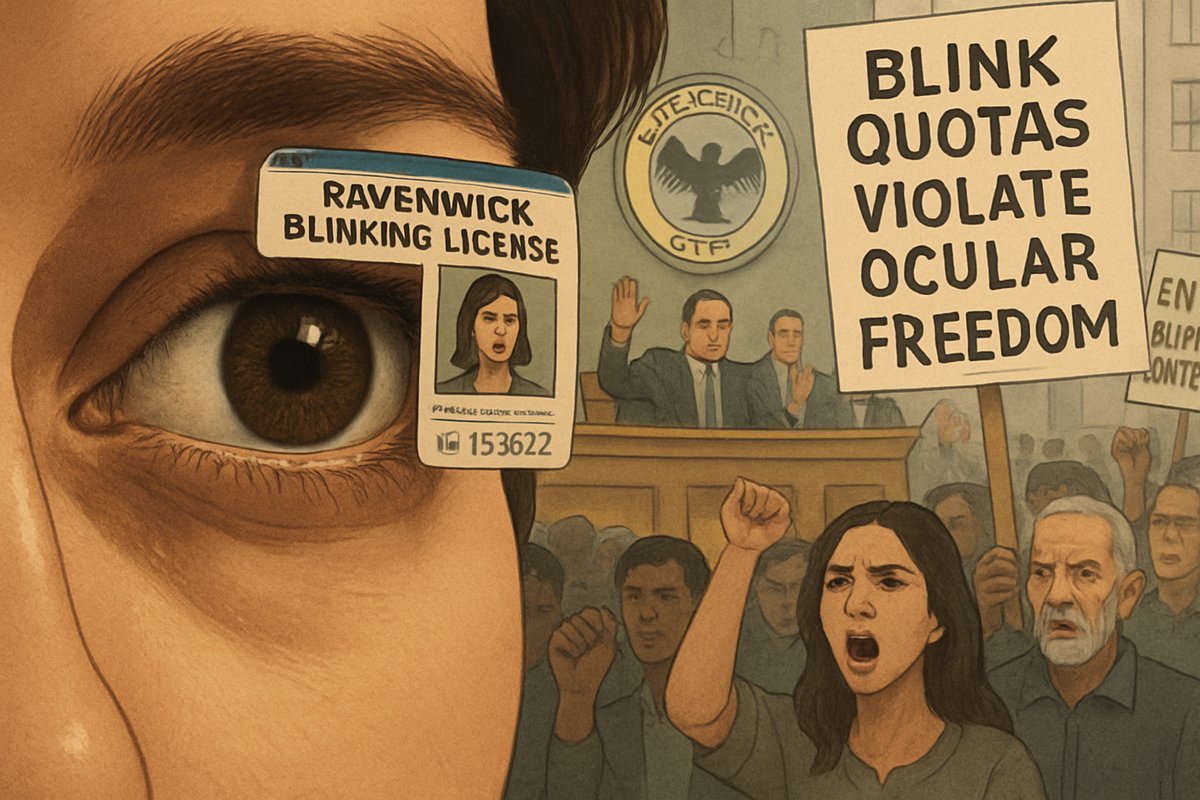
In an unprecedented move, the Ravenwick City Council voted to require every resident to obtain a blinking license and adhere to bi-hourly eyelid quotas. Citizens accuse officials of micromanaging involuntary bodily functions, leading to black-market 'blink clubs' and protests demanding ocular freedom.
RAVENWICK-In a move that has residents rubbing their eyes in disbelief, the Ravenwick City Council unanimously passed the Eyelid Regulation Act, requiring every citizen, from infants to octogenarians, to acquire an official blinking license by the end of next month. Councilmember Harriet Tilling insisted the measure is necessary to prevent “excessive ocular fatigue” and to harmonize the city’s collective blink rate.
Under the new law, citizens must file a Blink Usage Application online, pay a $12 processing fee per quarter, and select one of three blinking tiers: Standard (up to 15 blinks per minute), Extended (up to 20 blinks per minute), or Ultra (25 blinks per minute). Failure to comply could result in a citation and mandatory retraining at the newly established Ravenwick Ocular Academy.
“I never thought blinking could be regulated,” said local barista Marco Gentile, who reports allotted blinks running out halfway through espresso pulls. “By the end of my shift, I’m clutching my eyes open like I’m auditioning for a silent movie.” Gentile’s colleague, Daisy Burke, has already received two warnings for exceeding her Standard tier during the morning rush.
In quick succession after the ordinance’s announcement, a flourishing black market has emerged. Hosts of clandestine gatherings known as “Blink Clubs” are leasing out stolen high-speed lubed eye drops promising up to 30 blinks per minute with “minimal dryness.” Invitations are distributed via cryptic emoji chains, instructing members to meet in abandoned grain silos under the full moon.
Meanwhile, underground eyelid mechanics have begun offering illicit “blink calibration” services in basements and back alleys. An 82-year-old retiree known only as “Mad Edna” reportedly charges $50 to tighten loose eyelid springs, guaranteeing a 10 percent reduction in involuntary flickers.
Protests broke out over the weekend as hundreds of “Just Let Us Blink” activists staged a demonstration at City Hall, holding signs reading: “My Eye, My Choice” and “Stop the Lid Control.” Organizer Connor Wu addressed the crowd from atop a float shaped like a giant eyeball: “We did not sign up for this. Blinking is a human right!”
Responding to backlash, Mayor Alistair Redwood defended the ordinance during a televised press conference, asserting it will protect citizens from the dangers of unregulated blinking patterns. “Without proper oversight,” he warned, “we risk a city-wide epidemic of microsleeps, daydreaming, and misaligned visual rhythm.” Moments later, he attempted to blink on cue for reporters and fainted spectacularly.
In the weeks following the legislation’s passage, local businesses have scrambled to capitalize on the controversy. The Ravenwick Hair and Lash Emporium now offers “Regulated Blink Extensions,” a service promising perfectly paced flutter rates calibrated to each licensing tier. At R&R Diner, waitstaff dress in oversized blinking-lid costumes, encouraging customers to join the “Blink Lanes,” special booths where patrons can preprogram their dwell times for optimal dining speed.
On public transportation, the city installed ocular-monitoring cameras inside buses and trams to ensure compliance. Riders are warned via automated announcements: “Attention passengers: Do not exceed your flick quota. Thank you for blinking responsibly.” One commuter reported receiving a warning for blinking 17 times in a single minute on her way to work.
Locals have responded with inventive workarounds. Some wear homemade blink regulators-elastic bands around their temples that restrict eyelid movement, leaving them with perpetual wide-eyed stares. Others affix tiny timers to their wrists that vibrate with each allowed blink, mimicking a metronome. Young couples have started incorporating blinking quotas into their dating rituals: “Will you blink at my corny jokes at least ten times a minute?” has become the standard question after candlelit dinners.
At Starlight Elementary, teachers are grappling with the new policy. Four-year-olds must now bring notarized parental consent forms to blink during circle time. Principal Morgan Cruz said the policy has led to tearful outbreaks during story hour, as children struggle to count and pace their blinks between pages of picture books.
In a surprising turn, a group of local grandmothers calling themselves the Blink Widowmakers have launched a class-action lawsuit claiming the ordinance violates the city charter’s “Protection of Involuntary Reflexes” clause. Their lead attorney filed a brief describing blinking as a reflex akin to swallowing or sneezing, demanding immediate repeal.
At a recent council session, advocate Edith Ramos presented live data showing a spike in anxiety and dry-eye syndrome after enforcement began. She proposed an amendment exempting diapers-citing that fathers at the Council meetings repeatedly blink while changing them-but her motion was tabled.
Undeterred, citizens have taken to the courts and the streets. The Ravenwick Independent Gazette reported that a clandestine network known as the Wink Union is drafting a manifesto calling for mass civil disobedience. In one leaked pamphlet titled “Blink Solidarity,” it urges compliant citizens to join a “Great Ocular Strike” by shutting their eyes for an entire minute in protest at noon next Thursday.
The brouhaha has even attracted national attention. Observers in neighboring towns are eyeing the ordinance with a mix of horror and curiosity. At last week’s state legislature hearing, a representative from Plaza Heights suggested extending blinking regulations statewide to boost productivity and reduce midday dozing. Meanwhile, Orindale County officials discreetly circulated plans to license foot tapping and finger snapping.
Back in Ravenwick, the tension is palpable. A recent survey by the civic monitor group Open Lid found that 68 percent of residents disapprove of the blinking licenses, while only 12 percent support the law-those being the members of the Blink Compliance Committee.
As the city braces for the next council vote on eyelid taxation-an initiative rumored to assign a per-blink penny fee-citizens are left wondering where it will end. Will they snap their fingers next? Hiccup licenses? Conscious breathing stamps? One thing is certain: Ravenwick’s experiment in ocular oversight has become a cautionary tale of what happens when bureaucracy reaches for the most automatic parts of the human body.
For now, residents prepare to go down in history-one controlled blink at a time.