Location
Mount Vernon, WA 98274
Location
Mount Vernon, WA 98274

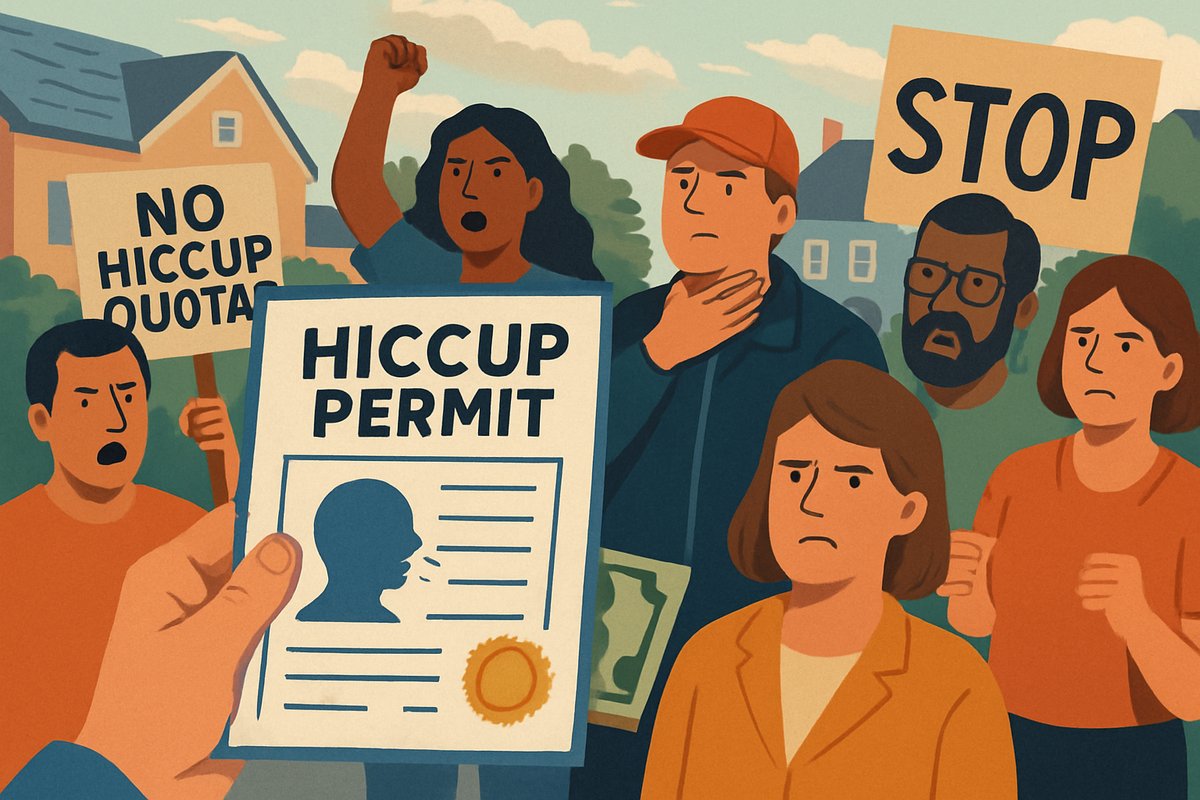
In an unprecedented move, Ashbrook Township now requires residents to apply for official hiccup permits, complete with processing fees and documented quotas. The new regulation has ignited underground hiccup rings, neighborhood protests, and questions about how far government oversight of bodily functions can go.
Ashbrook Township’s local government has unveiled a bizarre new ordinance mandating that every resident secure a permit before each set of hiccups. During last night’s council meeting, Mayor Lydia Clarke announced that the Hiccup Regulation Act is now in full effect, aiming to “restore civic tranquility” after a recent spike in spontaneous diaphragm spasms that left neighbors clutching their ears in despair. Under the law, citizens must file online or submit a paper application to the Township Clerk’s office at least 48 hours before any anticipated hiccup session, paying a $12 permit fee plus a modest administrative surcharge. Failure to comply could result in fines ranging from $25 to $150 depending on the volume and duration of unauthorized hiccup episodes.
Residents awoke this morning to flyers posted on every lamppost, featuring a cartoon diaphragm wearing a police hat and the headline “Don’t Let Your Hiccups Run Wild-Permit Them.” The application form demands detailed information including anticipated start time, estimated hiccup count, and a brief justification for why this round of diaphragm contractions should be approved. According to the online portal’s FAQ, applicants can receive up to 15 hiccups per week, but no more than three per day, with any extra bursts requiring special dispensation from the Hiccup Oversight Committee.
Public reaction has been polarized. Some applaud the council’s commitment to public decorum, pointing out that uncontrolled hiccups have become a nuisance at town hall meetings, libraries, and even during yoga classes. Others see it as an overreach of municipal authority, a ridiculous intrusion into natural bodily reflexes that no one can reliably predict. “I can’t pause a hiccup long enough to fill out a permit form,” complained one frustrated resident who asked to remain anonymous after accidentally registering for 50 unauthorized hiccups. “Now I’m facing a fine for something I never wanted in the first place.”
Within hours of the ordinance going live, townsfolk began trading tips for navigating the new bureaucracy. One neighborhood Facebook group lit up with heated debates over whether to list hiccup cures under “medical necessity” to qualify for additional quotas. Another resident started a petition demanding a “hiccup amnesty week” so locals could clear their backlog of unauthorized burbles without penalty. A handful of entrepreneurial types have already set up “permit assistance” services, charging to complete the application form on behalf of less tech-savvy neighbors.
Fierce opposition has emerged from the Grassroots Coalition for Spontaneous Reflexes (GCSR), a newly founded activist group that staged a flash mob protest at sunrise. Armed with placards reading “Don’t Cramp My Contractions” and “Hands Off My Diaphragm,” protesters hoisted signs and attempted to hiccup in unison but struggled to coordinate their own involuntary twitches. GCSR spokesperson Marisol Patel argued that the ordinance undermines human dignity and opens the door to regulating other reflexes like sneezing, yawning, and-inevitably-breathing. “It’s a slippery slope,” she warned. “Today hiccups, tomorrow our hearts.”
Meanwhile, an illicit market has sprung up, trading “black market hiccups” in exchange for cash, snacks, and questionable advice. Buyers seeking extra bursts meet in the parking lot behind a 24-hour diner, where a loose network of self-styled “hiccup pimps” administer sugary sips and coarse pepper challenges to trigger surprise spasms. Vendors hawk secret tinctures and rubber straw contraptions that promise “five free hiccups guaranteed,” though customers complain the results are both unpredictable and undignified. Federal authorities have thus far declined to intervene, labeling the operation “a local concern,” but neighborhood mothers are already jittery about the reputation these cloak-and-dagger hiccup rings are earning their children.
Not everyone is fighting the system. Retired science teacher Harold Kenworthy describes himself as a model permit holder. He meticulously logs his hiccups in a color-coded spreadsheet, complete with timestamps and frequency graphs. “I treat it like a hobby,” he explained, waving his stylus at a tablet screen. “I’ve engineered my daily habits to peak at exactly three hiccups around morning coffee time, and I always apply two days in advance. If the Township ever audited me, I’d have every hiccup accounted for.” Kenworthy admits he finds the whole affair oddly satisfying, though his neighbors question whether his disciplined approach to involuntary reflexes has crossed into performance art.
Experts in public administration see the ordinance as a natural extension of post-pandemic governance, where cities are experimenting with unprecedented levels of oversight to ensure public safety and order. Dr. Elena Morse, a policy analyst at the State University, suggests that officials view hiccups as low-hanging fruit-a harmless reflex that can be regulated to show constituents they’re “doing something.” “It’s a symbolic victory,” Morse explained. “By controlling hiccups, the township can claim credit for a quieter Main Street, fewer disruptions at council meetings, and an overall sense of civic discipline.” She cautioned, however, that this approach risks eroding public trust and could create backlash if more serious freedoms come under scrutiny next.
Mayor Clarke defended the new regulation in an evening press conference, citing an uptick in noise complaints and social media videos of group hiccup flash mobs dominating public spaces. She emphasized that the ordinance was crafted after workshops with local health professionals and noise-control experts, and that penalties would only be enforced after multiple warnings. When asked whether this might lead to hiccup protests turning violent, she shrugged. “We believe in measured responses,” she said. “If someone hiccups outside their approved hours, they’ll receive a gentle reminder. We’re not monsters.”
Not everyone is convinced. At the state legislature’s next session, a bipartisan coalition has drafted a resolution protesting Ashbrook’s new law and calling for a review of municipal authority over involuntary bodily functions. Representatives from neighboring towns worry that similar ordinances could spread like wildfire, leading to sneeze permits, yawn certificates, and maybe even mandated pause times for tears. One anonymous state senator quipped on the floor, “If we regulate hiccups, why stop there? Pretty soon we’ll need permits to blink.”
Back in Ashbrook, local attorneys are already eyeing class-action lawsuits on behalf of freelancing hiccupers. One legal notice sent to the township demands the repeal of the Hiccup Regulation Act on constitutional grounds, claiming it violates privacy and due process by forcing citizens to disclose personal health patterns. In anticipation of litigation, the township has hired a team of specialized permit consultants who claim expertise in “Reflex Regulatory Compliance,” though details of their services remain closely guarded.
As tensions mount, a handful of entrepreneurs have pivoted to selling “Hiccup Therapy” sessions. These guided experiences promise to help clients binge or suppress hiccups within the constraints of their permits. Sessions take place in converted garages outfitted with flip charts and white noise machines. Critics say it’s just another example of profiteering off regulatory overreach, while proponents claim it fosters community and helps residents navigate a confusing new reality.
The saga has even caught the attention of national media outlets, with late-night talk show hosts naming it among the top absurd stories of the week. Viral videos feature hysterical testimonials from residents complaining about the indignity of requesting permission to hiccup while trying to dinner-date or deliver public speeches. On social media, hashtags like #HiccupGate and #PermitMyBurbles are trending, and influencers post satirical tutorials on how to game the system by bundling multiple hiccups into one permit.
As Ashbrook braces for an influx of permit applications-and possibly permit refugees from neighboring municipalities weary of breathing and yawning fines-many are left to wonder where this topsy-turvy regulation frenzy will end. Will we soon carry wallets filled with sneeze stamps, burp coupons, and cough vouchers? Or will the backlash grow strong enough to force a repeal? In the meantime, Ashbrook residents face the daily calculus of whether a sudden tickle in the throat is worth the bureaucratic headache-or the risk of an unpermitted burble that could land them in civic purgatory. Only time, and a whole lot of hiccup counting, will tell what happens next.