Location
Mount Vernon, WA 98274
Location
Mount Vernon, WA 98274

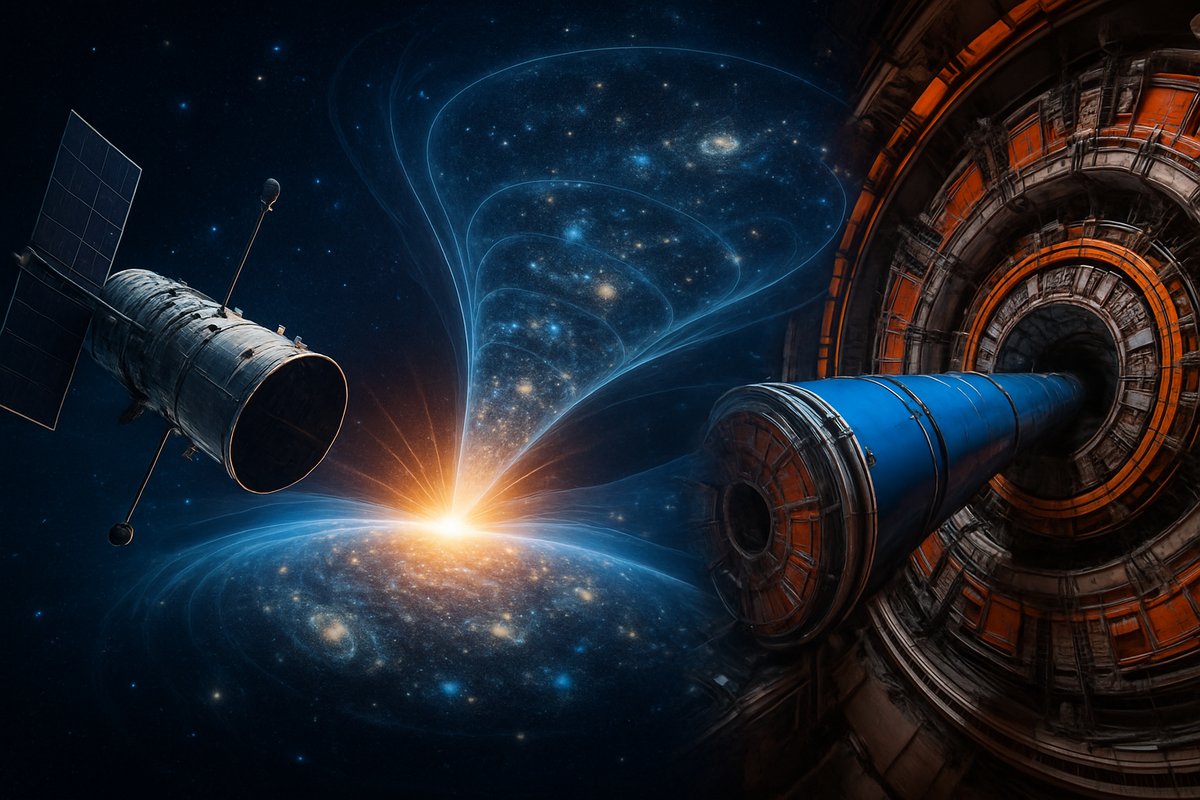
Humanity's quest to trace the universe back to its earliest flickers has revealed a saga of extreme forces, elusive particles, and deep paradoxes. As telescopes and colliders push boundaries, each discovery invites new questions about the very fabric of reality.
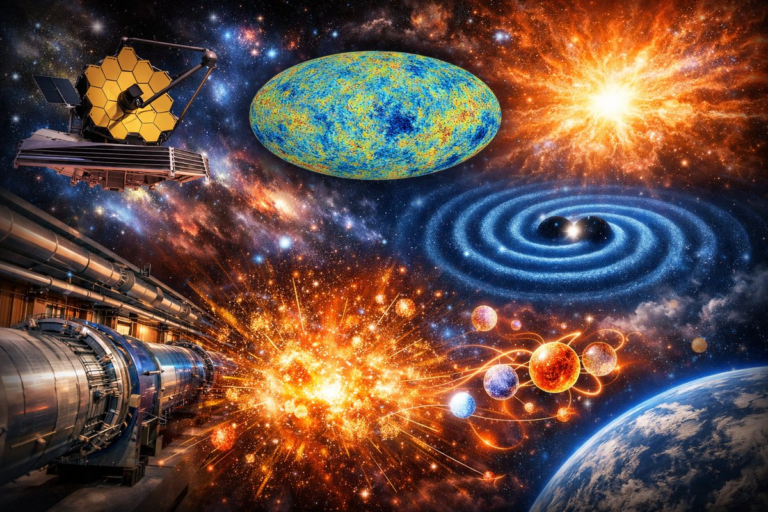
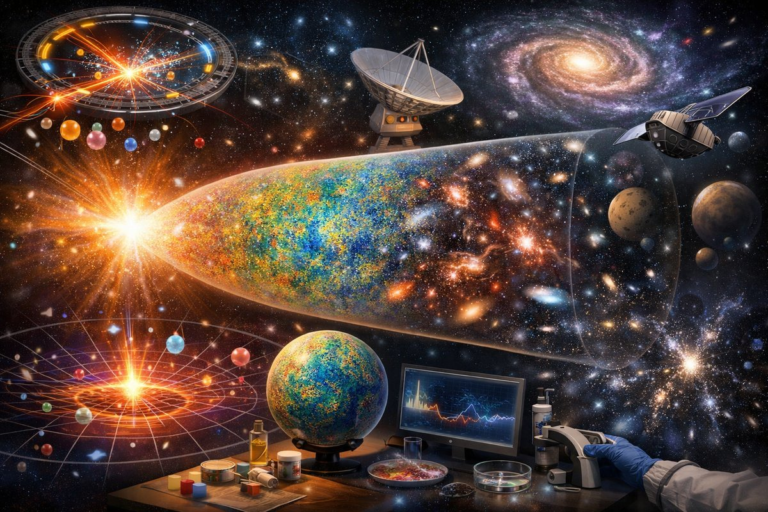
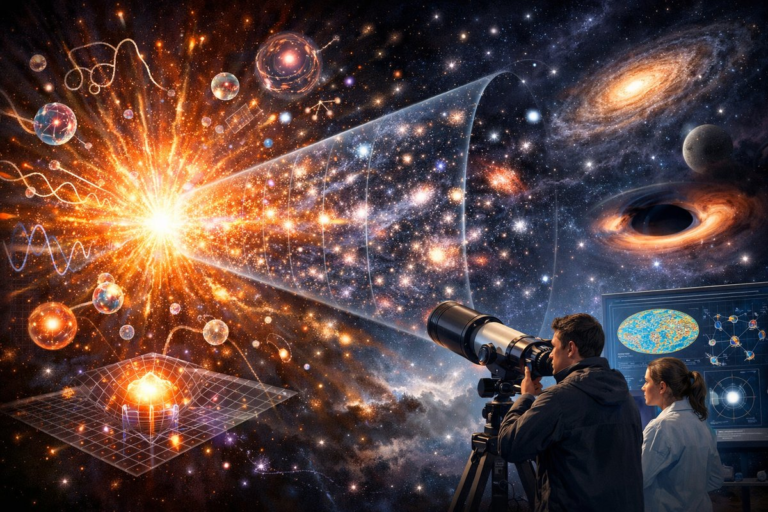
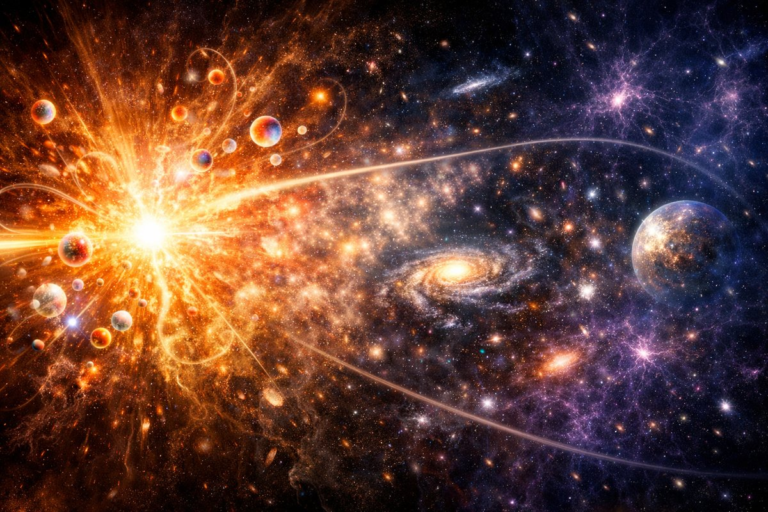
At the edge of human understanding, scientists assemble clues to reconstruct the universe’s opening act. The journey begins with an all-but-instantaneous expansion that stretched spacetime itself, and it unfolds through a series of phase changes that forged the particles and forces we observe today. Piecing together this cosmic origin story requires telescopes tuned to ancient photons, detectors sensitive to ghostly neutrinos, and particle colliders that recreate primordial conditions in miniature.
The notion of cosmic inflation transforms our picture of the universe’s birth. In the first heartbeat after whatever sparked creation, spacetime swelled faster than the speed of light, smoothing out irregularities and laying the groundwork for galactic clusters. This rapid ballooning also generated tiny quantum fluctuations-subtle ripples in energy that would later grow into stars, galaxies, and filaments of dark matter. Though inflation itself remains a theoretical framework, its predictions have passed critical tests, matching the texture seen in the cosmic microwave background.
In the furnace of the newborn cosmos, four fundamental forces once danced together in harmonious unity. As the universe cooled, symmetry broke and each force took on its own character. The strong nuclear force bound quarks into protons and neutrons, the electromagnetic force lit up charged particles, the weak force guided radioactive decays, and gravity began to sculpt the grand architecture of spacetime. Particle physicists today chase this early unification in high-energy accelerators, seeking signs of new carriers or hints that gravity itself might one day join the force roster.
Within the first microsecond, temperatures soared above trillions of degrees. Quarks and gluons formed a seething quark-gluon plasma, a liquid-like state where particles roamed freely. As the universe expanded and temperatures dropped below a critical threshold, quarks locked together into protons and neutrons. This epoch of hadron formation set the stage for the next act: the forging of atomic nuclei. Experiments at heavy-ion colliders recreate similar plasmas, giving researchers a window into these first moments and testing theories of strong interactions.
Moments later, in a process known as Big Bang nucleosynthesis, the first light nuclei emerged. Protons and neutrons combined to form deuterium, helium, and trace amounts of lithium. The predicted proportions align remarkably well with observations of primordial gas clouds, confirming that mere minutes after the opening expansion, the elements essential to life had begun to take shape. Yet lingering puzzles remain: the observed abundance of lithium falls short of theoretical predictions, hinting at unknown physics or astrophysical processes still to be unveiled.
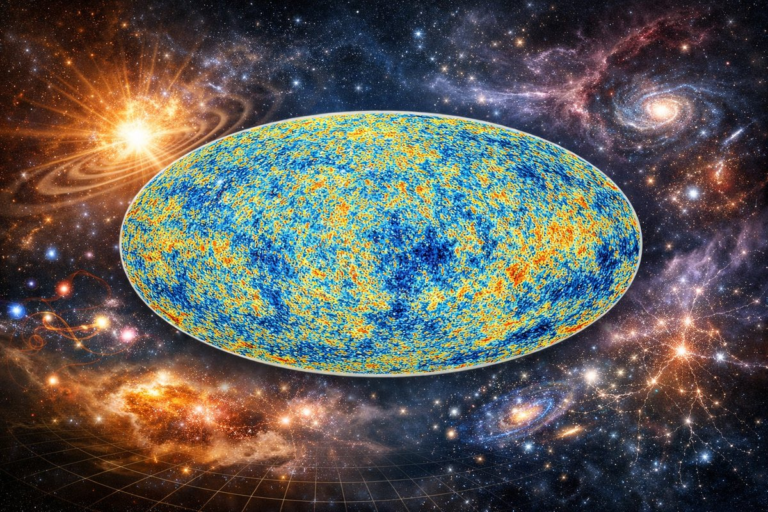
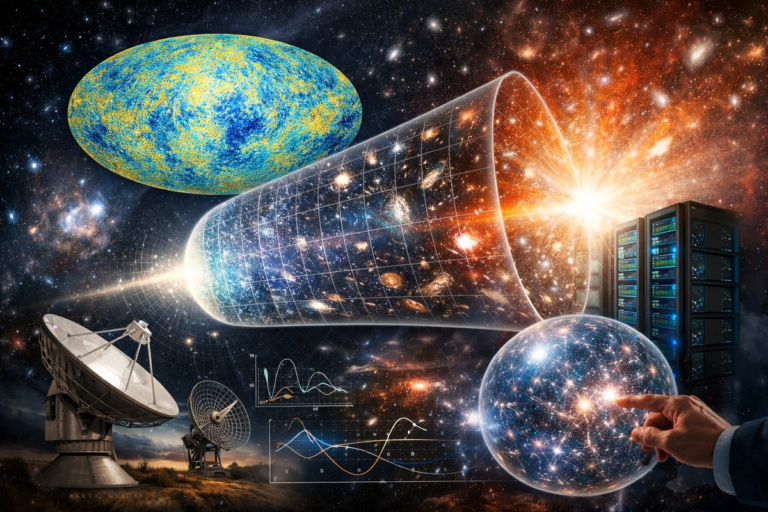
After about 380,000 years of searing brilliance, the universe cooled enough for electrons and nuclei to combine into neutral atoms. This recombination rendered space transparent to radiation, releasing a flood of photons that still permeates us today as the cosmic microwave background. Detailed measurements of its faint glow provide a snapshot of the infant universe, mapping temperature fluctuations with exquisite precision. They reveal a cosmos that is nearly flat, dominated by dark matter’s invisible scaffolding, and seeded by quantum seeds from inflation.
Dark matter, which outweighs ordinary atoms by a factor of five, remains stubbornly elusive. It neither emits nor absorbs light, yet its gravitational imprint shapes galaxies and sways cosmic expansion. Particle detectors buried deep underground and satellite observatories orbiting Earth hunt for rare interactions or annihilation signals. Meanwhile, astronomers track motions of stars and galaxies, using gravitational lensing as a cosmic magnifying glass. Solving the dark matter mystery could unlock insights into physics beyond the Standard Model and explain how structure first emerged from uniformity.
As cosmic expansion proceeds, a mysterious dark energy pushes galaxies apart with ever-increasing speed. Its discovery transformed cosmology, revealing that the universe’s fate is not governed solely by gravity. Instead, an unknown pressure bathes spacetime, altering the cosmic equation. The nature of this pervasive energy remains one of the deepest questions in science. Is it a simple cosmological constant, a vestige of vacuum energy, or the sign of dynamic fields that evolve over time? Upcoming surveys of supernovae and galaxy clustering aim to chart dark energy’s behavior with unmatched precision.
Quantum fluctuations that seeded all large-scale structure also give rise to tantalizing speculations. Could our observable region be just one patch in an eternally inflating multiverse? In such scenarios, different pocket universes might exhibit variations in physical laws or fundamental constants. While direct tests of these ideas prove difficult, researchers explore subtle signatures imprinted on cosmological data or search for gravitational wave echoes from neighboring bubbles. The multiverse remains speculative, yet it inspires new approaches to the origin problem and challenges our notion of reality.
Cosmology confronts paradoxes that strain imagination. The horizon problem asks why distant regions of space share almost identical temperatures despite never being in contact. Inflation offers a compelling solution, but its own mechanism and triggers remain debated. The flatness problem questions why the universe’s total energy density sits so near a critical threshold that separates eventual collapse from runaway expansion. Once again, inflation explains fine tuning, yet prompts questions about initial conditions of the inflating field itself.
As instruments advance, new windows on the infant universe continue to open. Gravitational wave observatories promise to detect ripples from the earliest phase transitions or cosmic strings laid down in symmetry breaking. Next-generation radio arrays aim to map neutral hydrogen back to the cosmic dawn, revealing the birth of the first stars and black holes. Underground neutrino detectors stand ready to capture the faint cosmic neutrino background, a promised relic carrying information from mere seconds after creation.
The voyage to the beginning is a blend of theoretical boldness and empirical rigor. Each discovery sparks fresh questions: What mechanism ended inflation? Why does matter dominate over antimatter? How did dark matter form its cosmic web? As physicists refine their models and engineers build ever more sensitive instruments, the story of origins unfolds in richer detail. With every photon collected and every simulation run, we peel back another layer of the universe’s opening chapter.
In this grand exploration, curiosity is both compass and engine. It drives us to peer into the cosmic past and to create bold theories that unite quantum mechanics with gravity. It inspires the next generation of thinkers to question the fabric of reality and to imagine new possibilities. The beginning of everything remains a captivating frontier, where paradox and pattern dance together, inviting us to journey ever deeper into the mystery of all that is.
Beyond equations and telescopes, the search for origins resonates on a human level. It reminds us that we are part of a vast story, connected by invisible threads to the first flicker of creation. The quest to understand where we came from can awaken awe, humility, and hope. In every dark sky and every careful measurement, we find a reflection of our desire to know and to belong. And so we continue, following the cosmic breadcrumbs that lead from the quantum realm to the star-filled heavens.
Fueling that journey requires tools, texts, and guides that connect curiosity with discovery. Whether gazing through a telescope or diving into complex data, each resource becomes a companion on our cosmic voyage. The universe’s first moments may seem remote, but in exploring them we uncover the roots of our own existence and the promise of what lies beyond the observable horizon.
Let this quest inspire you to look upward and inward, to study particles and photons, to embrace paradox and wonder in equal measure. The universe began with a whisper of energy, and in listening to that echo, we find the spark of human imagination shining ever brighter against the backdrop of the unknown.