Location
Mount Vernon, WA 98274
Location
Mount Vernon, WA 98274

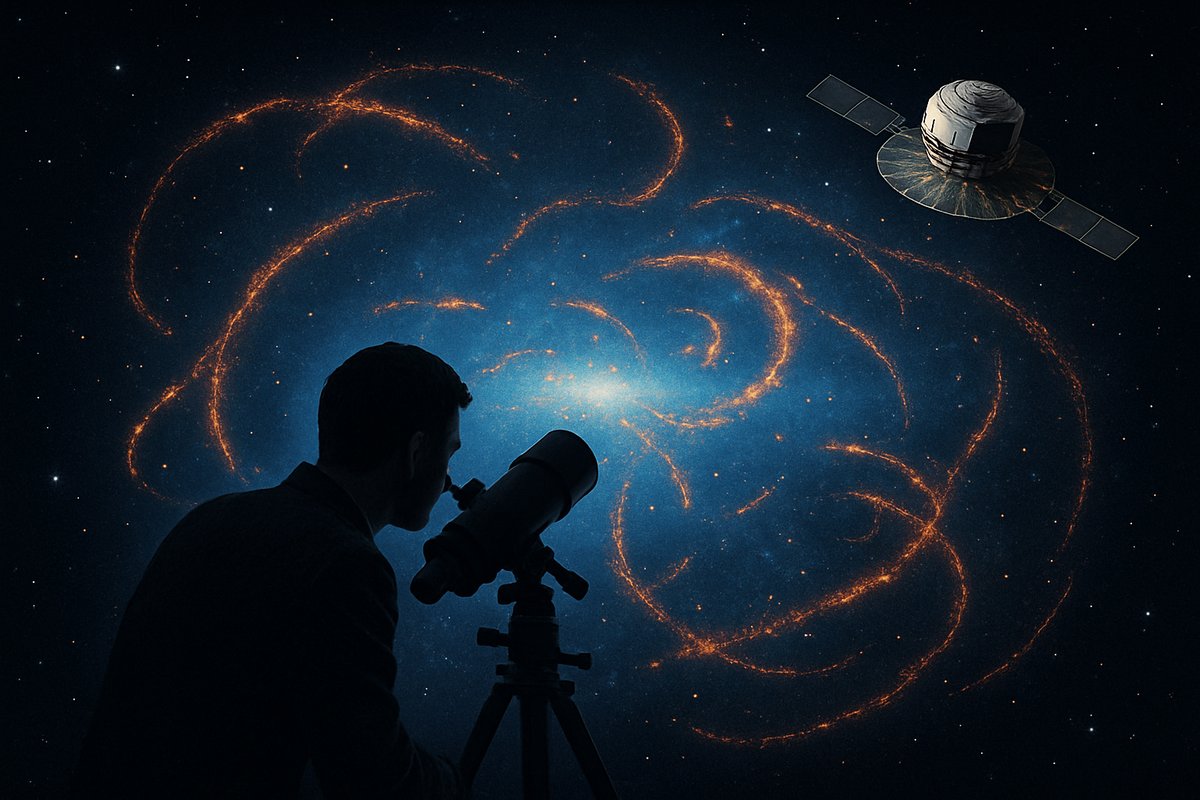
Astronomers have harnessed data from the European Space Agency's Gaia mission to map the elusive dark matter halo enveloping our galaxy. By tracing the arcs of ancient stellar streams, researchers are unveiling the shape and density of the invisible mass that governs the Milky Way's evolution.
The Milky Way is more than just a spiral tapestry of stars-it’s cocooned in a vast, invisible halo of dark matter. While this mysterious substance neither emits nor absorbs light, its gravitational pull shapes the motions of stars, gas clouds, and satellite galaxies. Now, an international collaboration of astrophysicists has exploited the exquisite precision of the Gaia spacecraft to trace the paths of stellar streams and derive the most detailed map yet of our galaxy’s dark matter halo.
Gaia, launched by the European Space Agency in 2013, has cataloged the positions, distances, and motions of more than 1.5 billion stars. Among those stars lie remnants of star clusters and dwarf galaxies torn apart by the Milky Way’s gravity-stellar streams that arc through the halo like cosmic ribbons. These streams act as natural probes, their graceful bends and twists encoding information about the underlying gravitational field.
In the recent study, researchers selected a dozen prominent streams stretching across tens of thousands of light-years. By combining Gaia’s high-precision astrometry with follow-up spectroscopy from ground-based observatories, the team measured each star’s velocity in three dimensions. They then ran computer simulations to test how different dark matter distributions would influence the streams’ orbits.
The result is a three-dimensional map revealing variations in dark matter density around the Milky Way. Contrary to earlier models that assumed a perfectly spherical halo, the new analysis indicates a mildly oblate shape-flattened along the galaxy’s rotation axis-with denser concentrations toward the galactic center and subtle asymmetries toward the outer regions.
“Stellar streams are by far our most powerful tools for dissecting the dark matter halo,” says Dr. Elena Moreno, lead author of the paper. “They retain the memory of the gravitational environment they’ve traversed, so by fitting their tracks, we can infer the underlying mass distribution with unprecedented detail.”
One stellar stream, dubbed “Phoenix,” extends more than 100,000 light-years across the sky. Its sinuous arc curves slightly inward on one side of the galaxy and bends outward on the other-a deviation that matches predictions for an oblate dark matter halo. Another stream, originating from a disrupted globular cluster, shows hints of clumpy disturbances. These small wiggles could signal encounters with dark matter subhalos-dense, compact clumps predicted by cosmological simulations but never directly observed.
Unraveling the dark matter halo is more than an exercise in galactic cartography. The shape and granularity of the halo carry critical clues about the fundamental nature of dark matter. If dark matter particles rarely interact beyond gravity, they should form a smooth halo peppered with countless small subhalos. If they self-interact or have other properties, the halo’s shape and substructure could look very different.
“By mapping stream perturbations, we’re essentially performing dark matter forensics,” explains Dr. Suresh Patel, a co-author specializing in computational cosmology. “If we detect fewer substructure-induced gaps than expected, it could point to self-interacting dark matter or alternative theories. So far, our measurements are broadly consistent with the cold, collisionless paradigm, but the uncertainties are still large.”
The research team used machine-learning algorithms to accelerate the modeling process. Simulating tens of thousands of possible gravitational potentials and computing stellar orbits for each stream would traditionally take months of supercomputer time. Instead, the team trained neural networks on a subset of simulations, allowing them to predict stream trajectories in milliseconds. This innovation enabled a thorough exploration of parameter space and tighter constraints on halo shape.
Beyond dark matter physics, the new map offers insights into the Milky Way’s formation history. The oblate shape suggests that the galaxy has undergone significant mergers and accretion events, redistributing mass over billions of years. A more spherical halo would indicate a relatively quiet past; an elongated halo aligned with the disk hints at collisions with other galaxies.
“Combining stream data with star-formation histories and chemical composition of stream stars, we can reconstruct a timeline of past mergers,” says Dr. Moreno. “Each stream carries a unique signature of its progenitor system. As we add more streams to our analysis, we’ll piece together the Milky Way’s family tree in exquisite detail.”
Future data releases from Gaia promise even greater precision and the discovery of fainter, more distant streams. Meanwhile, next-generation spectrographs on large telescopes will measure stellar velocities with sub-kilometer-per-second accuracy. Together, these advances will refine the dark matter map, probe smaller subhalos, and test exotic dark matter models.
There are also plans to apply this method beyond our galaxy. The Vera C. Rubin Observatory, slated to begin surveys in the coming years, will uncover streams around nearby galaxies in the Local Group. Extending gravitational maps to Andromeda and its satellites could reveal whether dark matter halos share common shapes or exhibit diversity tied to different assembly histories.
Despite the impressive progress, challenges remain. Interactions between streams and ordinary matter-such as giant molecular clouds or the galactic bar-can mimic dark matter-induced perturbations. Disentangling these effects requires careful modeling of the visible mass distribution and galactic dynamics.
Moreover, some streams are so diffuse that individual stars are hard to distinguish from the stellar background. Improving statistical techniques and combining multi-wavelength observations will be crucial to tease out these tenuous structures.
Nevertheless, the current breakthrough demonstrates the power of turning ancient stellar remnants into precision probes. In the coming decade, astronomers plan to weave stream data together with gravitational-lens observations, cosmic microwave background measurements, and laboratory experiments to build a cohesive picture of dark matter.
At its core, this research illuminates a profound truth: our galaxy’s visible stars are but the tip of the cosmic iceberg. Underneath lies a vast ocean of dark matter, sculpting galaxies and cosmic filaments across the universe. By following the delicate arcs of stellar streams, scientists are charting this hidden realm-one graceful ribbon at a time.
Through ingenuity, international collaboration, and cutting-edge technology, the Milky Way’s dark matter halo is finally coming into focus. As each new stream is mapped, the map grows more intricate, offering the promise of unlocking the greatest mystery in modern astrophysics: what is dark matter? And in solving that puzzle, we may discover new layers of reality that reshape our understanding of the cosmos.