Location
Mount Vernon, WA 98274
Location
Mount Vernon, WA 98274

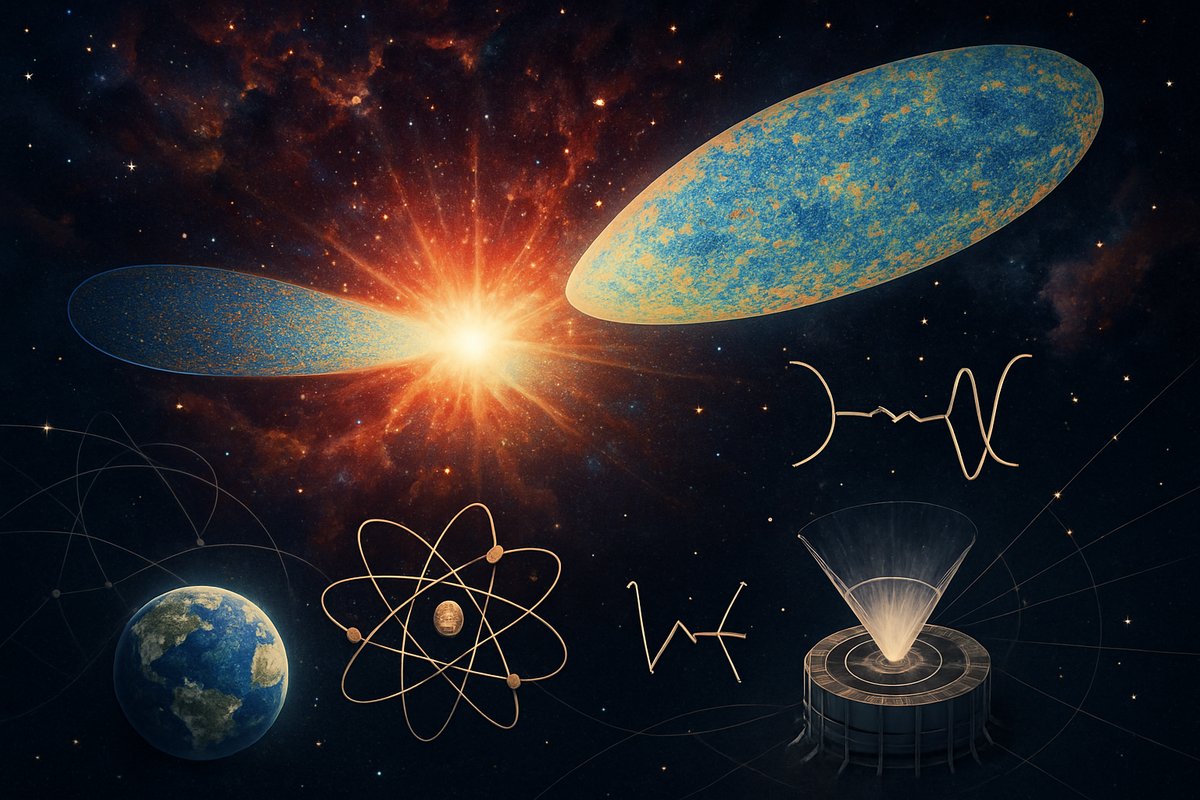
A voyage through the earliest instants of existence, exploring how quantum fluctuations, primordial forces, and baffling paradoxes forged the cosmos we inhabit today. Discover the experiments, observations, and theories driving our quest to glimpse the universe's hidden origins.
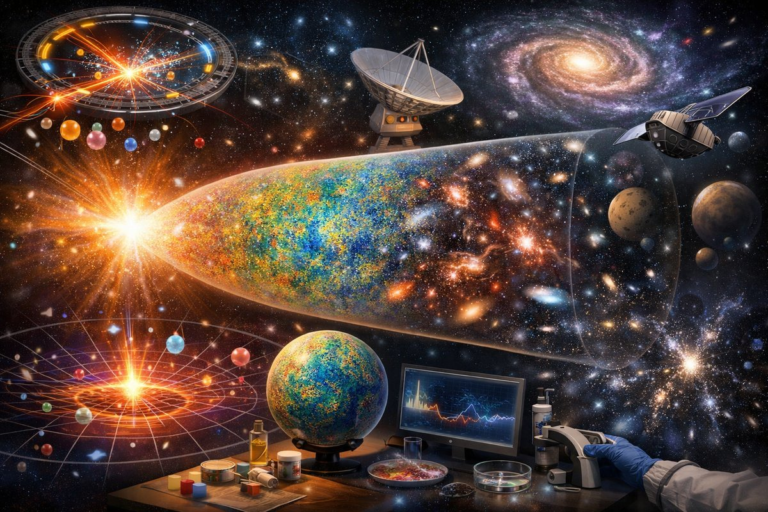
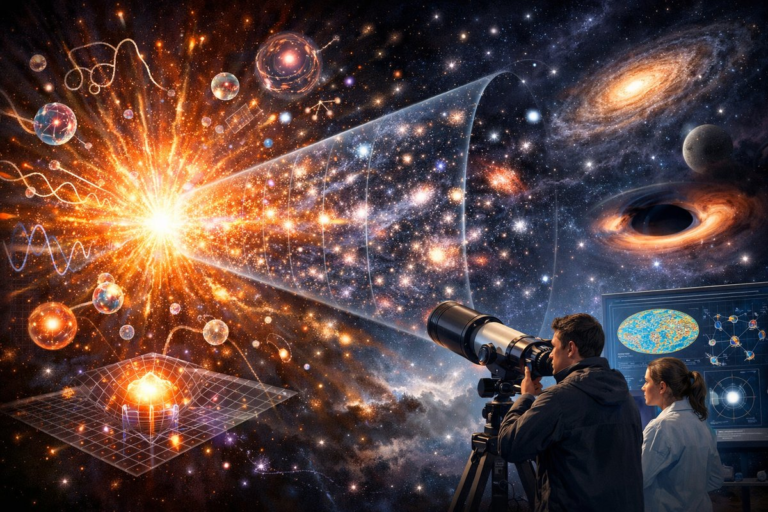
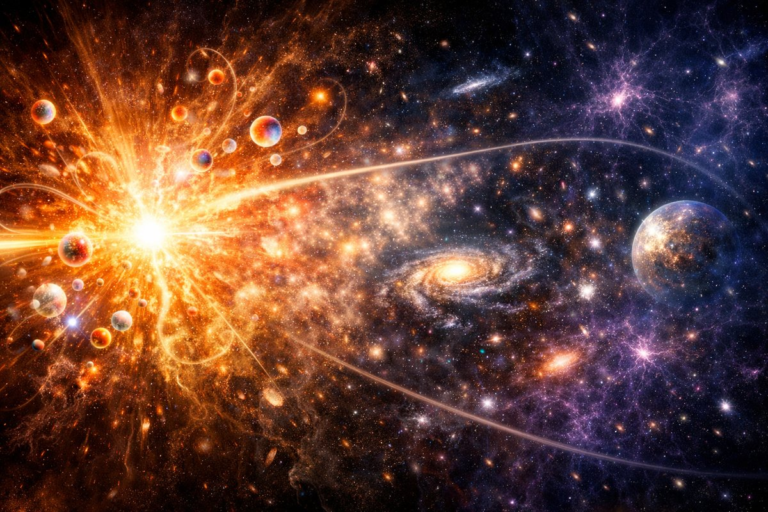
From the tiniest flicker of quantum uncertainty emerged the vast expanse of stars, galaxies, and cosmic voids we call home. At the very beginning, the universe was an incredibly dense, seething soup of particles and energy. Physics tells a tale of dramatic transformations: a blisteringly fast expansion known as inflation, the separation of fundamental forces, and the birth of matter itself. Yet as we peer further back in time, paradoxes arise. How did space become so uniform? Why is there far more matter than antimatter? Today’s telescopes, detectors, and theoretical breakthroughs are our time machines, carrying us closer to the hidden threshold when everything we know came into being.
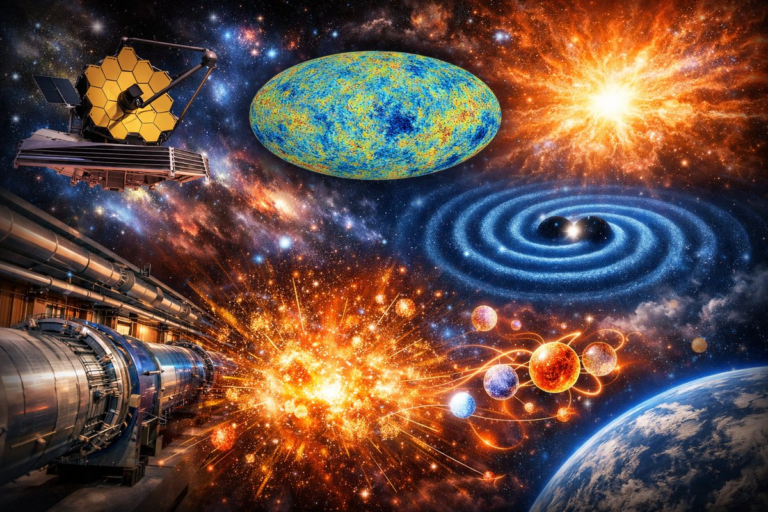
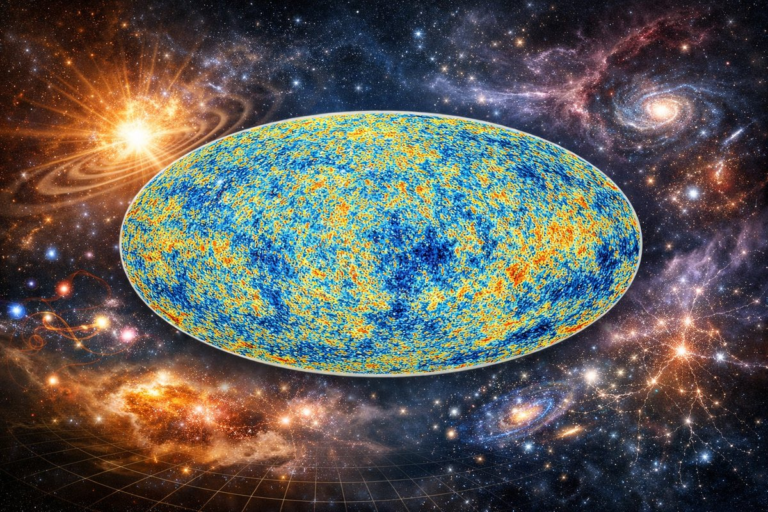
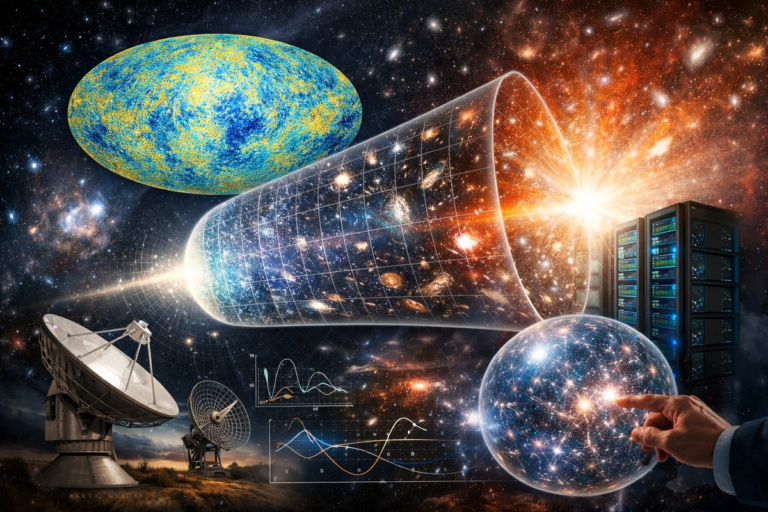
During the inflationary epoch, a fraction of a second after the cosmic beginning, space itself stretched faster than the speed of light. Tiny quantum jitters in that primordial fabric were blown up to macroscopic scales, seeding the uneven distribution of matter. These initial irregularities later blossomed into vast cosmic webs of galaxies and clusters. Measurements of the cosmic microwave background-the faint afterglow of the hot early universe-provide a snapshot of those fluctuations. Minute temperature variations, measured down to millionths of a degree, map the blueprint from which billions of galaxies eventually coalesced.
As inflation ended, the universe cooled enough for the four fundamental forces-gravity, electromagnetism, and the strong and weak nuclear forces-to reveal their distinct identities. This separation shaped the interactions that govern everything from the fusion of atomic nuclei in stars to the chemical bonds in living cells. High-energy particle accelerators on Earth mimic these primal conditions on a microscopic scale, probing how quarks and gluons bind inside protons and neutrons. Yet even the most powerful colliders cannot fully recreate the seething density that prevailed in the first microseconds of cosmic history.
One of the deepest mysteries lies in the imbalance between matter and antimatter. According to symmetrical laws of physics, every particle should have had an antiparticle twin, and they should have annihilated each other completely. Yet a tiny surplus of matter survived, seeding the formation of stars, planets, and ultimately life. Theoretical frameworks such as leptogenesis and baryogenesis propose mechanisms for this asymmetry, invoking subtle violations of symmetry in high-energy interactions. Experimental efforts at underground laboratories and neutrino detectors aim to capture hints of these rare processes, but the full picture remains elusive.
Dark matter and dark energy play starring roles in the cosmic saga, yet both remain stubbornly invisible. Dark matter provides the gravitational scaffolding necessary for galaxies to form, while dark energy drives the accelerated expansion of space today. Observations of galaxy rotation curves, gravitational lensing, and the large-scale clustering of galaxies offer clues to the nature of dark matter particles, which may be lightweight yet plentiful, or heavy and exotic. Meanwhile, surveys mapping distant supernovae and the cosmic microwave background trace dark energy’s influence through cosmic time, challenging physicists to reconcile its repulsive effect with quantum field theories.
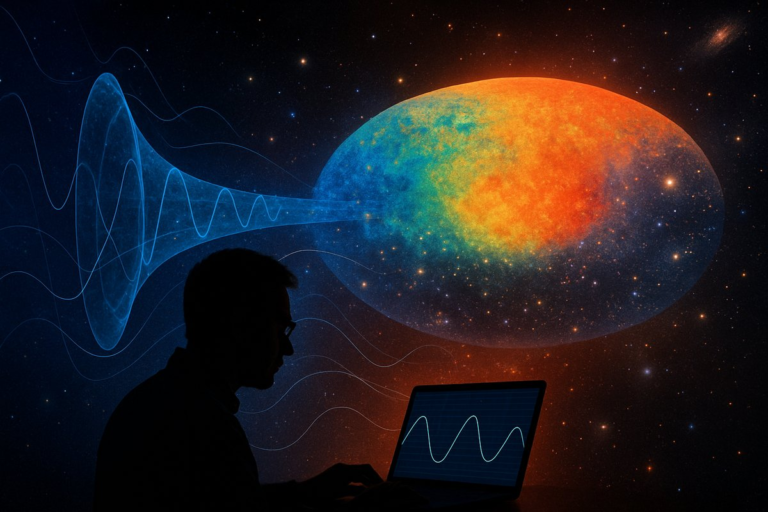
Our quest to witness the universe’s infancy relies on a growing fleet of instruments tuned to different “cosmic messengers.” Radio telescopes detect the faint hydrogen signals emitted in the dark ages before the first stars ignited. X-ray observatories reveal the hot gas in early galaxy clusters. Gravitational-wave detectors have opened a new window into the collisions of black holes and neutron stars, and future observatories may even capture gravitational murmurs from inflation itself. High-energy neutrino experiments buried deep underground or beneath ice sheets offer a unique glimpse at particles that have passed unimpeded through matter since the cosmic dawn.
The recent deployment of space-based observatories has revolutionized our view of the early universe. Sensitive infrared telescopes can peer through cosmic dust to spot the dim glow of the very first galaxies, billions of light-years away. Meanwhile, high-altitude balloon experiments carry microwave sensors above Earth’s atmosphere to refine measurements of the cosmic microwave background. On the ground, massive interferometers spanning continents collaborate to detect ripples in spacetime. Each new dataset refines our theoretical models, pushing the limits of particle physics, gravitational theory, and cosmology.
Yet beyond data and equations lies a world of profound questions. Could our universe be one bubble in a vast multiverse, each with its own physical laws? Does a cosmic singularity truly mark the beginning, or is there a cyclical process of births and deaths of universes? Some theories suggest space and time themselves emerge from entangled quantum bits. Others propose that our familiar spacetime is a holographic projection of deeper, higher-dimensional structures. These speculations, while untested, ignite the imagination and may one day inspire new experiments or reveal unexpected connections between gravity and quantum mechanics.
The implications of this cosmic origin story extend far beyond academic curiosity. Insights into early-universe physics drive advances in computing, imaging, and materials science. Techniques developed for detecting faint cosmic signals find applications in medical imaging and geological surveys. The pursuit of fundamental understanding fosters international collaborations and inspires generations to engage with science, technology, engineering, and mathematics. At the same time, the sheer scope of the cosmos reminds us of our fragile outpost on a small planet-and the urgency of stewarding that world for future explorers.
While each discovery peels back a layer of mystery, the earliest moments of existence remain the ultimate frontier. Upcoming missions aim to chart the cosmos with even greater precision: next-generation gravitational-wave observatories poised to detect the gentle hum of inflation, dark matter detectors cooled to near absolute zero in an effort to capture rare particle interactions, and artificial intelligence algorithms sifting through petabytes of astronomical data for unexpected patterns. Every advance brings us closer to answering age-old questions about the nature of reality and our place within it.
In the end, the story of cosmic origins is a story of human curiosity and ingenuity. From humble nights gazing at the stars to sophisticated arrays of detectors probing every corner of the electromagnetic spectrum, our journey is guided by wonder. We stand at the threshold of new discoveries that may rewrite our understanding of space, time, and the forces that sculpt the cosmos. As we assemble the pieces of this grand puzzle, each breakthrough carries a reminder: the universe’s first moments shaped everything we know-and everything we’ve yet to imagine.