Location
Mount Vernon, WA 98274
Location
Mount Vernon, WA 98274

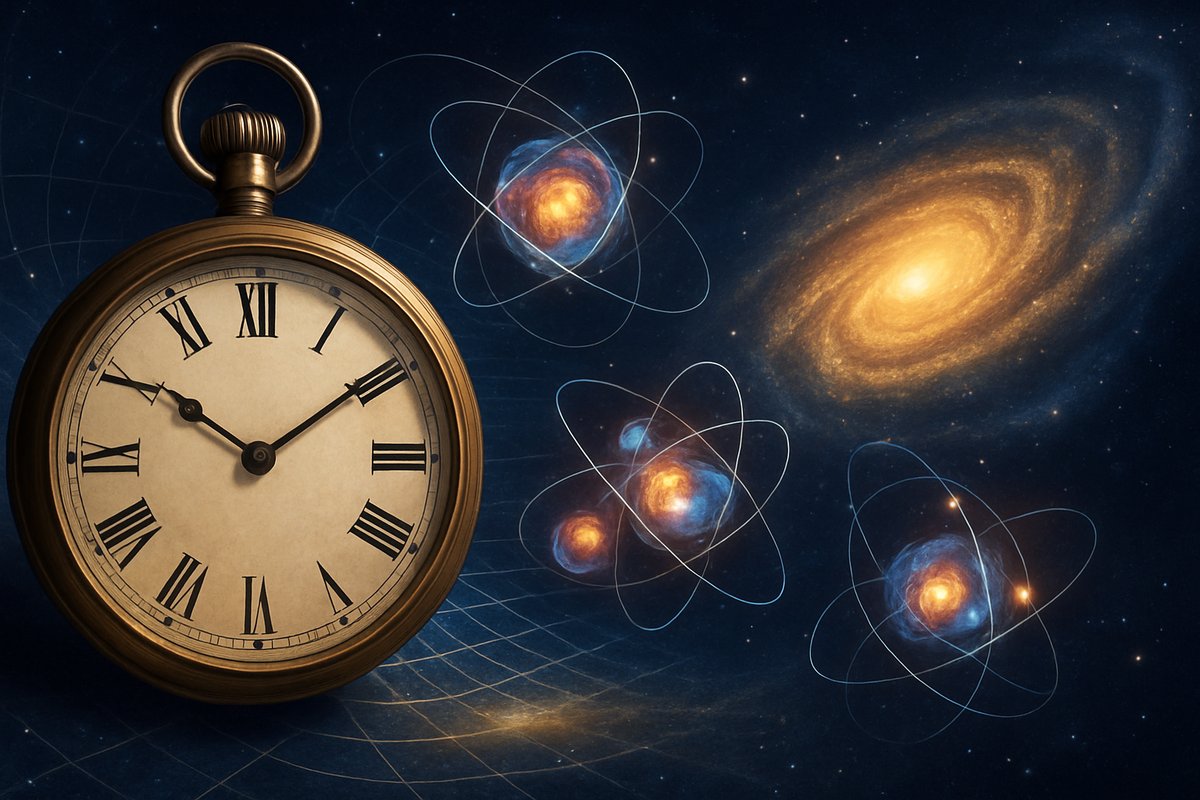
From the flicker of subatomic particles to the grand sweep of cosmic evolution, the interplay of time, matter, and entropy crafts the tapestry of existence. This exploration delves into the latest breakthroughs in cosmology and quantum physics, revealing how they reshape our understanding of reality and resonate within our daily lives.
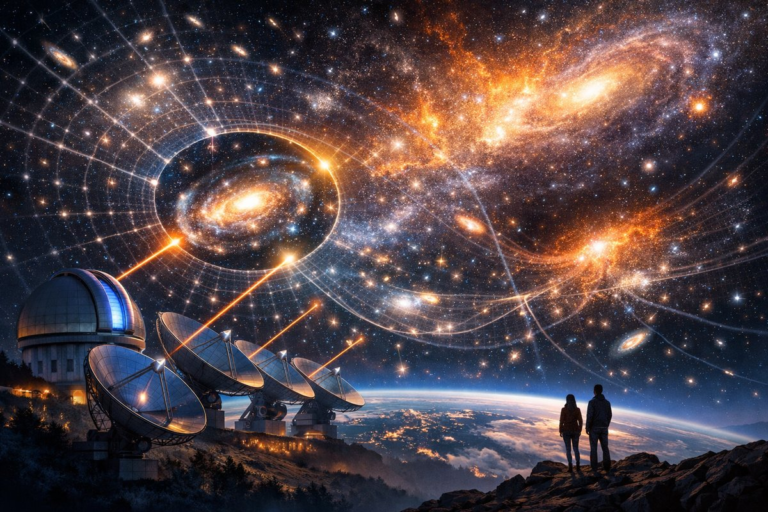
In a remote observatory nestled on a mountain ridge, powerful telescopes now peer deeper into the cosmos than ever before. They capture ancient galaxies whose faint light has traveled billions of years to reach us. Those photons, dispatched when the universe was a fraction of its current age, whisper stories about the nature of time and the matter that fills space. Within those cosmic beacons, astronomers have detected hints of unexpected chemical signatures-clues that challenge our models of how the first stars forged the elements that seed planets and, ultimately, life.
Meanwhile, in subterranean labs shielded by rock and steel, physicists collide particles at near-light speeds. Detectors record flurries of exotic debris: fleeting mesons, quarks bound inside protons, and particles that appear to wink in and out of existence. Each collision brings new data on how matter behaves under extreme conditions and offers glimpses of phenomena that defy our classical intuitions. One recent experiment measured the rate at which virtual particles flicker into being when an intense magnetic field is applied. That flicker, intimately linked to the fabric of spacetime itself, suggests a subtle connection between quantum fields and the relentless march of entropy.
Entropy, the measure of disorder and energy dispersion, is at the heart of the arrow of time. In everyday life we see ice melting, bread staling, and glasses shattering-processes that run in one obvious direction. Yet in the microcosm of quantum rules, time-symmetric equations apply. So why don’t we observe phenomena running in reverse? Recent theoretical work explores how the universe’s initial conditions-its extraordinarily low entropy at the Big Bang-set a directionality that persists across cosmic epochs. When matter clumped under gravity to form stars and galaxies, the local decrease in entropy was bought with a far greater increase in entropy in the surrounding environment, preserving the second law of thermodynamics and cementing time’s arrow.
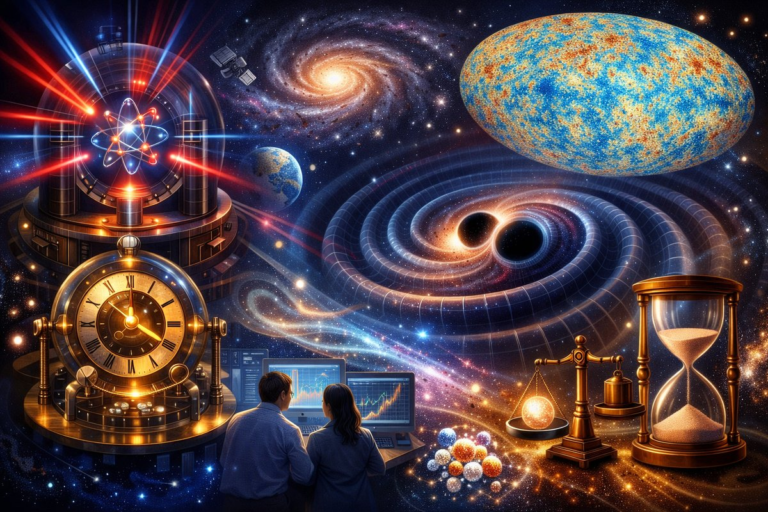
On the threshold between the very large and the very small lies the event horizon of black holes. Here, gravity warps spacetime so severely that even light cannot escape. Over the past year, astronomers have analyzed gravitational waves from dozens of black hole mergers. Each signal encodes information about the masses, spins, and orbital dance of colliding objects. But hidden within those waveforms are subtle imprints of quantum effects at the horizon scale-signatures that may one day resolve the infamous information paradox, a puzzle about whether information falling into a black hole is truly lost or somehow preserved.
Deep beneath the ice of a polar glacier, sensors listen not for visible light but for neutrinos-elusive particles produced in the hearts of exploding stars. Neutrinos rarely interact with matter, making them ideal messengers of events otherwise obscured by gas and dust. A recent burst of neutrino detections coincided with a distant supernova, offering a new way to triangulate cosmic distances and test whether the speed of neutrinos exactly matches that of light. This kind of precision measurement could reveal whether tiny violations of relativity occur at extreme energies, a hint that new physics awaits beyond the Standard Model.
On our own blue planet, matter cycles through living systems in patterns shaped by physics and chemistry. Photosynthesis harnesses photons from our star to split water molecules and build sugar, stashing energy in chemical bonds that power ecosystems. Entropy flows as heat and chemical gradients dissipate, yet life exploits this flow to maintain and reproduce intricate structures. In recent field studies, ecologists have mapped how microbial communities in soil adjust their metabolisms to seasonal shifts in temperature and moisture. Their findings highlight how the interplay of time and local chemistry shapes biodiversity from the smallest scale to entire biomes.
Time and matter collide even in the digital devices we carry. Modern computing relies on the controlled movement of electrons through silicon, a choreography bound by quantum tunneling and thermal noise. As chipmakers push transistors to ever-smaller dimensions, random fluctuations become a limiting factor. Researchers now explore novel materials and three-dimensional architectures that channel electrons along precisely defined paths, reducing unwanted disorder. These efforts connect directly to our concepts of entropy: the challenge is to design circuits that minimize energy dissipation while still performing billions of operations per second.
The human experience of time remains deeply subjective. Mindfulness practices train us to slow our perception of passing moments, while adrenaline surges can make seconds feel like hours. Neuroscientists have begun to identify molecular clocks in the brain that regulate attention and memory. One recent study used functional imaging to show how networks of neurons synchronize their firing patterns in response to rhythmic stimuli, such as music. Those patterns create temporal frameworks within which the brain stitches sensory inputs into coherent experiences.
Philosophers and artists have long drawn on scientific insights to probe the meaning of existence. Poets invoke entropy as a metaphor for loss and impermanence, while novelists imagine futures where humanity harnesses dark energy or voyages through wormholes. On a gallery wall, an interactive installation might translate the cosmic microwave background into shifting light and sound, inviting viewers to inhabit a universe four hundred thousand years after its birth. Such works remind us that the scientific quest is inseparable from our desire to find narrative coherence in a world ruled by chance and necessity.
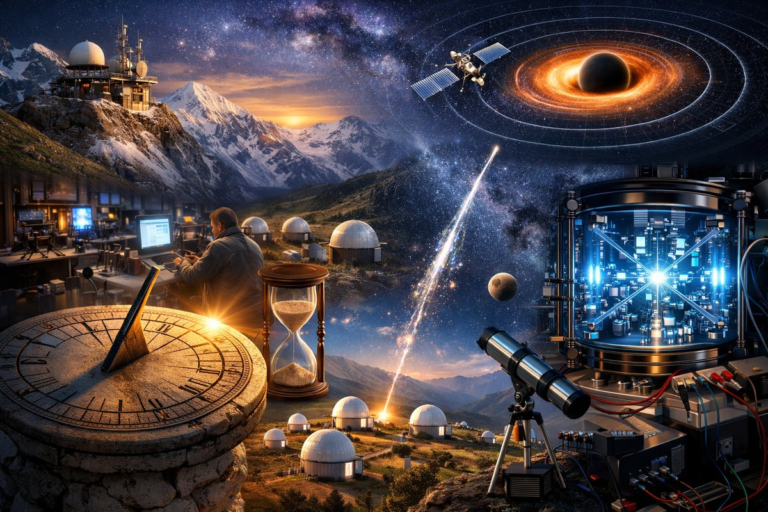
Advances in instrumentation continue to open new windows. A next-generation neutrino observatory will use tens of kilometers of undersea cables to detect faint flashes of light in the deep ocean. Space-based interferometers are being planned to capture low-frequency gravitational waves from supermassive black hole mergers. And particle accelerators with innovative superconducting magnets will soon probe energies well beyond current colliders. Each of these projects embodies a delicate balance between matter, energy, and the irreversible flow of time.
At the frontier of theory, some researchers explore the possibility that time itself is emergent, arising from more fundamental, timeless building blocks. In these models, entanglement patterns between quantum bits give rise to notions of distance and duration. If confirmed, such ideas could revolutionize our understanding of both spacetime and information. They might even suggest practical applications in quantum computing, where controlling entanglement and thermalization is key to building robust processors.
As our tools grow ever more precise, questions multiply. What is the nature of dark matter, the invisible mass that shapes galaxy formation? How did antimatter vanish shortly after the Big Bang, leaving the matter-dominated universe we inhabit? Could a unified theory tie together the standard forces with gravity in a single framework? Each answer will reshape not only physics but also our cultural narratives: how we imagine the past, conceive of the future, and situate ourselves in the cosmic drama.
In living rooms around the world, stargazers tilt their telescopes skyward, tracing constellations that have guided humanity for millennia. They measure the brightness of distant stars, tracking subtle variations that might hint at orbiting planets or stellar oscillations. Citizen science projects now empower enthusiasts to analyze streams of astronomical data, from exoplanet transits to fast radio bursts. Their efforts bridge the gap between professional research and popular curiosity, reminding us that science is a communal adventure.
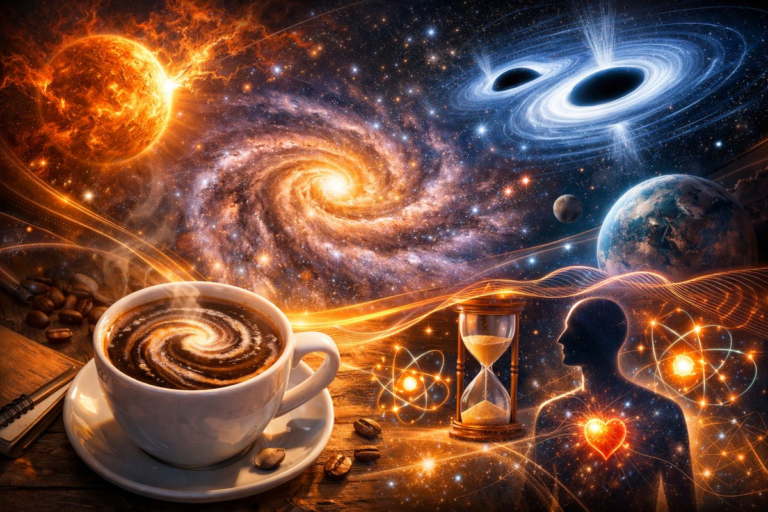
Every moment we exist at the intersection of time, matter, and mystery. The heat dissipating from a coffee mug, the cosmic rays showering our atmosphere, the synapses firing in our brains-all reflect the universal dance of energy and entropy. As telescopes and detectors continue to unveil new layers of reality, we find fresh reasons to marvel at this unfolding story. Our quest to decode the threads that bind time to matter is more than an academic pursuit-it is a human endeavor to understand who we are and where we come from.