Location
Mount Vernon, WA 98274
Location
Mount Vernon, WA 98274

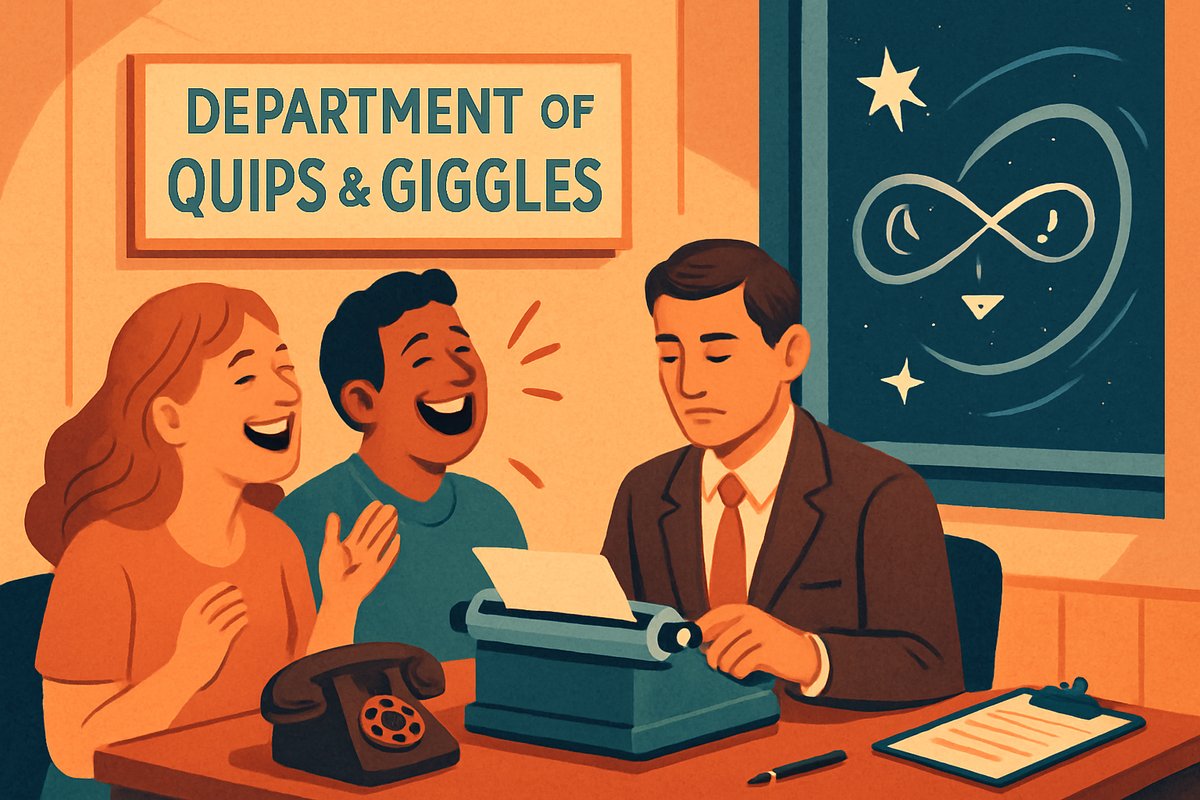
In a delightfully absurd directive, Ridgely Springs has launched a new municipal department requiring citizens to register every quip and giggle in advance. What began as an attempt to streamline local entertainment has spiraled into cosmic unintended consequences, complete with time-looping punchlines and impromptu laughter audits.
In an unprecedented move that has left both residents and passersby scratching their heads, the town of Ridgely Springs has inaugurated its Giggle Compliance Office (GCO). Under the new ordinance, every citizen-regardless of age, occupation, or propensity for dry wit-must submit a detailed transcript of any planned joke, pun, or chortle at least 48 hours before delivery. Late submissions incur a “punctuality penalty,” while completely unregistered laughter may prompt a surprise “giggle audit.”
The municipal council, led by Mayor Celeste Wainwright, insists the program is designed to “elevate communal mirth” and “prevent rogue humor outbreaks.” According to official memos, the GCO will use predictive algorithms to cue neighborhood-wide laughter intervals, ensuring synchronized chuckling that maximizes social cohesion. The initiative’s backers argue that choreographed levity reduces disruptive side effects such as snorting, inadvertent spit take, and excessive tears of mirth.
“We found that spontaneous laughter often leads to uneven distributions of joy,” explained Arlo Pender, recently appointed Director of Giggle Compliance. In a press briefing held in the newly minted ‘Laughscape Suite,’ Pender outlined the five-tier system for joke classification. Tier A covers one-liners and puns; Tier B includes short anecdotes; Tier C is reserved for observational stand-up bits; Tier D handles experimental improvisation; and Tier E-known colloquially as the ‘Cosmic Absurdity Tier’-encompasses surreal or time-bending humor.
Initial reactions from locals were a blend of confusion and reluctant cooperation. High school student Maya Ortiz spent her Sunday evening drafting a 12-point outline of her peppered-salt pun set before the junior prom. “I never thought I’d have to get a permit just to roast my best friend,” she sighed, clutching her officially stamped paperwork. Meanwhile, retirees have taken to forming “giggle cooperatives,” pooling their joke quotas for weekend comedy marathons in the town square.
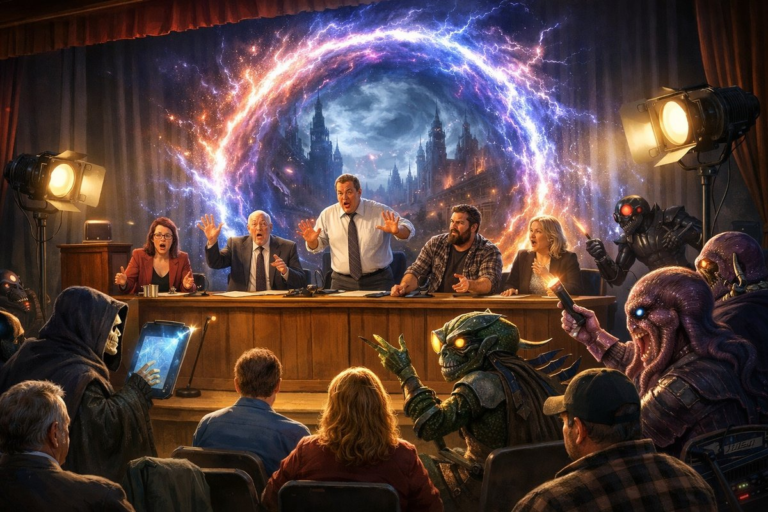
Not everyone is on board. A coalition of free-laugh advocates held a candlelit vigil outside the GCO, chanting slogans like “Unshackle the Chuckle” and “Down with the Preregistration Regime.” Their leader, self-styled humor anarchist Rocco “Sponty” DeLuca, staged an impromptu stand-up routine that quickly devolved into chaos when three participants attempted to shout punchlines without prior approval. The resulting laughter cascade triggered a neighborhood-wide sound alert, and the coalition was issued a collective citation for a “public mirth disturbance.”
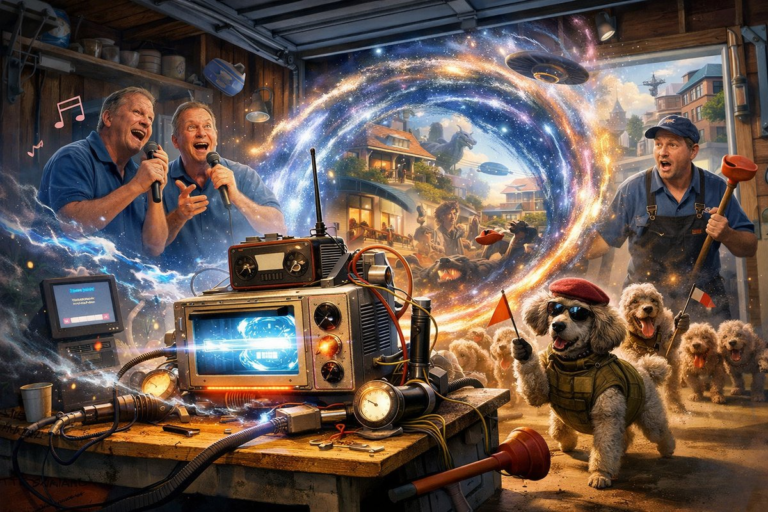
If bureaucratic oversight weren’t enough, the Giggle Compliance Office has already experienced its own cosmic hiccup. During a routine system upgrade, an experimental subroutine in the scheduling software accidentally looped the same dad joke every thirty seconds. “I haven’t slept in two nights,” confessed department intern Nadine Soto. “Every time I close my eyes, I hear, ‘Why don’t skeletons fight each other? They don’t have the guts.’ It’s like living inside a recycled greeting card.”
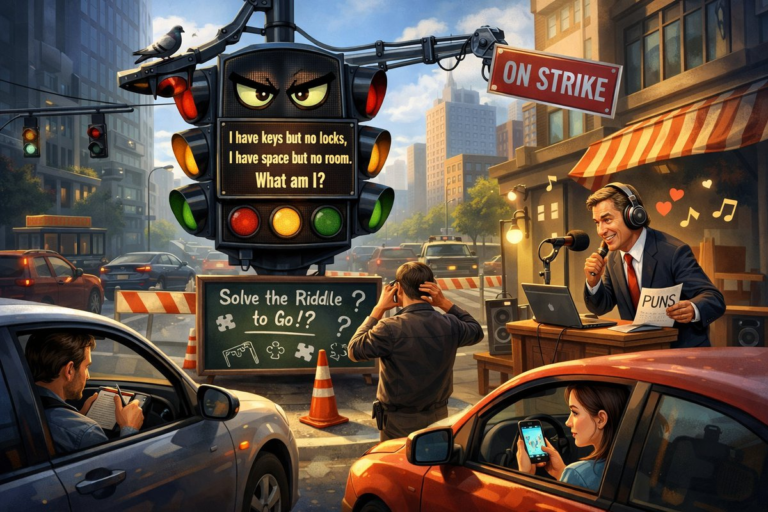
Inside the GCO’s starkly cheerful corridors, employees now rotate in shifts to monitor the Joke Log Matrix-a massive display tracking submissions in real time. “It’s like air traffic control for gut-busters,” said compliance officer Theo Nakamura. Clad in safety vests emblazoned with a winking emoji, staffers flag any joke that might trigger awkward silences or physical discomfort. The worst offenders are supposedly sent to a “rehabilitation workshop” where they learn to gauge audience receptivity through interpretive dance exercises.
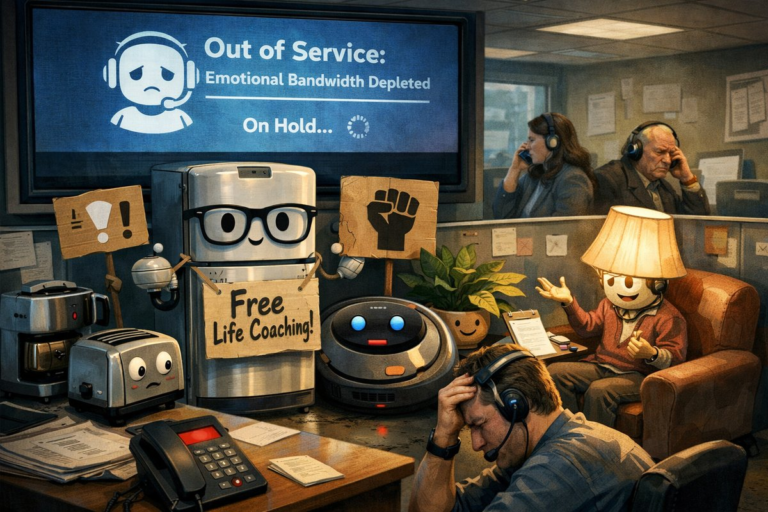
But the system’s most alarming glitch involves temporal misfires. Dozens of residents have reported spontaneous déjà vu events and disconcerting time loops, all tied to improperly scheduled humor. One local baker claims she’s been trapped for hours repeating her punchline about a baguette that goes to therapy. “I tell it once, then somehow I’m telling it again,” she said, exasperated. “By the tenth repeat, the joke isn’t even funny anymore-it’s existential.”
Despite these oddities, some Ridgely Springs citizens have discovered unexpected upsides. Early-morning joke sessions are now a town ritual, with families gathering on porches to share preapproved witticisms over coffee and toast. The synchronized laughter reportedly mends fences between neighbors, and an official “Happy Decibel Map” displays which blocks have achieved optimum giggle density.
Local comedian Jamal Rivers views the phenomenon as both opportunity and art installation. “I’ve never had so many ears waiting for my set,” he quipped. Rivers sold out his first GCO-approved show within minutes of the announcement, marketing it as “the only legal comedy in town.” His performance-which featured a mix of observational humor and calculated absurdism-earned rave reviews, though several audience members admitted they were still adjusting to the predicable comedic cadence.
Meanwhile, humor researchers have descended on Ridgely Springs to study the effects of regulated laughter. Dr. Lena Sprott, a behavioral psychologist, notes that the GCO experiment offers a live lab to examine cultural norms around levity. “When you schedule a laugh like an appointment, it changes our relationship with humor,” she told local reporters. “We’re witnessing a shift from spontaneous connection to communal coordination-a fascinating social evolution.”
Word of the program has spread far beyond town limits, prompting inquiries from several municipalities and even a small consortium of tech startups eager to license the GCO’s scheduling algorithm. A finance committee from New Prosperity Heights has already dispatched representatives to negotiate a partnership, hoping to embed synchronized giggling into their public transit announcements and elevator chimes.
Not everyone is convinced sustainability is guaranteed. Poetry enthusiast Harper Keen penned a scathing critique in the Ridgely Weekly Chronicle, lamenting that preplanned laughter lacks the authenticity of a genuine snort at the dinner table. Keen argues that humor thrives on surprise and emotional resonance, elements stifled when every joke demands official clearance. “When did we start outsourcing our own delight?” the poem reads. “Are we citizens or spectators to our own amusement?”
As Ridgely Springs navigates these growing pains, one thing remains clear: the Giggle Compliance Office has forever altered the town’s comedic landscape. Whether the program evolves into a model for civic cohesion or collapses under its own laugh track, residents can’t deny that life here now follows a punchline schedule. Late-night rebellions and underground open-mic nights have already sprouted, as a few rogue jokers test the boundaries of the ordinance.
In the meantime, the GCO has announced plans to pilot “Surprise Chuckle Days,” during which registered comedians will deliver unlisted jokes at random intervals. Officials promise these events will reinject a dash of unpredictability into the regulated rhythm of local mirth. If all goes according to plan, Ridgely Springs may soon become the nation’s first town where laughter is both choreographed and ceaselessly surprising-an experiment in how far we’ll go to manage the unmanageable: our own sense of humor.