Location
Mount Vernon, WA 98274
Location
Mount Vernon, WA 98274

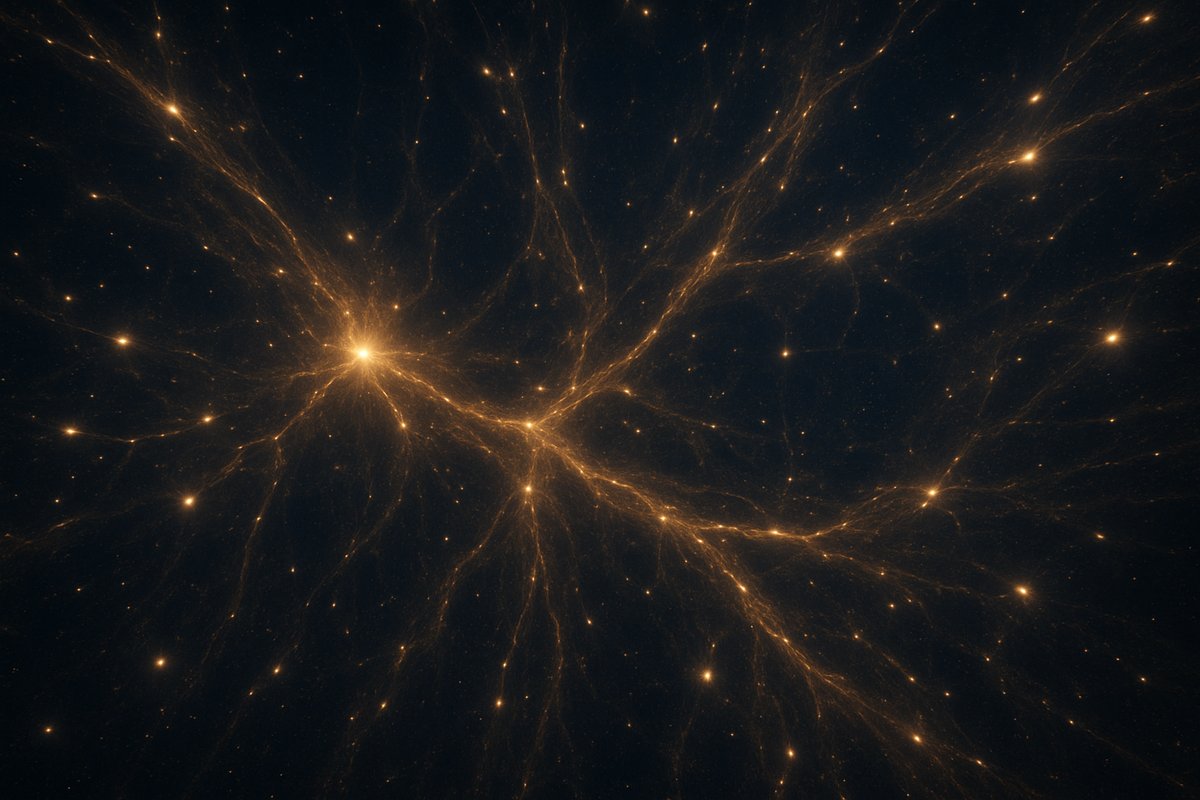
Recent surveys reveal an intricate network of matter connecting galaxies across the universe. Advanced techniques are now charting these cosmic filaments, offering fresh insights into how galaxies grow, evolve, and cluster within the grand tapestry of space.
When we gaze up at the night sky, individual stars and bright galaxy clusters capture our imagination. Yet beneath this dazzling façade lies a vast, ethereal structure known as the cosmic web: a network of filaments composed of dark matter, diffuse gas, and galaxies woven across the universe. Long predicted by theoretical models, these filaments serve as the scaffolding for galaxy formation, funneling matter into nodes where clusters emerge. Charting this hidden architecture has become a frontier of modern astrophysics, combining cutting-edge instrumentation, sophisticated simulations, and creative data analysis to illuminate the universe’s hidden framework.
The concept of a cosmic web first emerged in the 1980s, when pioneering N-body simulations modeled the gravitational interactions of millions of dark matter particles. Researchers discovered that gravity naturally organizes matter into a sponge-like pattern: dense knots connected by elongated threads and separated by vast voids. These simulations showed how gravity amplifies tiny density fluctuations in the early universe, sculpting a filamentary network that guides the clustering of galaxies. The results provided a theoretical blueprint, but observing the web directly remained challenging-until technological advances in the early 21st century began to turn theory into sight.
Large galaxy redshift surveys, like the Sloan Digital Sky Survey and the Dark Energy Spectroscopic Instrument, have mapped the positions of millions of galaxies in three dimensions. By plotting each galaxy’s location, astronomers can infer the underlying dark matter distribution and trace out the web’s skeleton. These maps reveal sprawling filaments hundreds of millions of light-years long, knotted at dense galaxy clusters. Yet galaxies alone offer a partial view. What lies between them-the diffuse gas that fuels star formation-requires more sensitive probes.
Enter Lyman-alpha forest tomography, a technique that uses distant quasars as cosmic flashlights. As quasar light passes through intergalactic hydrogen clouds, it imprints characteristic absorption lines. By observing dozens or hundreds of quasars distributed behind a target region, researchers reconstruct a three-dimensional map of hydrogen density. Recent campaigns have achieved filamentary reconstructions across tens of millions of light-years, revealing bridges of gas linking galaxy clusters and confirming simulation predictions with unprecedented clarity.
Radio astronomy brings another dimension. Neutral hydrogen emits a faint signal at a specific radio frequency, known as the 21-centimeter line. Next-generation radio arrays, such as the Hydrogen Epoch of Reionization Array and the Square Kilometre Array pathfinders, are pushing toward direct detection of this signature across cosmic time. By mapping hydrogen in emission rather than absorption, researchers hope to chart filaments even in regions devoid of bright background sources. Early results hint at subtle filamentary patterns, poised to sharpen with deeper observations and more sensitive receivers.
Gravitational lensing offers a way to map dark matter directly. Massive filaments distort spacetime, bending light from background galaxies and subtly warping their shapes. By measuring these distortions across millions of galaxies, astronomers can create dark matter maps that overlap with galaxy and gas surveys. The combination of lensing, redshift surveys, and radio tomography is forging a multi-messenger view of the cosmic web, where each dataset fills in gaps and cross-validates the others.
Despite these breakthroughs, challenges remain. Filaments are faint by nature, and the signal-to-noise ratio can be low. Cosmic variance-the fact that each region of the sky has unique structures-demands wide-field coverage to build a representative picture. Calibrating instruments and controlling systematic errors become critical when mapping such subtle features. Collaborative networks of observatories across continents and the development of ever-more stable detectors are essential to overcome these hurdles.
Data analysis itself has become a frontier. The enormous datasets generated by modern surveys defy traditional techniques. Machine learning and deep neural networks are now trained on simulated universes to recognize filamentary patterns in noisy data. These algorithms can denoise maps, predict missing regions, and even identify new filament candidates. Open-source platforms allow researchers worldwide to contribute code and share results, accelerating progress and ensuring transparency in methods.
Citizen science is playing a surprising role. Projects like Galaxy Zoo and Zooniverse have enlisted volunteers to inspect images and flag filamentary features. Human pattern recognition remains remarkably adept at spotting the web’s threads, especially when guided by interactive visualization tools. These contributions have helped validate algorithmic approaches and inspired new discovery, highlighting the value of public participation in big-data cosmology.
Mapping the cosmic web is not just an exercise in cartography-it reshapes our understanding of how galaxies form and evolve. Filaments funnel gas into galaxies, regulating star formation rates and influencing their morphology. The location of a galaxy within a filamentary network affects its interaction with neighbors, its likelihood of mergers, and even its chemical composition. By tracing these pathways, astronomers can reconstruct the life histories of galaxies and test models of structure growth under different physics scenarios, including alternative dark matter candidates.
Beyond science, the cosmic web invites a philosophical reflection on interconnectedness at the grandest scale. The same gravitational laws binding stars to galaxies also weave galaxies into filaments, and filaments into a universal tapestry. Our own Milky Way resides along a filament that connects to nearby clusters, reminding us that even isolated points in space share a cosmic kinship. Observing this web fosters a sense of unity and curiosity, bridging the gap between distant galaxies and our own cosmic home.
There’s a poetic resonance too: the interlaced structure of life, ecosystems, and human networks mirrors the cosmic filaments overhead. Just as neurons connect in our brains and rivers snake across continents, the universe itself seems drawn to patterns of connection. This analogy inspires cross-disciplinary dialogues, from complexity science to art installations that mimic filamentary geometry. Such collaborations enrich both scientific inquiry and cultural expression.
The future of cosmic web mapping promises even deeper insights. Planned facilities like the Vera C. Rubin Observatory and the Euclid space telescope will produce vast new catalogs of galaxies, while improved radio arrays will push hydrogen detection to earlier epochs. High-resolution simulations incorporating baryonic physics will refine predictions, guiding observations toward subtle filament features. Emerging instruments may even detect signatures of cosmic magnetism threading through filaments, opening a new window into the interplay between matter and magnetic fields on enormous scales.
Ultimately, mapping the cosmic web transforms abstract simulations into tangible structures we can explore. Each new filament charted brings us closer to a complete portrait of the universe’s architecture and the forces that shaped it. In this grand quest, curiosity, precision, and collaboration converge-reminding us that discovery often emerges at the intersection of bold ideas, innovative tools, and collective effort. As we continue to weave our own maps, the hidden threads of the cosmos stand ready to reveal fresh wonders and deepen our cosmic perspective.