Location
Mount Vernon, WA 98274
Location
Mount Vernon, WA 98274


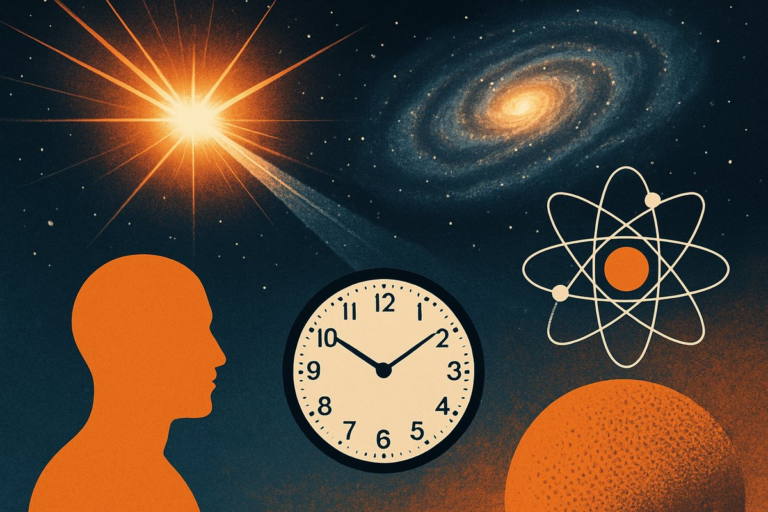
From the flicker of a distant star to the fleeting beat of our heart, the cosmos we inhabit is woven from the same fundamental strands: time, matter, and the ever-unfolding mystery between them. This exploration travels from subatomic particles to galaxy clusters, revealing how physics shapes both the universe and our inner lives.
Every sunrise feels like a simple ritual-light spilling over the horizon, warmth spreading across the land. Yet behind that familiar glow lies a tapestry of deep principles. Time ticks forward, matter arranges itself into stars and cells, and an underlying mystery hums at every scale. To grasp even a fragment of this cosmic weave is to feel both small and infinitely connected. Scientists and storytellers alike find themselves drawn to these threads, tracing the contours of reality through experiments, observations, and the quiet moments when we look skyward and wonder.
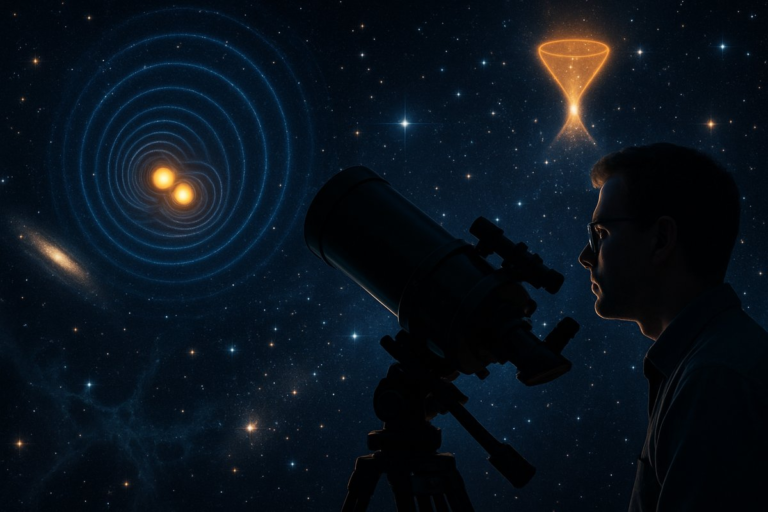
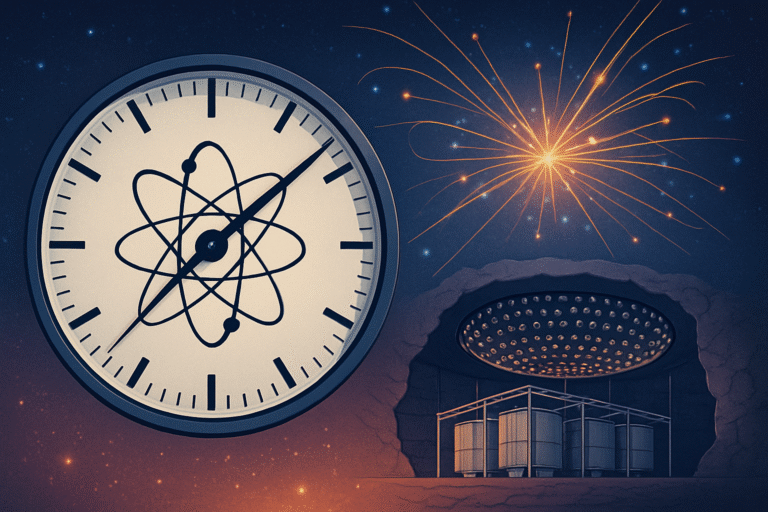
Time was once considered absolute, the same for everyone everywhere. A revolution began when physicists discovered that motion and gravity can stretch and squeeze this universal clock. Satellites circling Earth must adjust for these effects, or global navigation systems would lose track by miles each day. On a grander scale, pulsars-rotating neutron stars emitting rhythmic beams of radio waves-act as cosmic metronomes, revealing ripples in spacetime known as gravitational waves. Observatories tuned to such signals recently detected the faint tremors from merging black holes, providing a new way to listen to the universe’s hidden orchestra.
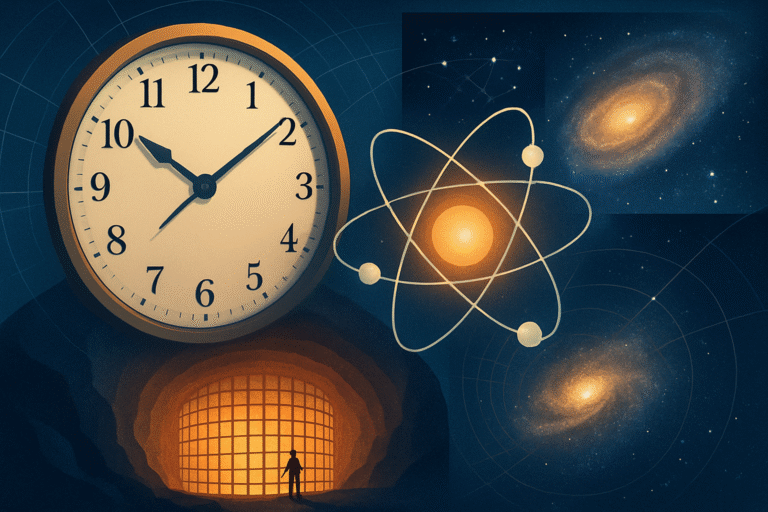
What we touch, taste, and build is made of atoms, but atoms themselves are composed of quarks and leptons governed by quantum rules. High-energy colliders have mapped dozens of these elementary particles, establishing the Standard Model. Yet a vast majority of the universe’s mass remains invisible. Dark matter doesn’t emit or absorb light, but its gravitational fingerprint is clear-galactic rotations, gravitational lensing, and cosmic web structures all demand its presence. Underground detectors seek rare particle interactions to identify these elusive constituents, while sky surveys map dark halos enveloping galaxies in stunning filaments.
Order evolves into disorder. That simple observation underlies the second law of thermodynamics, which governs everything from steam engines to the fate of black holes. Entropy defines the direction of time itself: eggs can scramble but never unscramble, heat flows downhill, and stars burn fuel until they cool. In the cosmic view, entropy leads to an eventual ‘heat death’ where energy differences vanish. Yet quantum phenomena and dark energy suggest the story is far from over. Some theorists propose that new pockets of low‐entropy conditions could emerge, perhaps spawning fresh universes in a vast multiverse.
Light bridges time and matter, carrying snapshots of events billions of years old. The James Webb Space Telescope, peering into the cosmic dawn, unveiled infant galaxies brimming with star-forming gas. Closer to home, lab experiments use ultrafast lasers to freeze-frame chemical reactions, revealing how bonds break and form in femtoseconds. Meanwhile, detectors converting rare photons into electronic signals enable quantum communication, promising unhackable data links. Each photon captured is a messenger from the frontier between the known and the unknown.
Beyond clocks and calendars, time is woven into our thoughts and emotions. Moments of danger slow our perception, making split seconds feel like lifetimes. Memory stitches together past experiences into a seamless narrative, yet that tapestry can fray with age or trauma. The physics of aging involves complex molecular processes, from DNA damage to protein misfolding, but researchers exploring cellular repair pathways are seeking ways to extend healthy lifespans. In parallel, mindfulness exercises train the mind to inhabit the present, reshaping our personal sense of time as skillfully as any physicist explores cosmic scales.
Human ingenuity has harnessed time and matter in remarkable ways. High-precision atomic clocks now keep time to within a fraction of a billionth of a second, enabling network synchronization for financial markets and scientific collaborations. Materials scientists engineer metamaterials that bend light around objects, hinting at cloaking technologies. Quantum computers manipulate entangled qubits, potentially cracking complex simulations of molecular interactions or decrypting next-generation cryptography. Each breakthrough carries ethical and environmental considerations, urging developers to maintain sustainability and respect privacy in the rush to innovation.
Science paints a portrait of reality, but interpretation lies in the realm of philosophy and art. If time can dilate and contract, what does that say about free will or destiny? If matter can appear and vanish in quantum fluctuations, where do we draw the line between existence and illusion? Storytellers across cultures have long grappled with these questions, from ancient myths about cosmic eggs giving birth to the universe to futuristic tales of simulated worlds. Each narrative invites us to consider our place in the vast unfolding drama.
Standing beneath a star-filled sky, most people feel awe-a mix of wonder and humility. That emotional intelligence, recognizing our interdependence with the cosmos, can inspire more than just scientific inquiry. It fuels conservation efforts to protect dark skies from light pollution, supports renewable energy to curb climate change, and nurtures communities that value curiosity over cynicism. By linking the cold equations of physics with the warmth of human experience, we foster an inclusive approach to exploration that honors diverse perspectives.
The story of time, matter, and mystery is far from complete. New telescopes, particle experiments, and mathematical insights promise fresh surprises. Perhaps we will detect signals from the first moments of the Big Bang, or craft materials with properties that defy our current understanding. As we press forward, the guiding thread remains our capacity to ask questions-big, humble, and fearless. After all, every answer uncovers deeper puzzles, ensuring that the tapestry of reality continues to expand and delight those who dare to look.