Location
Mount Vernon, WA 98274
Location
Mount Vernon, WA 98274

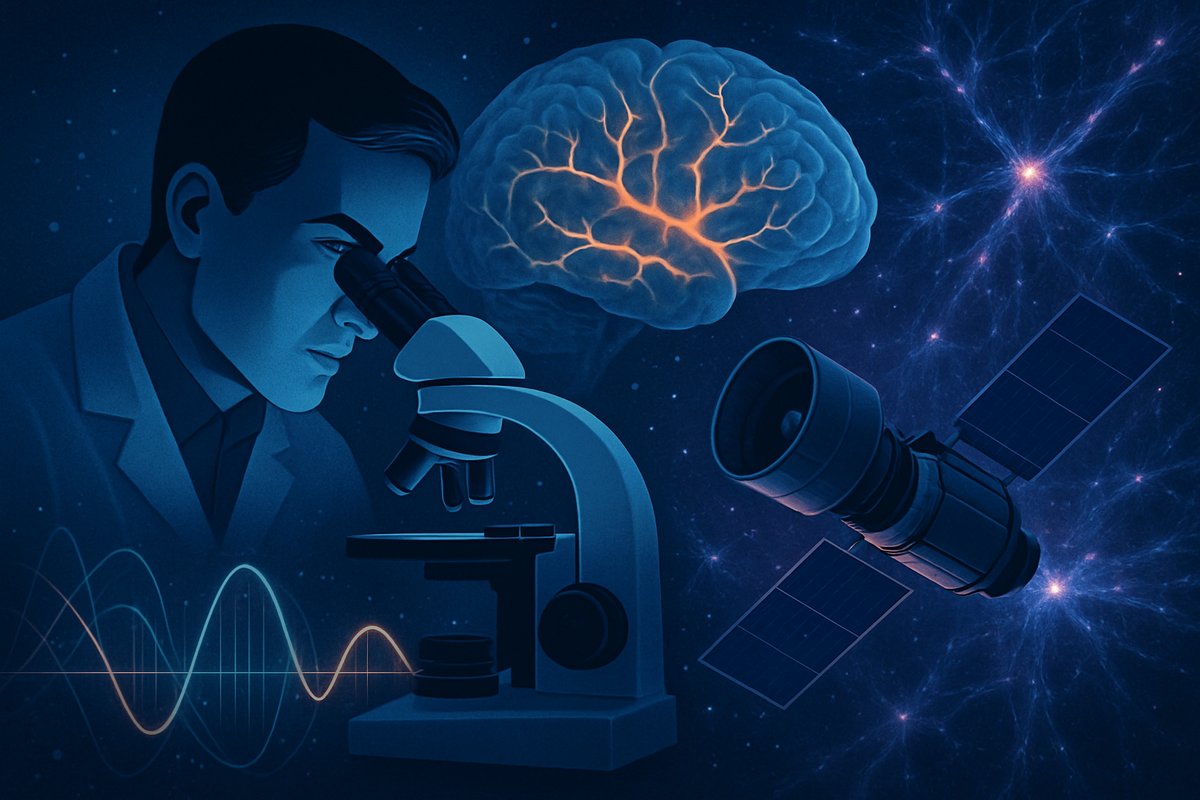
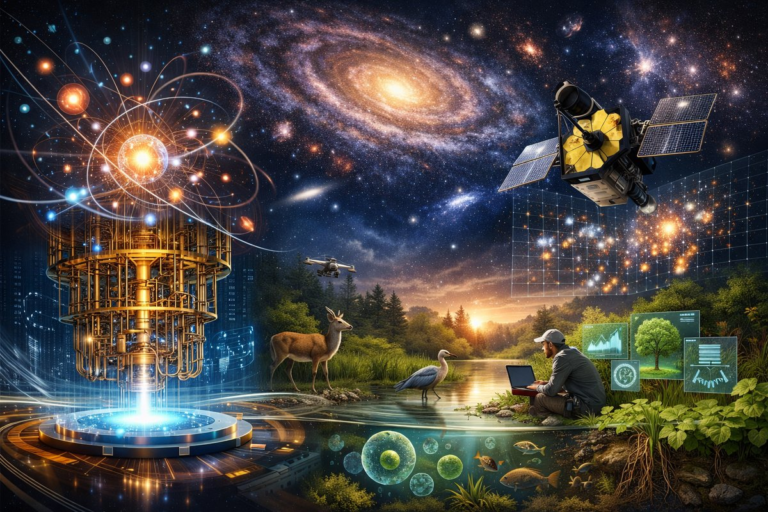
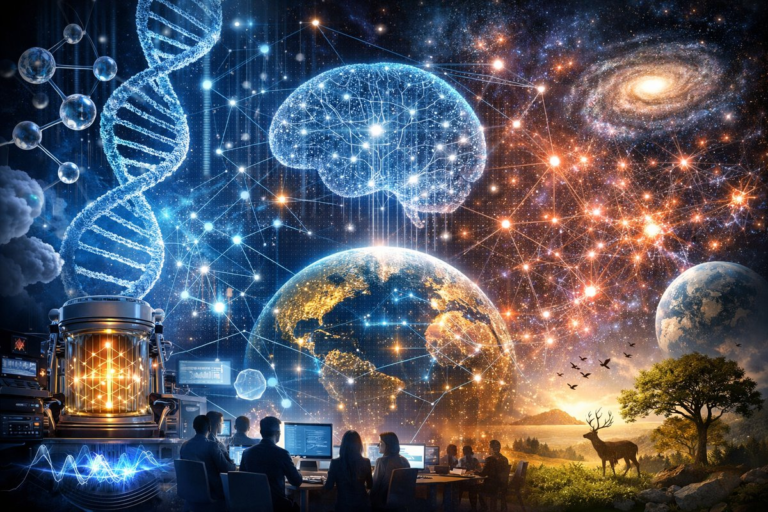
Science stretches from the smallest quantum fluctuations to the vast interstellar web, weaving precision and imagination into every discovery. From mapping dark matter with space telescopes to decoding neural patterns in the human brain, researchers continually expand the frontier of what we know-inviting us all to engage, question, and explore.
Science lives in the space between wonder and rigor. It asks us to embrace curiosity without relinquishing precision, to welcome questions as eagerly as we test answers. At its core, science spans every scale and every system-from the flicker of a photon in a quantum lab to the spiral arms of a distant galaxy, from the dance of microbial communities in soil to the patterns of human society. In every corner of inquiry, researchers apply rigorous tools and creative leaps, birthing insights that reshape our understanding of reality and spark new avenues for exploration.
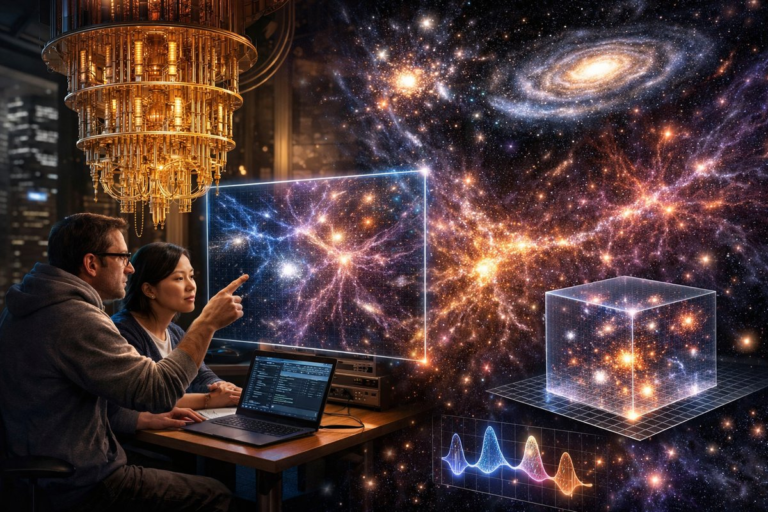
On cosmic scales, recent missions are charting the invisible scaffolding of the universe. The European space telescope launched in mid-2023 is now painting detailed maps of dark matter by tracing the subtle bending of light from billions of galaxies. Combined with gravitational wave observatories registering ripples from colliding neutron stars, scientists can trace where heavy elements like gold and platinum are forged. These observations don’t just refine cosmological models-they connect our material world to cataclysmic events billions of light-years away, reminding us that Earth’s periodic table is written in the depths of spacetime.
Meanwhile, quantum laboratories are turning the bizarre predictions of physics into tangible technologies. Last year, metropolitan fiber networks in Asia carried entangled photons across hundreds of kilometers, demonstrating the first steps toward a quantum internet. Such networks promise ultra‐secure communication and distributed sensing grids sensitive enough to detect subterranean tunnels or hidden fault lines. At the same time, miniaturized quantum sensors aboard small satellites are beginning to measure subtle shifts in Earth’s magnetic and gravitational fields-tools that could one day forecast volcanic eruptions or track melting glaciers with unprecedented precision.
Shifting down to the cellular realm, high-throughput single-cell sequencing techniques are reconstructing the inner workings of tissues at remarkable resolution. Initiatives contributing to the Human Cell Atlas are cataloguing every cell type in our bodies, revealing rare stem cell populations and unexpected immune actors. This emerging blueprint is guiding regenerative medicine efforts-envision patches of new tissue grown in the lab, personalized to each patient’s genetic profile. It’s also uncovering microbial partnerships: thousands of bacterial species inhabiting our gut influence everything from digestion to mood, and modulating those communities through tailored probiotics or engineered phages could revolutionize healthcare.
Beyond human biology, ecological sciences are harnessing environmental DNA and satellite imagery to map biodiversity hotspots in real time. By collecting water samples in remote rivers or using drone-mounted hyperspectral cameras over coral reefs, researchers can identify hundreds of species from a single measurement. In regions previously inaccessible by foot, machine learning algorithms analyze these data streams to alert conservation teams when endangered species appear or invasive predators encroach. This blend of fieldwork and data science is turning conservation into a dynamic, responsive practice rather than a static inventory.
The neural frontier is advancing just as rapidly. Noninvasive brain imaging techniques are now capable of resolving activity patterns at sub-millimeter scales, and invasive electrode arrays have begun to interface with individual neurons to decode motor intentions in real time. Clinical trials are underway to restore communication to paralyzed patients via brain-computer interfaces-devices that translate thought patterns into synthesized speech or cursor movements. These breakthroughs not only offer new therapies but also force deeper philosophical questions about consciousness, free will, and what it means to be human in an age of intimate machine partnership.
At every scale, computational power has become the microscope and the telescope of our era. Generative algorithms propose novel molecules for cancer drugs, redesign battery materials atom by atom, and even simulate complex phenomena like planetary formation or climate tipping points. Exascale computers, capable of a billion billion calculations per second, are now tackling global circulation models that account for clouds, ocean currents, and ice sheet dynamics all at once. The speed and fidelity of these simulations help policymakers make informed decisions on carbon budgets and habitat protection before critical thresholds are crossed.
And yet, the true magic emerges when disciplines collide. Astrobiologists are studying extremophile microbes living in Earth’s deep-sea vents to inform the search for life on icy moons like Europa. Atmospheric chemists collaborate with biologists to track how industrial emissions alter phytoplankton blooms, which in turn influence carbon dioxide uptake. Quantum physicists and neuroscientists explore whether principles of information theory can unify our understanding of black holes and brain networks. In these intersections, the boundaries between fields blur, and entirely new frameworks take shape.
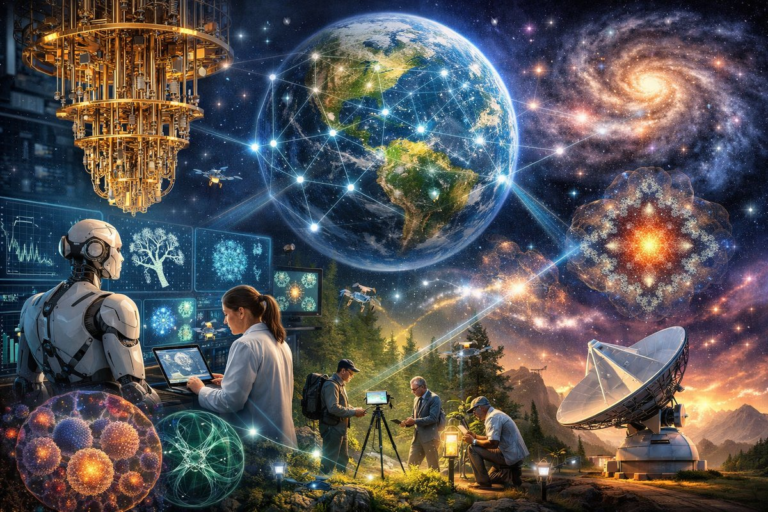
None of these advances would be possible without cutting-edge instrumentation and open collaboration. From open‐source lab robots that automate pipetting protocols to global data repositories where researchers share genomic and cosmological measurements, the ethos of transparency and reproducibility accelerates discovery. Citizen science platforms engage volunteers to classify galaxy shapes or tag bird calls from rainforest recordings, literally turning living rooms into control rooms for ongoing experiments. This democratization of science ensures that fresh perspectives and diverse talents contribute to humanity’s collective pursuit of knowledge.
With these opportunities also come responsibilities. The same genomic tools that enable disease therapy can be misused for biothreat creation if safeguards and regulations don’t keep pace. Satellite data that reveal deforestation can also infringe on indigenous land rights if shared without proper consent frameworks. Algorithms trained on biased historical data may perpetuate inequalities in medical or policing practices. Ethical considerations around privacy, sustainability, and equity must be woven into the fabric of research-embedding values into experimental design, data governance, and technology deployment.
Looking ahead, the next decade promises even bolder milestones. Next-generation gravitational wave detectors will probe collisions of black holes smaller than the sun, while space interferometers may directly image the event horizon of a supermassive black hole. Quantum computers with thousands of error-corrected qubits will tackle chemistry problems that stump classical machines. Portable lab-on-a-chip devices will enable rapid diagnostics in remote clinics, cutting the time for outbreak detection from days to minutes. And as neural interfaces shrink further and AI companions grow more intuitive, we will need to define the boundaries between collaboration and autonomy in entirely new ways.
Science’s beauty lies in its perpetual motion-every answer opens fresh questions, every tool suggests new experiments, and every discovery reveals deeper mysteries. Whether you’re gazing at star clusters through a backyard telescope, inserting probes for quantum experiments, swabbing soil for microbial DNA, or training machine learning models on terabytes of data, you become part of this unfolding story. By sharing data, nurturing ethical standards, and embracing interdisciplinary dialogue, we ensure that science remains a playground for curiosity, precision, and awe-where the next revelation awaits just beyond the horizon.