Location
Mount Vernon, WA 98274
Location
Mount Vernon, WA 98274

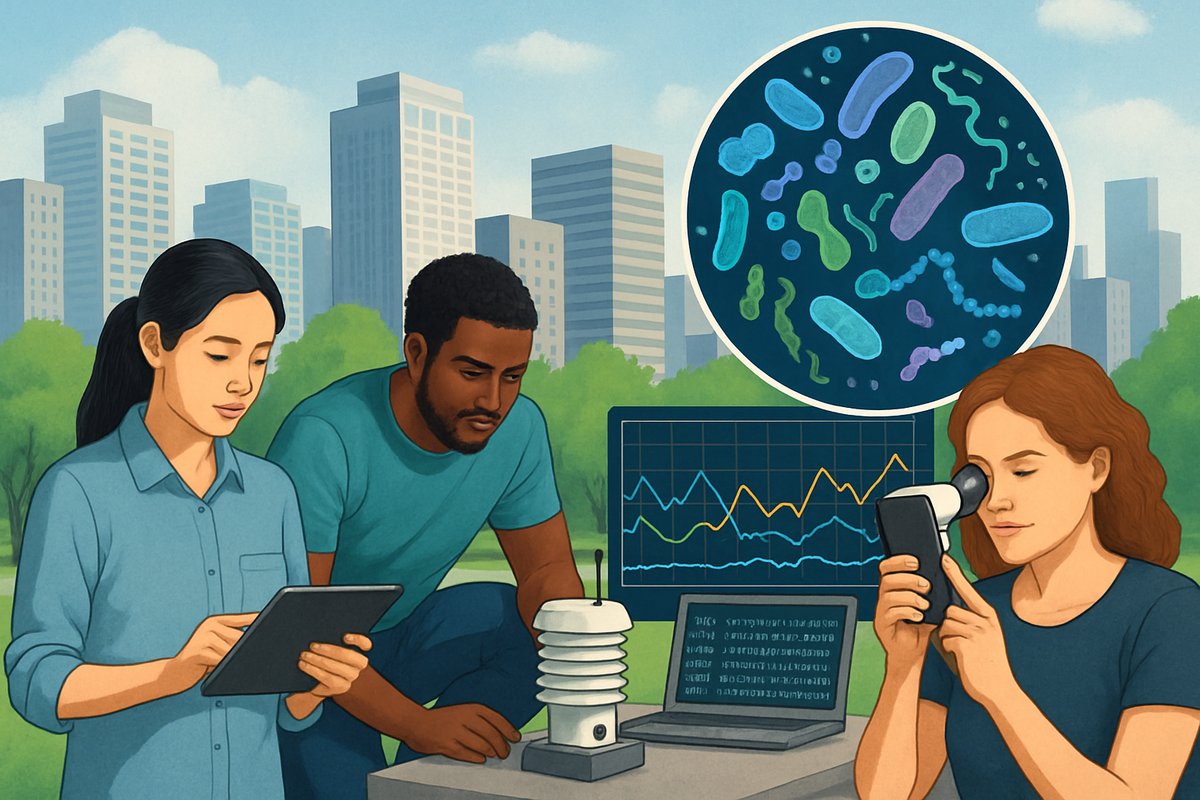
In a groundbreaking project, researchers teamed up with volunteers to chart the unseen microbial life swirling through city air. Employing low-cost sensors, smartphone microscopes, and data-crunching methods borrowed from astrophysics, this initiative reveals patterns of airborne bacteria that challenge assumptions about urban health and green planning.
A new global initiative has enlisted everyday city dwellers to explore a frontier that exists all around us yet remains largely invisible-the urban microbiome. By combining portable air-sampling devices, smartphone-mounted microscopes, and statistical techniques originally developed to map galactic filaments, scientists have constructed the first large-scale atlas of airborne microbial communities in metropolitan environments.
Volunteers in ten major cities across three continents signed up to host compact air-sampling stations on their balconies, rooftops, and even bicycle baskets. Each unit channels ambient air through a sterile filter over the course of a week, trapping bacteria, fungi, and other microscopic hitchhikers. After collection, participants photograph filter imprints through a clip-on microscope attached to their phones, then upload the high-resolution images to a cloud-based platform.
Behind the scenes, data scientists apply computational pipelines that mirror those used to detect filaments in the cosmic web. Just as astronomers look for faint strands of dark matter linking galaxies, these algorithms pick out subtle clusters and streaks of microbial signatures in a sea of noise. The result is a high-definition map that shows where different microbial species bloom, drift, or vanish entirely.
Early results have already upended expectations. In cities with aging water infrastructure, for instance, aerosolized bacteria linked to corrosion hotspots appear at higher concentrations. Green roofs and urban parks emerge as clearinghouses for diverse-but largely benign-microbial communities that change over the seasons. High-traffic corridors, by contrast, host bacteria known to harbor antibiotic-resistance genes, raising new questions about the health impact of relentless vehicle emissions.
“People tend to think of microbes as either harmful or invisible,” says Dr. Simone Alvarez, a microbiologist coordinating the project. “What we’re showing is that there’s a rich tapestry of life floating in our street air, and that tapestry shifts in response to the built environment, weather, and human activity.”
Mapping these living strands may sound poetic, but the stakes are practical. Public health officials can use the atlas to predict how allergens or pathogens disperse after events such as major storms or transit strikes. Urban planners might design new green corridors not just for pedestrian comfort but also to cultivate beneficial microbial exchange between neighborhoods.
The project’s commitment to open data means anyone can explore an interactive globe dotted with sampling sites. By zooming in on their own block, volunteers see microscopic organisms rendered as colored filaments and nodal clusters. A click reveals species names, known interactions, and even metabolic profiles. The interface encourages users to compare data across cities, seasons, or urban typologies-industrial zones versus waterfront promenades, for example.
Data privacy and ethical considerations presented early challenges. Gathering environmental DNA on private balconies sparked questions about inadvertent collection of human genetic material. To address that, the team engineered filters that selectively capture airborne cells larger than typical skin flakes, and all genetic analyses occur on de-identified, aggregated samples. Transparency around protocols has helped reassure participants that their own privacy remains intact.
Behind the curtain of community science, a core research group refines machine-learning models that reduce false positives when identifying microbial taxa. They’re adapting neural nets originally trained on galaxy photographs to distinguish between pollen grains, fungal spores, and prokaryotic cells. This cross-disciplinary approach exemplifies how tools from one branch of science can spark breakthroughs in another.
The initiative has sparked creative side projects too. School classes have used cheap smartphone add-ons to survey playgrounds, comparing the microbial diversity under swings with that beneath slides. Architects are experimenting with façade materials that passively filter airborne microbes, inspired by the project’s hotspot maps. Even artists have translated filament networks into immersive installations, inviting viewers to walk through glowing webs of color representing unseen life.
Challenges remain: rain and humidity skew sampling efficiency, and small-scale filters can clog quickly in dusty districts. The team is testing self-cleaning membranes and battery-powered fans to keep air flowing consistently. A pilot in a tropical megacity revealed the need for solar-powered units to cope with frequent power outages.
Future phases will integrate chemical sensors to link microbial patterns with pollutants such as nitrogen oxides and volatile organic compounds. By overlaying these layers, researchers hope to pinpoint interactions between toxins and living cells, shedding light on how air quality affects urban ecology at the microbial level.
This project highlights science’s power to transform daily life into a platform for discovery. When curiosity meets precision engineering and a dash of cosmic perspective, the world opens up in surprising ways. The urban microbiome-once the domain of laboratory hoods-now unfurls across rooftops and lampposts, mapped by citizens tapping into the same statistical tools used to chart the universe’s grandest structures.
For the volunteers behind each sampler, the experience has been both humbling and empowering. After all, every breath we take carries invisible companions shaped by our surroundings. By revealing this hidden biosphere, the initiative invites deeper reflection on how we design, inhabit, and share the spaces we call home.
Looking ahead, the team plans to expand to more cities and collaborate with public health agencies to track seasonal spikes in allergens or disease-causing microbes. There’s even talk of integrating drone-based sampling for real-time monitoring of hard-to-reach areas. The blend of grassroots engagement and cutting-edge computation promises to keep the urban microbiome at the forefront of environmental science-and remind us that awe can lie in the smallest of scales.