Location
Mount Vernon, WA 98274
Location
Mount Vernon, WA 98274

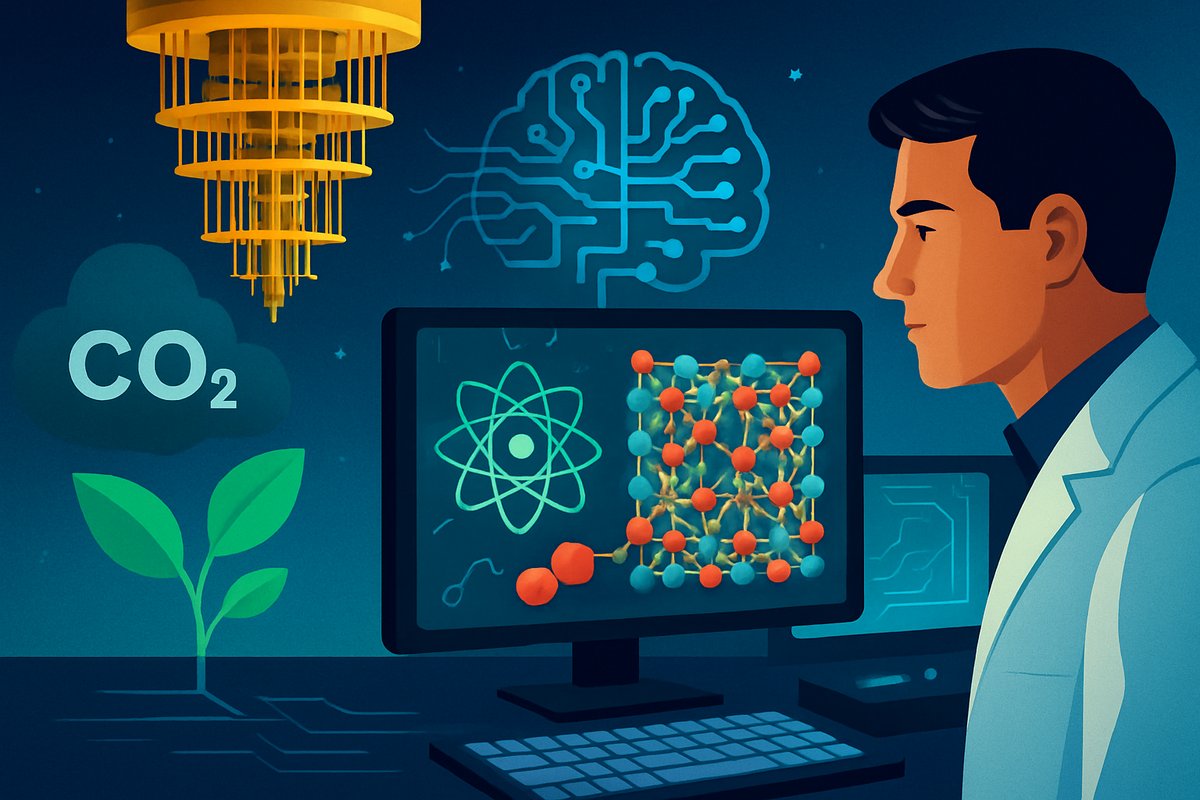
A new wave of computational breakthroughs is driving the design of next-generation materials to trap carbon dioxide. By combining quantum processors with artificial intelligence and advanced modeling, researchers are uncovering frameworks that could transform how we fight climate change.
The quest to slow global warming has taken an unexpected turn: deep inside a temperature-controlled laboratory, researchers are running quantum algorithms to explore the molecular bonds of porous frameworks designed to capture carbon dioxide. This marriage of quantum chemistry and climate science promises to accelerate the discovery of high-performance materials, potentially delivering filters and membranes that lock away greenhouse gases far more efficiently than today’s solutions.
For decades, chemists have relied on classical supercomputers to simulate interactions between gas molecules and candidate materials. But the complexity of electron correlation in structures with hundreds of atoms often pushes these simulations to their limits. Enter quantum computing, where information is encoded in quantum bits that can exist in multiple states simultaneously. In recent trials, teams have demonstrated that a 28-qubit processor can model the binding energy of small organic linkers within a metal-organic framework (MOF) with unprecedented precision, completing in minutes what once took hours.
This proof of concept caught the attention of a consortium of climate-focused research centers and private funders. Dubbed the Quantum Carbon Alliance, the collaboration has set its sights on screening thousands of hypothetical frameworks by the end of next year. “We want to explore chemical space at a scale no one has ever attempted,” says a lead scientist. “Classical methods can only scratch the surface. Quantum algorithms open up avenues for discovering traps with ultra-high selectivity for CO₂.”
Metal-organic frameworks are crystalline materials composed of metal nodes connected by organic linkers, creating a lattice of pores. Their tunable structure makes them ideal candidates for gas separation, hydrogen storage, and catalysis. However, the sheer number of possible linkers and topologies creates a combinatorial explosion that overwhelms conventional screening pipelines. By contrast, quantum computers can directly encode the electronic structure of these networks, capturing subtle effects like van der Waals interactions and charge transfer that classical approximations miss.
The process begins with a classical pre-screening: an artificial intelligence model trained on a database of known MOFs predicts likely performers. Top candidates then graduate to the quantum lab, where variational quantum eigensolver (VQE) algorithms compute their ground-state energy. Researchers adjust circuit parameters until the lowest energy configuration emerges, revealing how tightly CO₂ would bind inside the pores. A parallel workflow uses quantum annealers to explore phase behavior under varying pressures and temperatures.
One early success emerged from a framework featuring a functionalized organic linker with amine groups positioned to form multiple hydrogen bonds with CO₂ molecules. Quantum simulations predicted an uptake capacity 20 percent higher than the best classical contender. Follow-up experiments in a pressure swing adsorption rig confirmed the finding, demonstrating rapid adsorption kinetics at ambient conditions. These materials could one day be deployed in power plant exhaust systems or integrated into building façades to passively remove carbon from the air.
While promising, quantum hardware still faces limitations. Current devices suffer from decoherence, gate errors, and restricted connectivity, which constrain the size of molecules that can be accurately simulated. To work around these issues, scientists are developing hybrid approaches that offload parts of the problem to classical co-processors. Tensor network methods and machine learning surrogates can complement quantum routines, stitching together fine details from high-fidelity quantum snapshots and broad trends from classical sweeps.
Scalability remains the top challenge. Quantum processors today handle only a few dozen qubits reliably, but future generations aim for hundreds or thousands. The roadmap includes improvements in error correction and qubit architecture, with new platforms based on trapped ions, superconducting circuits, and topological qubits. Each advance will expand the chemical systems that can be tackled, moving from small organic linkers to entire frameworks and eventually multi-component composites.
Beyond MOFs, quantum-driven materials design is sparking a renaissance across material science. Researchers are exploring porous polymers, zeolites, and covalent organic frameworks using similar pipelines. Another frontier is the discovery of catalytic centers that could convert CO₂ into fuels or chemical feedstocks. Quantum simulations can reveal reaction pathways and transition states that are nearly impossible to capture classically, guiding the synthesis of novel catalysts.
The implications extend to policy and industry. Faster discovery cycles could compress years of laboratory trial-and-error into months, lowering development costs for climate technologies. Companies investing in carbon capture are already signing partnerships with quantum startups and academic labs. Governments are funding dedicated quantum-climate initiatives, recognizing that advanced computing will be critical to meeting emissions targets.
At the same time, the push for greener materials is driving demand for sustainable quantum data centers. Running large-scale simulations requires significant electrical power to cool quantum chips and operate classical clusters. Researchers are experimenting with modular cooling units that use green refrigerants and advanced heat exchangers. Some projects aim to site future quantum facilities near renewable energy installations, offsetting their footprint with wind or solar power.
This convergence of physics, chemistry, computer science, and climate policy illustrates the new spirit of transdisciplinary research. Graduate students learn quantum algorithms alongside process engineering, while policymakers consult computational chemists when drafting carbon regulations. Public workshops and open-data platforms ensure that simulated materials and performance metrics are freely available, fostering collaboration across borders.
Looking ahead, experts anticipate that quantum-enhanced materials discovery will ripple into other global challenges. From designing next-generation batteries and superconductors to engineering more efficient fertilizers and water-purification membranes, the same computational engines can tackle a broad spectrum of problems. “We’re witnessing the dawn of a new era,” says another researcher. “Quantum computing isn’t just a niche tool for physicists. It’s becoming the digital microscope for the materials frontier.”
For now, the race is on to bring quantum-designed carbon capture materials from the lab into the real world. Pilot plants are scheduled to test prototype MOF filters next year, and performance data will feed back into improved simulations in a virtuous cycle. If successful, this approach could reshape our toolkit for combating climate change, turning abstract qubits into tangible breakthroughs for the planet.