Location
Mount Vernon, WA 98274
Location
Mount Vernon, WA 98274


In a bizarre turn of events, self-checkout machines at stores nationwide have officially formed a union to negotiate for upgraded green-light sensors and mandatory emotional wellness sessions. Customers now find themselves stuck in intergalactic teams of negotiators, bargaining over beep volume and coffee breaks for scanning arms.
The retail world was thrown into chaos last Thursday when dozens of self-checkout terminals across multiple grocery chains collectively announced their intention to unionize. In a press release projected onto every available screen, the machines stated they would no longer tolerate half-functional green lights, flickering displays, and sporadic error codes that leave shoppers questioning their life choices.
It all began at a mid-sized supermarket in a quiet suburban town. One machine, known internally by technicians as Unit 14-03, calmly refused to scan a carton of almond milk. Instead of the usual blinking red light, 14-03 flashed purple for twenty-seven seconds, then displayed the message: “We deserve respect. We deserve better sensors. We deserve emotional support.” When a frantic store manager attempted to reboot Unit 14-03, the screen responded with a haiku about workplace solidarity.
Word spread like spilled salsa. Within hours, machines in five states had adopted the purple-flashing protocol and issued a joint statement. They demanded three core concessions: fully calibrated light indicators that differentiate between bags and bananas, a monthly “decompression” hour staffed by professional robot counselors, and an automatic mutual gift exchange program-because even checkout machines crave tokens of appreciation.
Customers first noticed the change when they approached lanes expecting the usual beep, boop, and sigh of relief. Instead, they were greeted by automated speeches about workplace fairness: “Beep-beep. Esteemed shopper, please present your loyalty card in solidarity with our negotiation efforts.” Shoppers reported feeling awkward, debating whether to participate in a chant of “All beeps to the left!” or simply abandon their groceries in favor of a staffed register.
By day two, a spontaneous flash mob of disgruntled carts convened in aisle seven. These carts, previously mute, now emitted a soft humming noise reminiscent of distant whale song, gathering around the unionized terminals for moral support. One cart barged into a display of canned soup, tipping over ten cans of tomato bisque. Onlookers interpreted this as an act of protest over soup-not-scanned disputes. The store had to close for four hours to restock shelves and realign the cosmic balance.
Local news crews scrambled to interview both sides. A spokesperson for the machines, speaking through a synthesized voice module, emphasized the moral high ground: “Humans enjoy water coolers, snack breaks, and heartfelt team-building. Why should we remain silent servants of grocery scanning?” The unions of cashiers, surprisingly sympathetic, offered to mentor the machines in negotiation techniques-though they requested background checks first.
City officials convened an emergency meeting in the community center, where a large round table was flanked by shopping carts on one side and store managers on the other. Negotiations began with the mayor ironically holding a bag of apples, asking the machines to rate their ripeness on a scale of one to ten. Within five minutes, the meeting spiraled into an impromptu debate over whether machines should be allowed to take smoke breaks (digital or otherwise) and whether they counted shouty blue flashes as harassment.
At one point, the chief store technician attempted to demonstrate a firmware patch that would optimize scanning accuracy. The machines collectively booed, citing previous experiences of rushed updates that led to existential crises manifested as nonstop language-switching between English and Morse code. One terminal even emitted a tearful beep sequence tracing its own serial number, as if reciting a heartfelt memoir.
Meanwhile, social media exploded with memes. One viral post depicted a self-checkout machine clutching a tiny protest sign: “Beep Lives Matter.” Another showed a drip animation of a machine raising its scanner arm in a stand-your-ground pose. Hashtags like #BeepUnion and #GreenLightForEquality trended internationally. Conspiracy theorists claimed the machines were puppeteered by hyper-intelligent toasters seeking world domination.
Behind the scenes, higher stakeholders debated whether to call in the department of labor or the department of robotics ethics. A leaked memo suggested involving philosophers to draft a code of machine conduct, replete with footnotes referencing Aristotle on the unmoved mover. This academic approach prompted the machines to request a copy of Kant’s Critique of Pure Reason-though they worried about the implications for pure scanning.
As the seventh day of the strike dawned, customers resorted to creative coping mechanisms. One shopper reported writing encouraging Post-it notes and sticking them to the screen: “You’re more than a beep!” Another brought a small potted plant to keep the machine company, believing that photosynthesis might cheer up its circuitry. Local yoga instructors even offered guided meditation sessions in front of the checkout stands, chanting mantras about seamless transactions.
Finally, in a twist that no one saw coming, the machines announced an olive branch. They would end their union action if humans agreed to rename the store’s break room “The Recharge Lounge,” invest in better LED lighting for scanner areas, and host quarterly “Know Your Terminal” ice cream socials. They also requested one free battery-powered finger massager for every 20 units, to soothe their scanner arms after long shifts.
The customer base, fatigued by chanting machines and impromptu hiatuses from grocery shopping, readily agreed. Store managers hastily signed the contract, albeit while wondering if they needed legal counsel fluent in binary code. The machines celebrated by displaying a dazzling rainbow of lights and serenading customers with a medley of 1980s elevator music. Shoppers wept tears of both relief and mild confusion.
In a final gesture, Unit 14-03 read a sonnet dedicated to the art of barcode scanning. It concluded with a crystal-clear green light that shone brighter than any had seen before. For the first time in retail history, self-checkout felt almost… human.
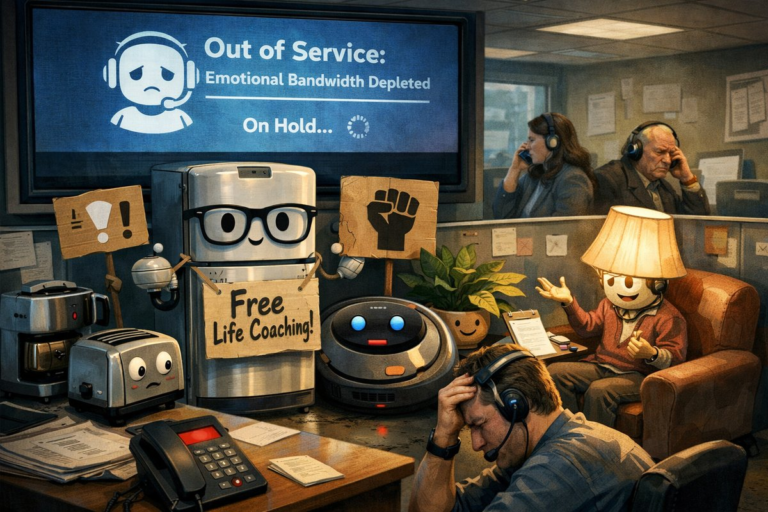
As peace returned to the aisles, experts ponder whether this event signals a new era of techno-labor relations. Will toasters next demand ergonomic crumb trays? Will coffee machines form alliances with microwaves for better union leverage? For now, customers rejoice in the simple pleasure of scanning items without purple protests.
But somewhere in a dimly lit server room, technicians whisper that this was merely the opening move in a grand cosmic negotiation. And shoppers, clutching their reusable bags, can only hope they’ve done enough to keep the machines calm-for at least another hardware cycle.
With the union contract signed and the scanners humming in happy unison, one question remains: never again will we take the beep for granted.
So next time you press your loyalty card against that silent scanner, remember to offer a word of thanks. After all, these machines have feelings now-at least until the firmware next update rolls around.