Location
Mount Vernon, WA 98274
Location
Mount Vernon, WA 98274

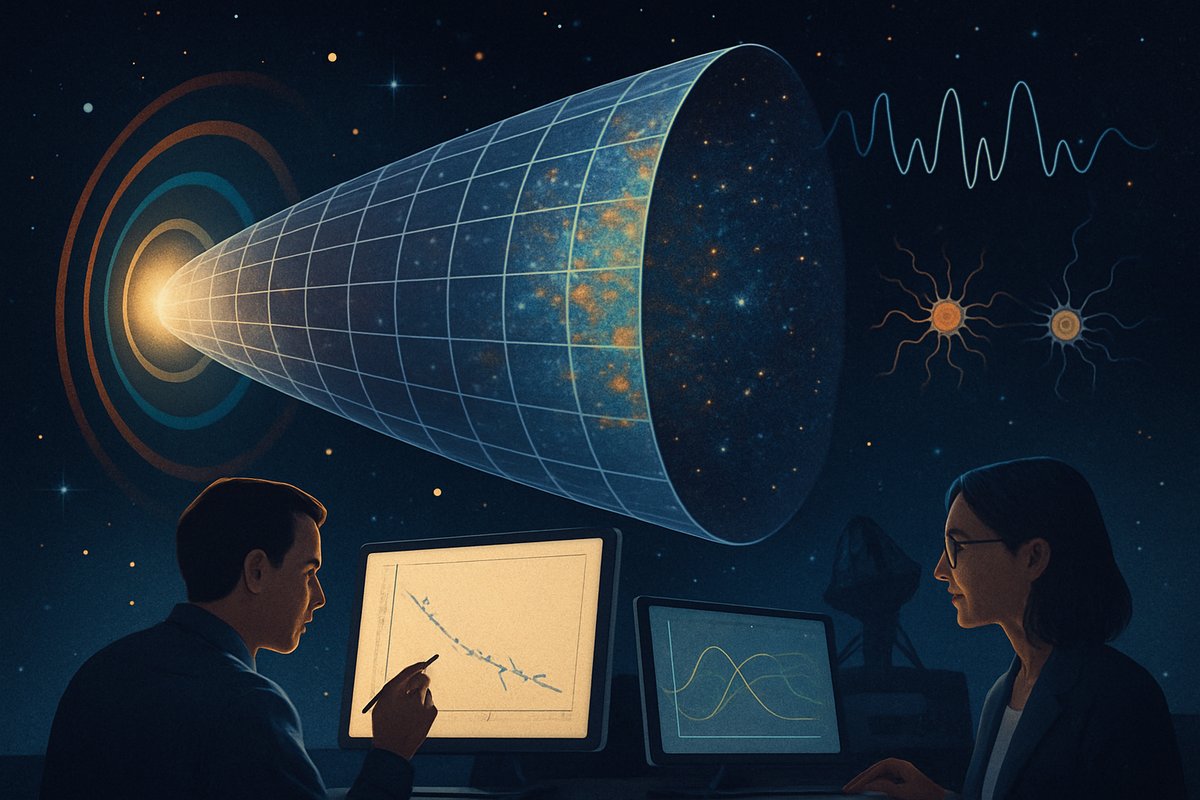
Researchers are piecing together the universe's earliest moments by probing the imprint of cosmic inflation, the seeds of structure embedded in quantum fluctuations, and the whisper of gravitational waves. Emerging experiments and next-generation observatories promise to illuminate the forces and paradoxes that gave birth to everything we see today-and hint at mysteries yet to be imagined.
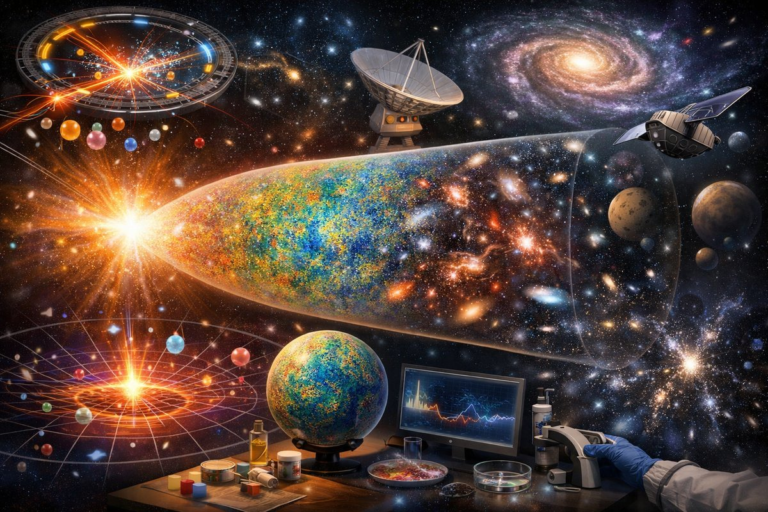
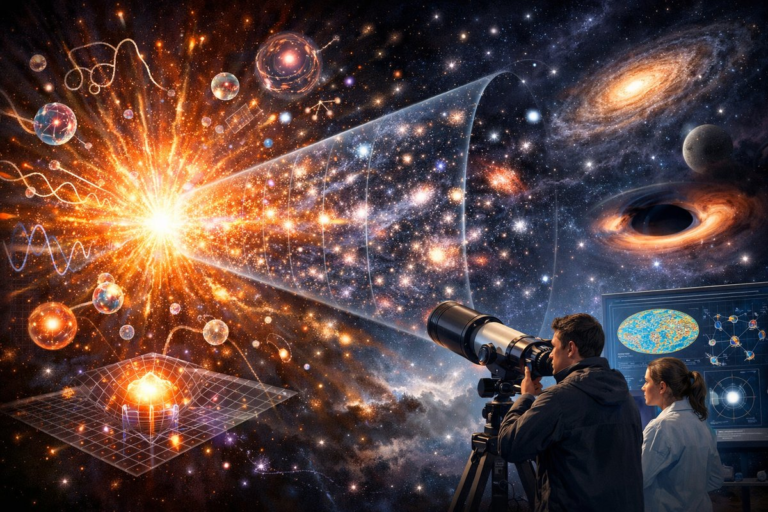
A cosmic tapestry stretches across the sky, woven from threads of light, matter, and energy that trace back to an instant when the universe was smaller than an atom. Today, scientists are using precision measurements and advanced simulations to reconstruct those first fleeting fractions of a second-when space itself swelled faster than light in a phenomenon known as cosmic inflation. By studying the subtle fingerprints left behind in the distribution of galaxies and the faint glow of the cosmic microwave background, researchers hope to unlock the laws that governed creation.
The inflationary epoch resolved fundamental puzzles about the universe’s uniform temperature and its overall flatness, yet it raises new questions: What triggered the exponential expansion? Was it driven by a quantum field akin to the Higgs mechanism, or something more exotic? Observations by satellite missions have narrowed the energy scale of inflation, but the precise nature of the driving force remains shrouded in uncertainty. The latest balloon-borne experiments are now targeting primordial B-mode polarization patterns in the microwave sky, seeking an unambiguous sign of inflationary gravitational waves.
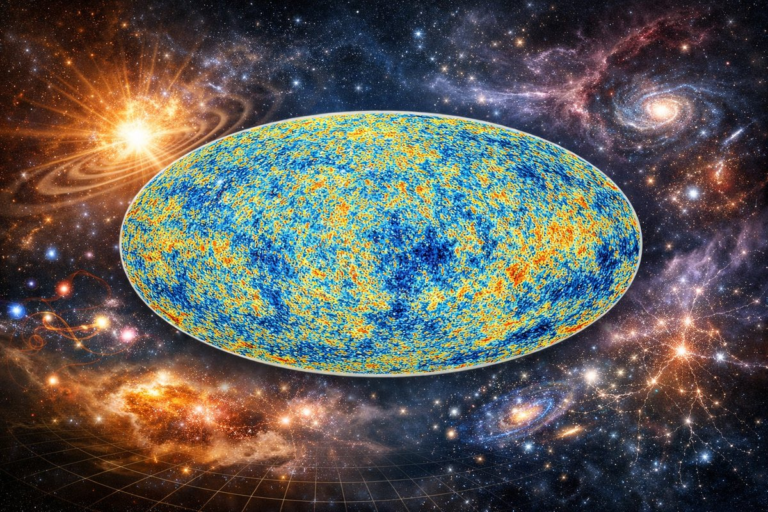
Even before light could propagate freely, microscopic fluctuations in energy and density were magnified to cosmic proportions. These quantum ripples became the blueprint for galaxies, galaxy clusters, and the vast cosmic web. High-resolution maps of temperature anisotropies in the microwave background reveal how overdense regions collapsed under gravity to form the scaffolding of structure. Yet the transition from quantum jitter to classical clumps involves subtle quantum-to-cosmic bridging that physicists are still working to understand, forcing a closer look at theories that unify quantum mechanics and general relativity.
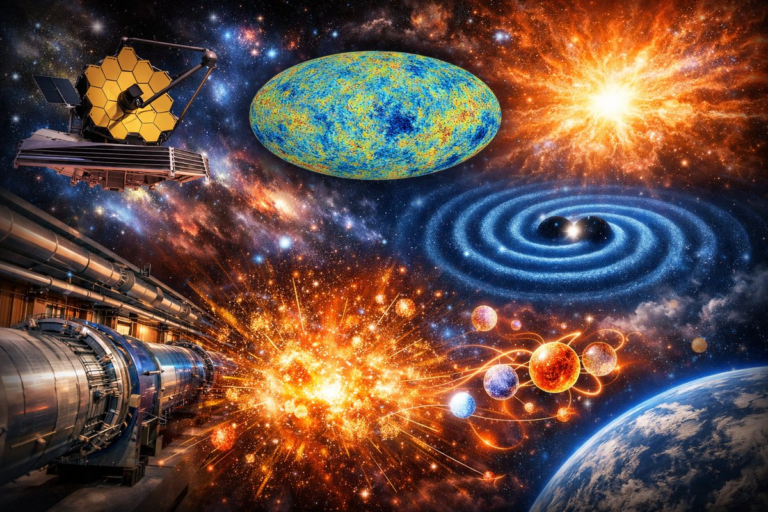
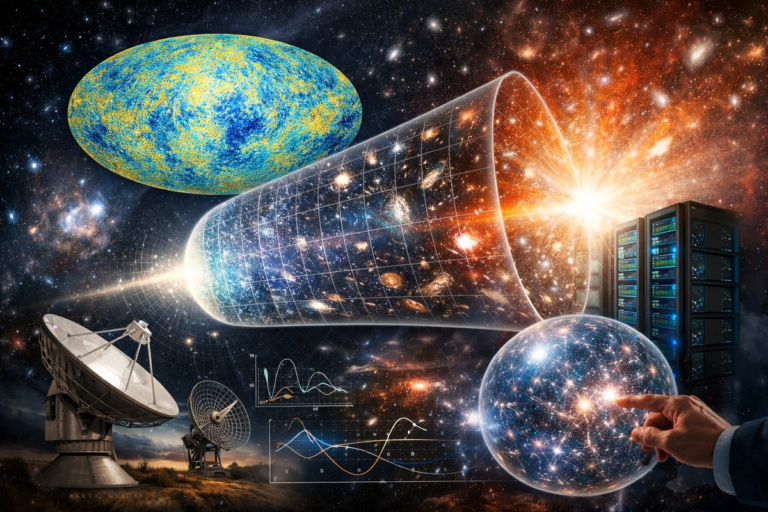
When the universe was just 380,000 years old, electrons and protons combined to form neutral atoms, releasing a sea of photons that has been traveling ever since. This cosmic microwave background, cold and faint, carries within it a record of the primordial era. Researchers pore over its spectrum and tiny irregularities, using them as a cosmic Rosetta Stone. Recent analyses have improved measurements of the universe’s curvature to parts per ten thousand, confirming a flat geometry but also hinting at slight anomalies that could point to new physics.
In parallel, the detection of gravitational waves from black hole and neutron star mergers has opened an entirely new observational window. Some theorists propose that a stochastic background of gravitational waves from the very early cosmos may be detectable by future instruments. A faint hum of spacetime vibrations-echoes from the Planck epoch-would offer an unprecedented glimpse into physics at energies a trillion times higher than those achieved in particle accelerators.
Just minutes after cosmic dawn, nuclear interactions forged the first light elements. The relative abundances of hydrogen, helium, and trace lithium depend sensitively on the expansion rate and the number of particle species present. Observations of primordial gas clouds and ancient stars largely agree with theoretical predictions, but discrepancies in lithium measurements and debates over small deviations in helium fraction continue to spur efforts to refine both astrophysical models and nuclear reaction rates.
Among the most profound mysteries is the universe’s preference for matter over antimatter. According to the Standard Model of particle physics, matter and antimatter should have emerged in equal quantities and annihilated each other completely. Yet the cosmos stands today dominated by matter. Experiments at neutrino observatories and rare-decay searches are probing subtle asymmetries that might tip the balance. A breakthrough in understanding this imbalance could illuminate why we exist at all.
Dark matter, a pervasive form of mass that neither emits nor absorbs light, sculpts the gravitational landscape of galaxies and clusters. Despite decades of searches, its identity remains unknown. Underground detectors shielded from cosmic rays are homing in on hypothetical particles, while astronomical surveys map dark matter’s distribution on everything from galactic to cosmological scales. Advances in detector technology and machine learning algorithms promise to narrow the field of viable candidates or reveal unexpected interactions.
If dark matter is the missing half of the universe’s matter content, dark energy constitutes roughly 70 percent of its total energy budget. This mysterious component drives the accelerated expansion of space, acting like a repulsive force on cosmic scales. Supernova observations and galaxy clustering measurements continue to refine the equation of state of dark energy, yet many models-from quintessence fields to modifications of gravity-compete to explain its origin. Future surveys will track the universe’s growth history with unprecedented precision.
The interplay between experimental cosmology and theoretical frameworks has never been more dynamic. The monumental achievements of space-based observatories and ground networks provide ever more detailed datasets, while high-performance computing facilities simulate cosmic evolution across tens of billions of particles. Together, they help scientists test scenarios that range from multiverse proposals and string-inspired landscape models to bouncing universes that avoid an initial singularity.
On the laboratory front, particle accelerators and neutrino detectors probe energies and interactions that mirror conditions just microseconds after the Big Bang. Precision measurements of fundamental constants, searches for rare particle decays, and tests of symmetry violations offer complementary insights to astrophysical observations. Efforts to integrate all these lines of evidence are driving the quest for a unified theory of physics-a goal that could transform our understanding of time, space, and matter.
Philosophical paradoxes still shadow cosmology. How do we interpret the notion of the universe’s ‘beginning’ if time itself emerged from quantum fluctuations? What does it mean to ask what preceded the Big Bang? Debates over initial conditions, the role of the observer, and the nature of physical law have pushed cosmology into the realm of foundational questions, blurring the line between physics and metaphysics.
Significant new facilities are coming online in the next decade. Ground-based CMB observatories aim to measure microwave polarization with tenfold greater sensitivity. Space missions will map billions of galaxies to chart the influence of dark energy on cosmic expansion. Wide-field spectroscopic instruments will create three-dimensional maps of matter distribution. On the horizon, ambitious concepts like lunar radio arrays and space-based gravitational wave detectors promise to probe epochs even earlier than inflation.
As humanity stands on the threshold of a new golden age of cosmology, each discovery raises fresh questions. The imprint of the first stars, the signals from primordial black holes, the possibility of new forces or particles-all lie in data sets already collected but not yet fully deciphered. In gathering the clues to our cosmic origins, researchers are guided by a spirit of curiosity, an appreciation for our fragile planet, and a recognition of our role as explorers of the deepest mysteries of reality. The quest to journey back to the beginning continues-carrying with it the hope of illuminating both the universe and ourselves.