Location
Mount Vernon, WA 98274
Location
Mount Vernon, WA 98274

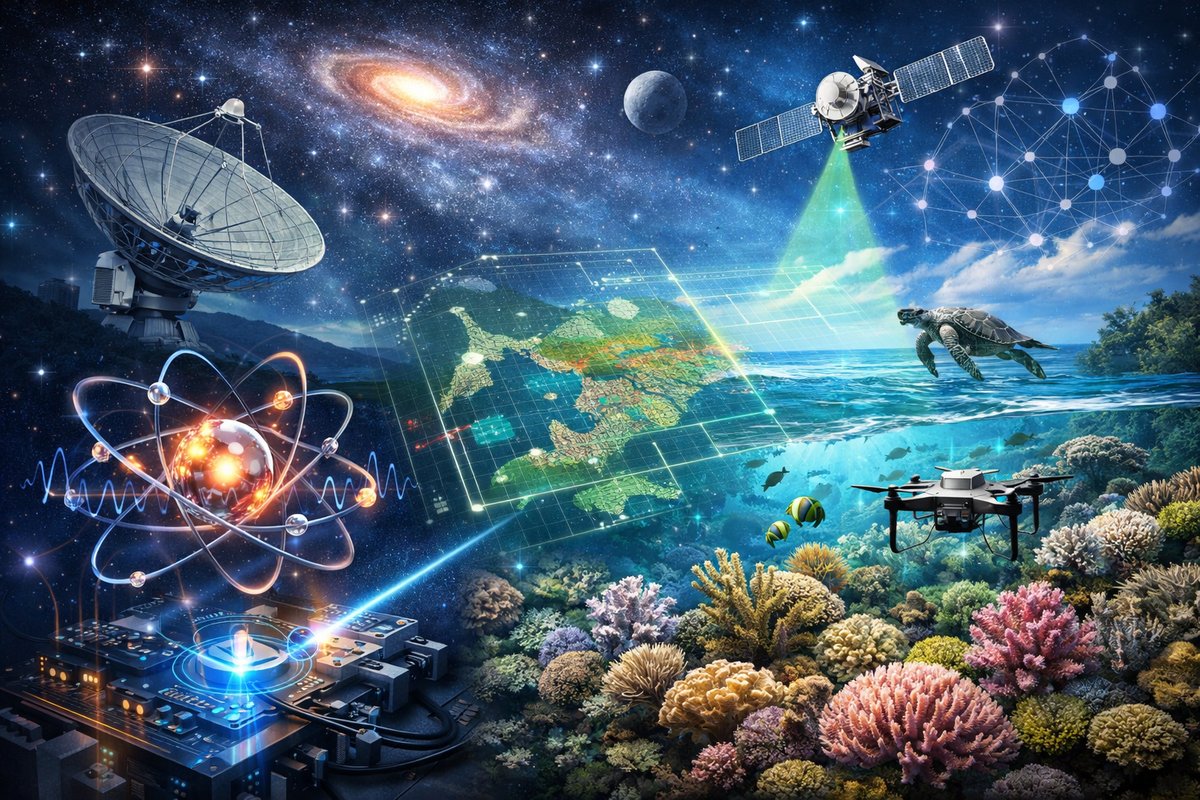
In a world where the tiniest fluctuations in an atom's spin can shed light on the health of distant coral reefs, scientists are weaving together tools from quantum physics, remote sensing, and network models to reveal the fundamental patterns that underlie life and the cosmos. This article explores how breakthroughs in sensor technology, ecological mapping, and cosmic observation are converging to offer unprecedented insights across scales.
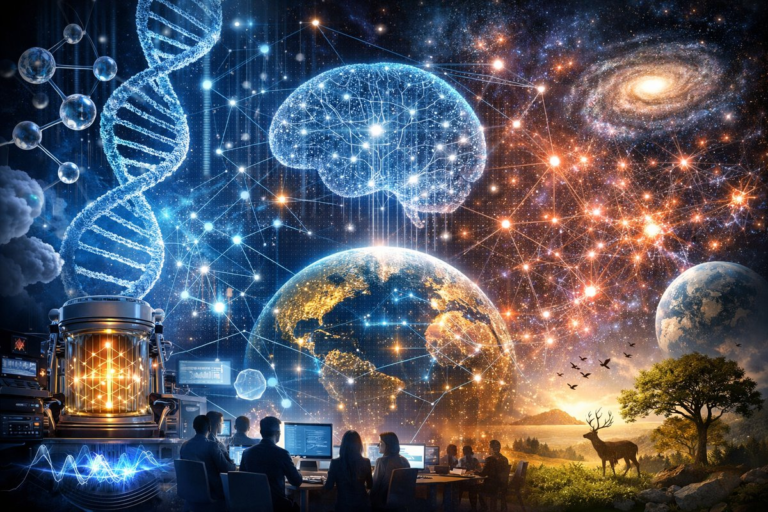
From the humming of lasers in ultracold labs to the rumble of drones skimming treetops, modern science is crafting an unprecedented bridge between the infinitely small and the breathtakingly vast. The contemporary scientific landscape is no longer partitioned into isolated domains of quantum mechanics, ecology, or astrophysics. Instead, researchers are combining advancements in quantum sensing, hyperspectral imaging, and computational network analysis to trace the fingerprints of fundamental forces-from the jitter of subatomic particles to the sweeping currents of planetary ecosystems.
It begins with curiosity. Take the quantum magnetometer: a device capable of detecting magnetic fields millions of times weaker than the Earth’s main field. Originally deployed to study exotic phases of matter and the behavior of electrons in superconductors, these sensors are now finding new life in environmental science. By mounting atom-based magnetometers on underwater vehicles, oceanographers can detect mineral deposits, map subterranean fault lines, and even monitor subtle changes in the Earth’s crust that foreshadow seismic activity. That same precision, when applied to tree roots, can reveal water uptake patterns in drought-stressed forests, offering a novel early-warning system for wildfire risk.
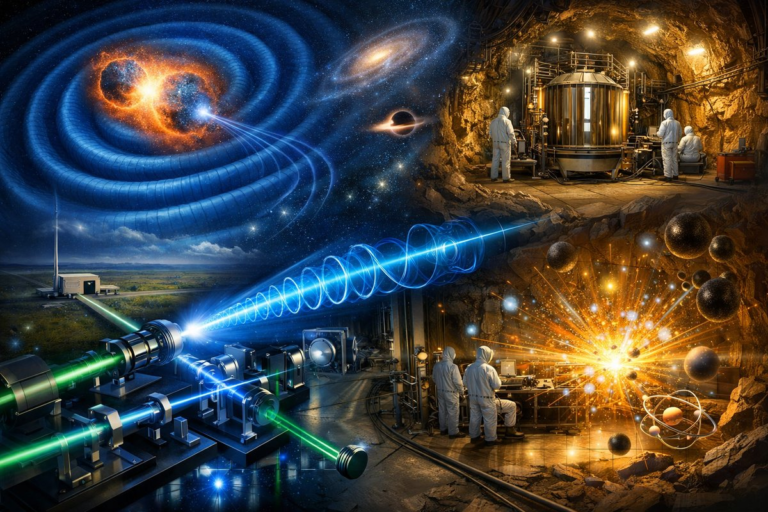
Meanwhile, timekeeping has been taken to an atomic extreme. Optical lattice clocks, which rely on lasers to trap and probe millions of atoms simultaneously, can measure time with such fidelity that a clock would lose less than a second over the entire age of the universe. When networks of these clocks are synchronized and distributed across research stations and offshore buoys, they become sensors for gravitational potential. A tiny shift in local gravity-caused by melting glaciers or rising groundwater-registers as a measurable tick-rate change. This marriage of quantum chronometry and geophysics is revealing how mass redistributes itself across the planet in near real time.
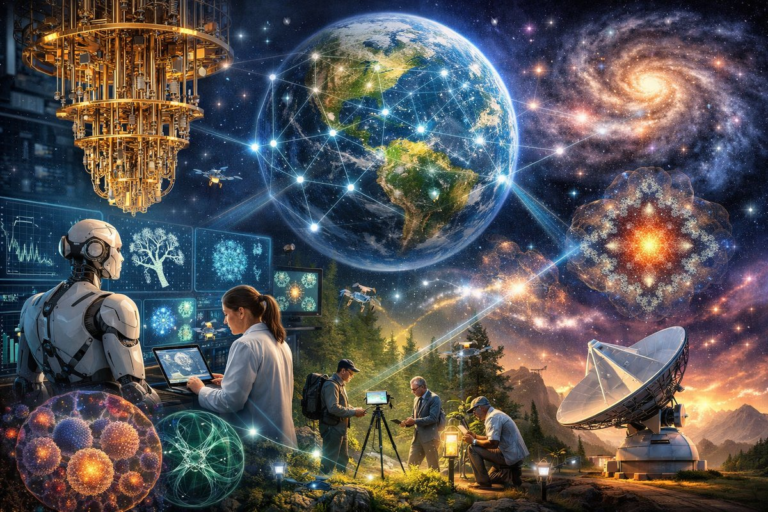
Above land and sea, drones equipped with multispectral imaging cameras are painting a kaleidoscopic portrait of terrestrial and aquatic ecosystems. These aerial platforms operate at altitudes of a few dozen meters to several kilometers, capturing reflected light outside the visible spectrum. Ultraviolet and near-infrared bands highlight plant health, while thermal sensors detect water stress and animal heat signatures. When these datasets are fused with machine-learning algorithms trained on quantum sensor readings from the ground, researchers gain a full 3D picture of nutrient flows, pollutant spread, and biodiversity hotspots.
Citizen scientists are joining the quest, too. Smartphone attachments-compact spectrometers and miniaturized microscopes-are proliferating. Enthusiasts carry pocket‐size devices that capture spectral signatures of local water sources, airborne pollen counts, and particulate pollution. By uploading geotagged measurements to open databases, these volunteers extend the reach of professional research teams into urban canyons, rural valleys, and remote shorelines. The result is a crowdsourced tapestry of environmental data whose granularity would have been impossible just a decade ago.
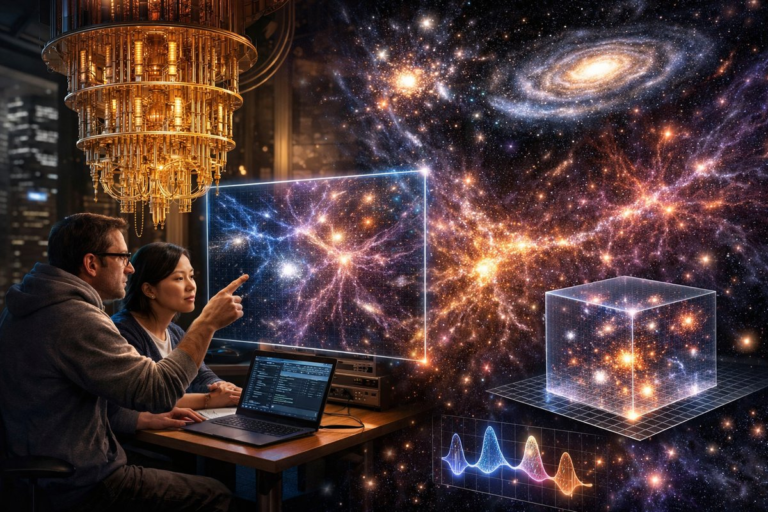
Shifting our gaze skyward, radio antenna arrays in deserts and on mountaintops are scanning the heavens for faint whispers of cosmic origins. Next-generation observatories combine dishes separated by thousands of kilometers; their signals are stitched together via high-speed fiber networks and quantum-secure encryption to produce images with resolutions rivaling optical telescopes. They probe the polarization patterns in the cosmic microwave background, hunt for transient bursts of fast radio signals, and use spectral line mapping to follow the distribution of dark matter across galactic clusters.
In parallel, physicists are exploiting entanglement-a phenomenon once described as “spooky action at a distance”-to build networks of quantum sensors that coordinate observations across continents. By linking magnetometers, gravimeters, and atomic clocks with entangled photons, these distributed systems can cancel out local noise sources and detect signals that would otherwise be buried beneath background fluctuations. Potential applications include subterranean tunnel detection for humanitarian demining, noninvasive monitoring of groundwater flow in agricultural regions, and even the search for exotic particles that could explain dark matter.
But the same principles apply on the social scale. Network scientists map the flow of information, ideas, and disease through communities by borrowing tools from statistical mechanics and percolation theory. The spread of viral memes on social media, the diffusion of innovations in rural villages, and the trajectories of epidemics all reveal fractal patterns-self-similar structures that repeat across scales. By treating individuals or local sensor nodes as “particles” in a networked field, researchers can predict tipping points where small perturbations cascade into major transformations. These insights inform city planning, public health strategies, and the design of resilient supply chains.
Underpinning all these advances is a spirit of modular curiosity. Laser physics labs share calibration protocols with marine research vessels. Ecology field stations adopt data pipelines developed by cosmology collaborations. Software frameworks written for quantum control find new life in airborne lidar analysis. This cross-pollination accelerates discovery because each discipline contributes pieces of a puzzle that spans orders of magnitude.
One striking example comes from a remote archipelago where volcanologists, botanists, and quantum physicists teamed up to study island evolution. Quantum gravimeters monitored subterranean magma flow beneath an active volcano. Simultaneously, drones mapped the regrowth of hardy pioneer plant species on newly formed lava fields. The combined data revealed how nutrient raw materials, soil moisture, and geological activity interplay to create ecological niches that seed future biodiversity. With real-time feedback from ultrastable atomic clocks deployed on buoys offshore, researchers even assessed how tidal stresses influence magma migration beneath the seafloor.
As we peer deeper into the quantum underpinnings of matter, we find echoes in the grand architectures of galaxies and the intricate networks of human society. The same equations that describe electron orbitals inform our models of traffic patterns and opinion dynamics. The same spectral tools that dissect starlight reveal the chlorophyll absorption in a single leaf. This unity of technique reminds us that nature’s patterns do not respect disciplinary boundaries.
The frontier now lies in scaling these integrations to global observatories that blend quantum sensors, environmental drones, citizen networks, and cosmic arrays. Imagine a real-time dashboard that overlays undersea volcanic plumes, atmospheric pollution plumes, migratory animal routes, and space-weather events, all against a forecast of tectonic stress. Such a system would revolutionize disaster preparedness, resource management, and basic research.
But beyond practical applications, the profound takeaway is epistemic humility. Every new instrument extends our sensory reach and reveals that reality is far richer than our previous mental models. Whether you’re calibrating an ion trap or counting tree rings, you’re participating in the same grand quest: to decode the forces and patterns that shape existence from the infinitely small to the infinitely grand.
Science, in this sense, becomes less an archive of facts and more an evolving mosaic of methods. Each discovery is not an endpoint but a portal to new questions. When you calibrate a quantum gyroscope on a drifting iceberg, you’re also sketching the outlines of a universal grammar of motion. When you calibrate a radio dish on the edge of the desert, you’re listening to the heartbeat of stars and the whispers of dark energy.
In the coming decade, expect even more seamless fusions: quantum networks that relay data through satellite constellations; biohybrid sensors that merge living cells with electronic readouts; augmented-reality interfaces that let us visualize fractal patterns in real time. The playground of curiosity, precision, and awe is expanding, and it welcomes explorers of all ages and backgrounds.
Whether your next project is building a DIY spectrometer, contributing to a crowd-sourced phenology study, or simply stargazing with a pair of binoculars, you’re part of a continuum. From atoms to ecosystems to galaxies, science invites you to think deeply, measure precisely, and discover boldly. The patterns are out there, waiting to be uncovered-and the tools at our disposal have never been more powerful or more accessible.