Location
Mount Vernon, WA 98274
Location
Mount Vernon, WA 98274

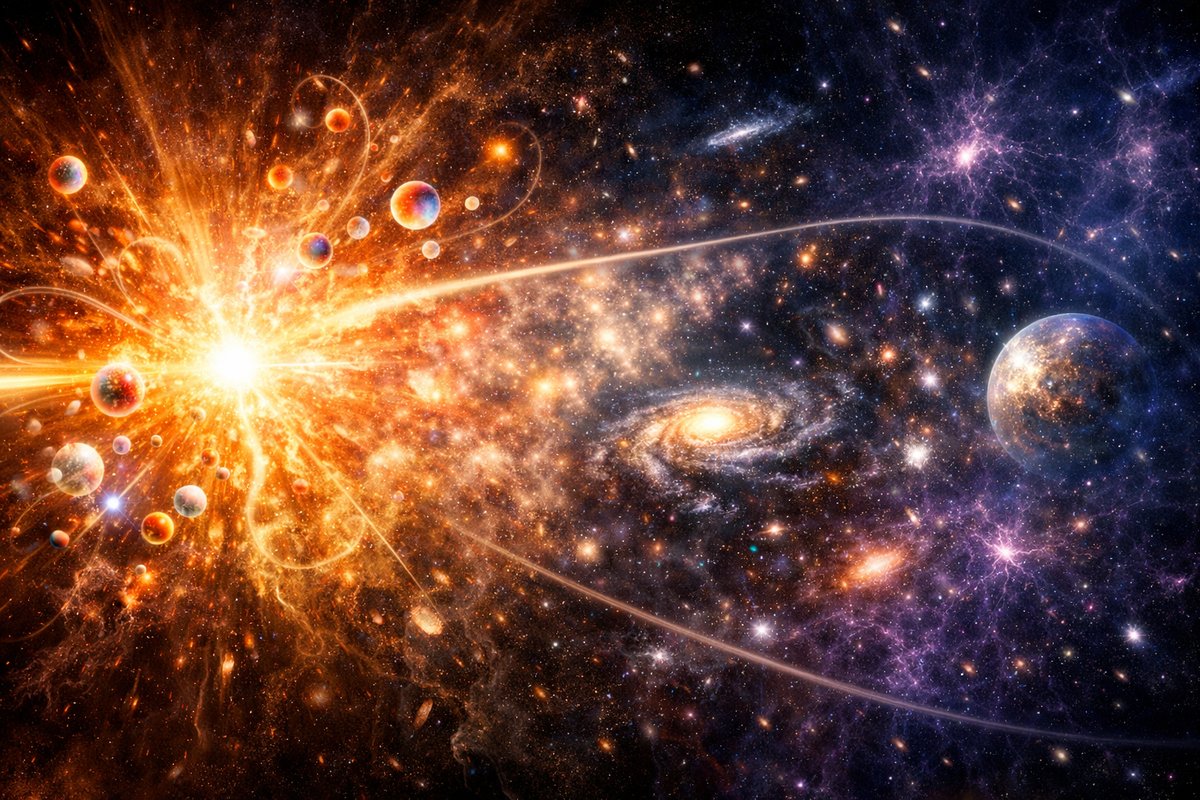
A journey through the earliest instants of existence, tracing how microscopic jitters gave rise to cosmic structures. From the searing furnace of particle formation to the silent vastness of dark energy, this report illuminates the forces and paradoxes that forged everything around us.
The story of the cosmos begins in a realm we can scarcely imagine, where space and time themselves were born. In that infinitesimal instant before even the tiniest fraction of a second passed, the universe existed as a turbulent sea of energy and nascent space. It was here, within quantum fluctuations of unimaginable intensity, that the seeds of all structure were planted. Tiny ripples in the energy field would expand with bewildering speed, laying the groundwork for every star, planet, and galaxy we know today.
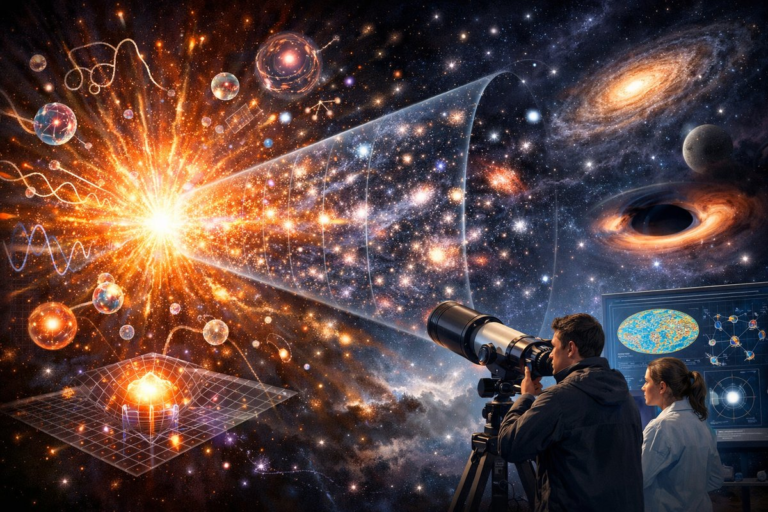
According to the inflation paradigm, those infinitesimal ripples were magnified by the sudden stretching of space. In less time than it takes for a single photon to cross a proton, the universe ballooned by a factor so vast that regions now hundreds of millions of light-years apart were once packed side by side. That explosive growth smoothed out many irregularities even as it amplified quantum jitter into macroscopic patterns. The physics underpinning inflation is still a topic of active research, and telescopes operating across the electromagnetic spectrum continue to hunt for subtle signatures in the cosmic microwave background that might reveal exactly how this process unfolded.
Once inflation slowed, the universe entered a hot, dense phase where temperature and pressure reached extremes beyond any earthly experiment. In that cosmic crucible, four fundamental forces-gravity, electromagnetism, and the strong and weak nuclear interactions-began to separate from an earlier, unified state. Particles and antiparticles formed in pairs, and as the seething plasma cooled, some found partners to annihilate, while others persisted. That delicate imbalance between matter and antimatter shaped our very existence; without it, there would be no atoms, no stars, and no observers to ponder the cosmos.
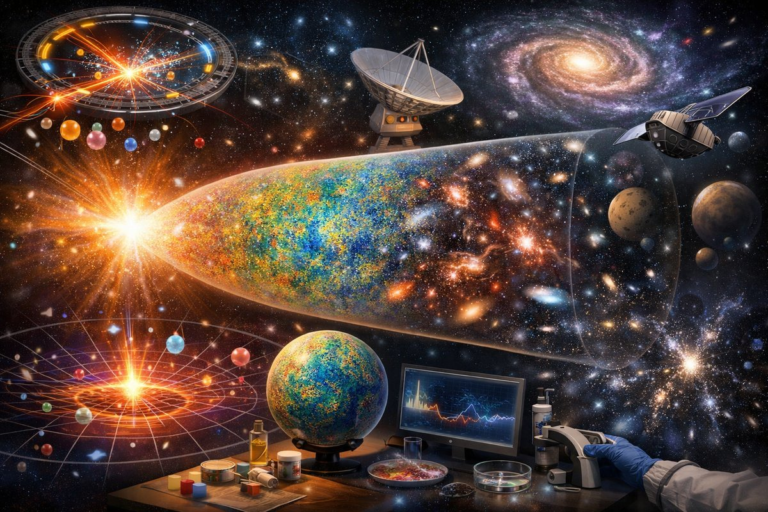
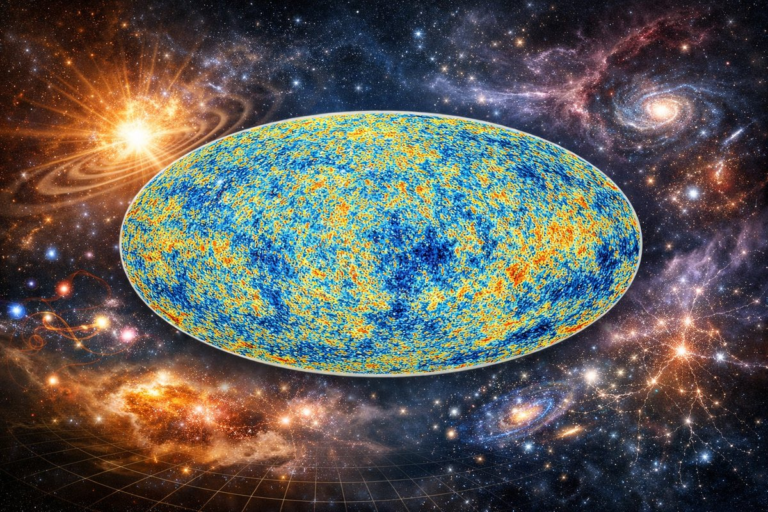
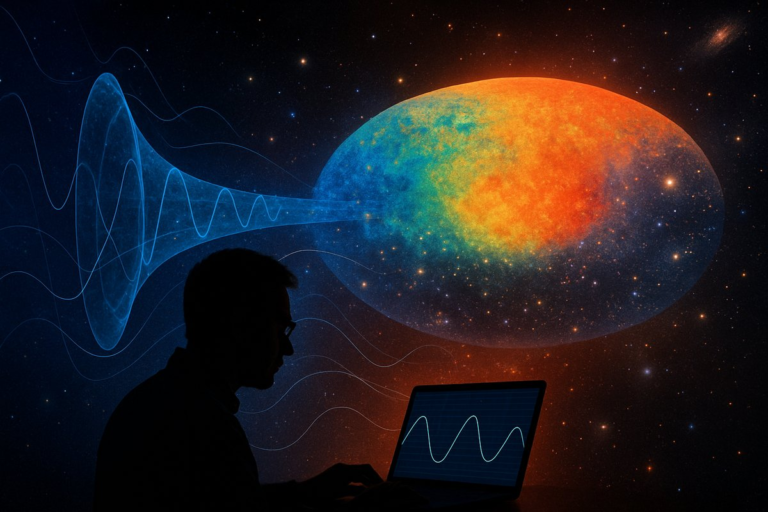
Within the first few minutes, protons and neutrons fused into light atomic nuclei in a process known as primordial nucleosynthesis. Brief though it was, this epoch set the initial chemical makeup by creating hydrogen, helium, and trace amounts of lithium. For hundreds of thousands of years, the universe remained an opaque fog of plasma. Only when electrons combined with nuclei to form neutral atoms did photons break free, flooding space with the afterglow we detect today as the cosmic microwave background. Sensitive detectors aboard space observatories and ground-based radio telescopes have mapped those faint relic photons, revealing a pattern of hot and cold patches that offers a snapshot of the infant cosmos.
Even as atoms coalesced under gravity to form the first stars and galaxies, another invisible ingredient was shaping cosmic evolution. Dark matter, an elusive substance detected only through its gravitational pull, acts as scaffolding for galaxy formation. It remains undetected by conventional instruments, but its fingerprints are seen in the motion of stars and the bending of light around massive clusters. Meanwhile, a mysterious force called dark energy is now accelerating cosmic expansion, pushing galaxies ever farther apart. These two invisible components account for roughly 95 percent of the universe’s content, yet their nature remains one of the greatest unsolved puzzles in modern physics.
At the heart of these mysteries lie paradoxes that challenge our deepest intuitions. The horizon problem asks how regions of the universe never in causal contact nonetheless exhibit nearly identical properties. The singularity at time zero defies description under known laws, where density and curvature become infinite. Some theoretical frameworks suggest that our observable cosmos could be just one bubble in a vast multiverse, each with its own laws and constants. If true, such speculation touches philosophical as well as scientific questions about why our cosmic patch appears finely tuned for complexity and life.
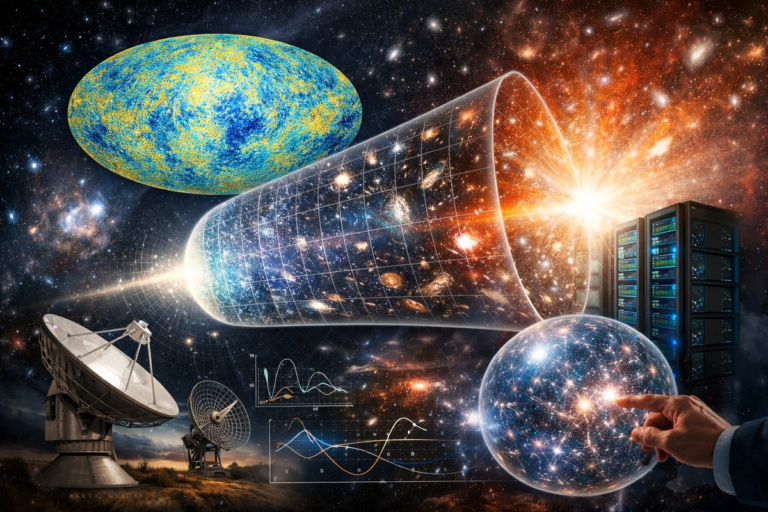
To probe these frontiers, researchers combine powerful particle accelerators with advanced computer simulations. Particle colliders recreate conditions similar to those in the early universe, revealing how fundamental particles acquire mass or transform under extreme energy. On the computational side, high-performance clusters run codes that simulate the growth of cosmic structures over billions of years, tracing the interplay of gravity, gas dynamics, and dark matter. Amateur astronomers and students can also join the quest using sky charts, star-mapping apps, and backyard telescopes to observe distant galaxies, nebulae, and transient events like supernovae.
The search for origins is more than a scientific endeavor; it stirs emotions of wonder, humility, and curiosity. As we reflect on our place within an ever-expanding cosmos, questions about meaning and purpose emerge. How do the forces that governed the first trillionths of a second relate to the rise of consciousness? Can understanding the architecture of spacetime reshape our ethical perspectives? These are not distractions but integral to the human impulse to explore and connect.
Though we may one day send probes to the cosmic edge or develop detectors sensitive enough to spy on neighboring universes, the essence of discovery remains the same: a blend of imagination, rigorous observation, and collaborative spirit. From the tiniest quantum event to the largest galaxy cluster, each clue brings us closer to a coherent narrative of existence. And while the next breakthrough could arrive from an underground laboratory or a space-borne observatory, the journey to the beginning is a collective odyssey inviting everyone to look up, ask questions, and seek new horizons.