Location
Mount Vernon, WA 98274
Location
Mount Vernon, WA 98274

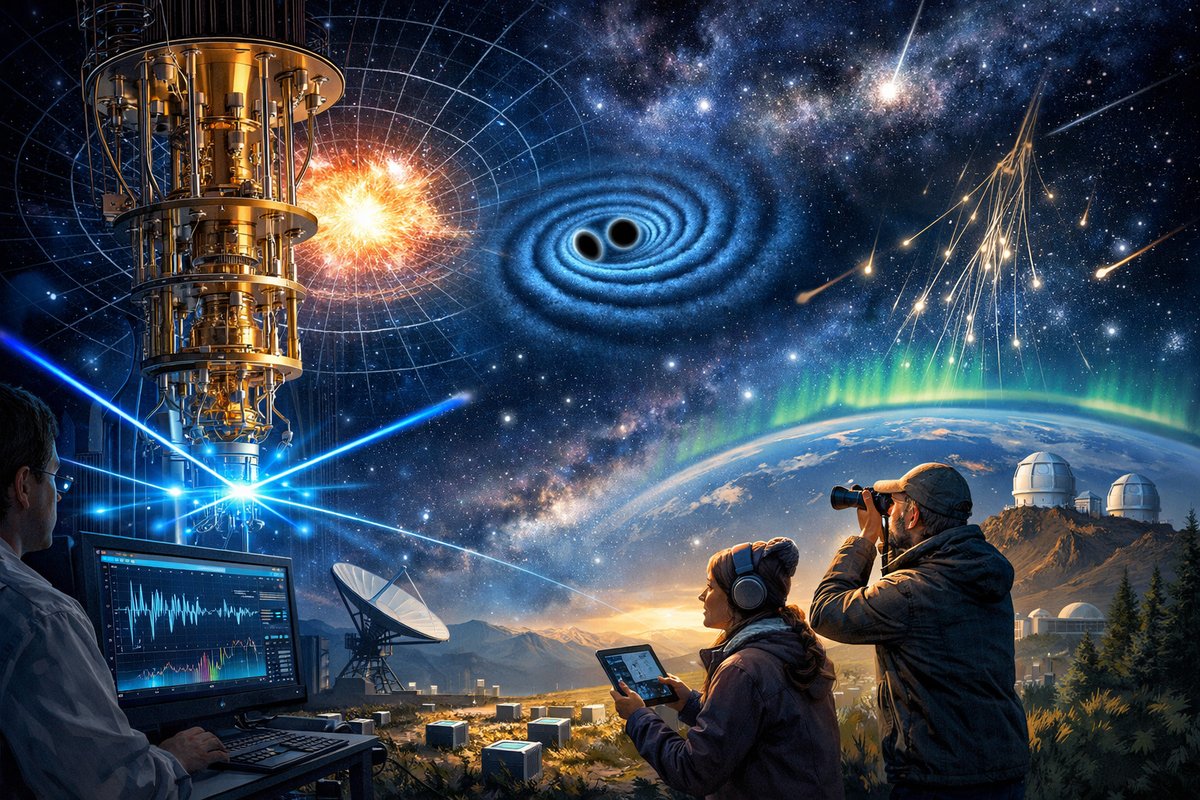
A new generation of quantum-enabled detectors is listening to the universe in ways never before possible-capturing the faint tremors of the Big Bang and the dance of cosmic rays in Earth's atmosphere. This article explores how precision measurement meets wonder at scales from the subatomic to the cosmological, and how citizen scientists are joining professional labs in a global quest for discovery.
Humanity has long gazed upward, searching for clues to our cosmic origins in starlight and the silent hum of space. Now, a wave of quantum-enhanced sensors promises to transform that age-old curiosity into an unprecedented scientific playground. By harnessing the delicate properties of quantum states-entanglement, superposition and extreme sensitivity-researchers are constructing arrays of detectors capable of picking up signals so faint they were once thought lost in cosmic noise.
The cosmic microwave background (CMB), relic radiation from the universe’s fiery birth, has been a treasure trove for physicists mapping parameters of inflation and dark matter. Yet its subtle polarization patterns and temperature fluctuations still hide deeper secrets about the earliest microseconds after the Big Bang. At the same time, cosmic rays-high-energy particles bombarding Earth’s atmosphere-carry information about distant supernovae and the structure of our galaxy’s magnetic web. Traditional radio antennas or ground-based observatories can only scratch the surface of these phenomena, limited by thermal noise and environmental interference.
Enter superconducting nanowire single-photon detectors and atomic magnetometers cooled near absolute zero. These quantum devices can detect single microwave photons from the CMB and minute magnetic field perturbations caused by passing cosmic rays. Advances in materials science have produced wires just a few atoms thick, coupled with cryogenic amplifiers that maintain noise at imperceptible levels. Optical atomic clocks, once the province of national metrology institutes, have been miniaturized into transportable modules, offering picosecond precision in timing cosmic ray showers as they ripple through atmospheric layers.
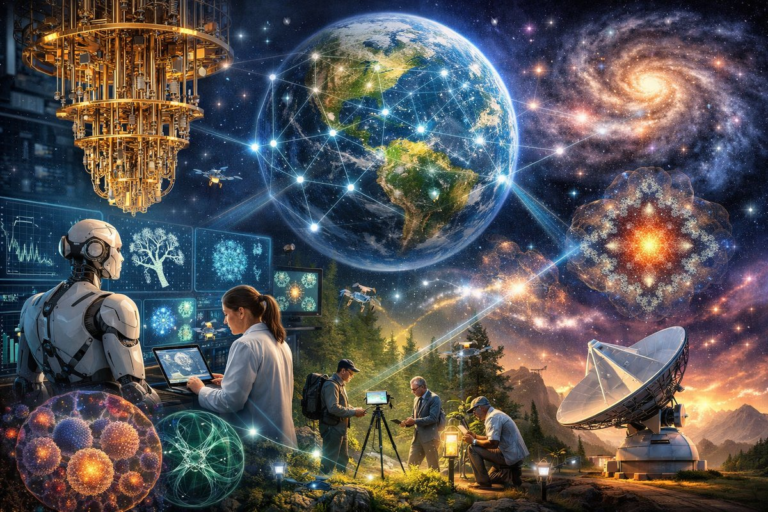
Researchers have begun linking hundreds of these sensors into a global network known as the Quantum Cosmic Observatory (QCO). Each station, installed at universities, high-altitude research stations and even private backyards, streams timestamped data to open-access platforms. Citizen scientists, from students to amateur astronomers, can download raw measurements and test hypotheses about solar storms, geomagnetic anomalies or hidden signatures of primordial gravitational waves. This crowd-sourced approach accelerates anomaly detection and invites fresh perspectives from outside institutional labs.
Local geographic features become part of the experiment. Mountainous observatories detect cosmic ray footprints filtered through different atmospheric thicknesses, while urban sites contend with electromagnetic pollution that must be meticulously calibrated out. Sensor nodes near coastlines reveal how humidity and salt aerosols influence the distribution of secondary particles. Ecologists are now collaborating with physicists to co-monitor environmental variables-temperature, pressure and humidity-to isolate subtle correlations between cosmic patterns and climate processes.
Just last year, a QCO station in the Andes recorded an unexpected cluster of ultra-high energy events coinciding with solar flare impacts. The anomaly sparked real-time alerts across the network, prompting further observation by radio telescopes and neutrino detectors. Preliminary analysis suggests a transient channeling effect in Earth’s magnetic field-an effect predicted by theoretical models but never observed at this scale. These early successes hint at a future where every cryptic ripple from the cosmos can be tracked and studied with citizen engagement.
On the theoretical front, data from quantum sensors are feeding into models of early universe inflation and quantum gravity. By comparing the polarization of CMB photons detected at different latitudes, physicists hope to test ideas about cosmic topology-whether the universe has subtle twists and folds on scales billions of light-years across. Meanwhile, timing jitter in atomic clocks exposed to fleeting gravitational wave passes could open a complementary window to observatories like LIGO and Virgo, which focus on much more violent astrophysical events.
For those who want to join the quest, modular DIY kits have emerged. Building a simplified cosmic ray detector with scintillator panels and photomultiplier sensors is now within reach of motivated learners. Online communities offer step-by-step guides on cooling simple superconducting circuits with liquid nitrogen, calibrating photon counters, and integrating Arduino-based microcontrollers for data logging. Such initiatives foster not only technical skills but also a sense of shared stewardship over the scientific process.
The philosophical implications are profound. As we link quantum uncertainty to cosmic vastness, familiar notions of scale and causality blur. Every single photon from the CMB and every charged particle from distant supernovae reminds us that the universe is in constant conversation with our planet. In deciphering these faint whispers, we also confront questions about consciousness and observation-how the act of measurement shapes the reality we perceive.
The QCO’s open-data ethos champions transparency and inclusivity. All raw data streams and analysis tools are released under permissive licenses, ensuring that researchers in under-resourced regions can participate without financial barriers. Workshops and hackathons teach vulnerable communities to shield sensors from local interference and to interpret cosmic signals alongside pressing environmental data-highlighting the intersection of pure science and societal resilience.
Looking ahead, the integration of quantum sensors with neutrino observatories, laser interferometers and space-borne telescopes promises a new era of multi-messenger astronomy. Imagine a global alarm triggered by a subtle shift in CMB polarization, followed by targeted observations of a newly forming black hole merger across the electromagnetic spectrum and in neutrino bursts. This seamless choreography between micro and macro detectors could reveal the mechanics of extreme astrophysical engines in real time.
Our place in this unfolding story is both humble and audacious. We stand on the brink of listening to the universe in frequencies we have never heard, decoding messages that have traveled billions of years to reach us. Each quantum sensor, whether nestled in a professional lab or perched on a student’s windowsill, is a testament to human curiosity and collaboration. As more voices tune in, the collective symphony of cosmic whispers will guide us toward deeper insight and ever greater wonder.