Location
Mount Vernon, WA 98274
Location
Mount Vernon, WA 98274

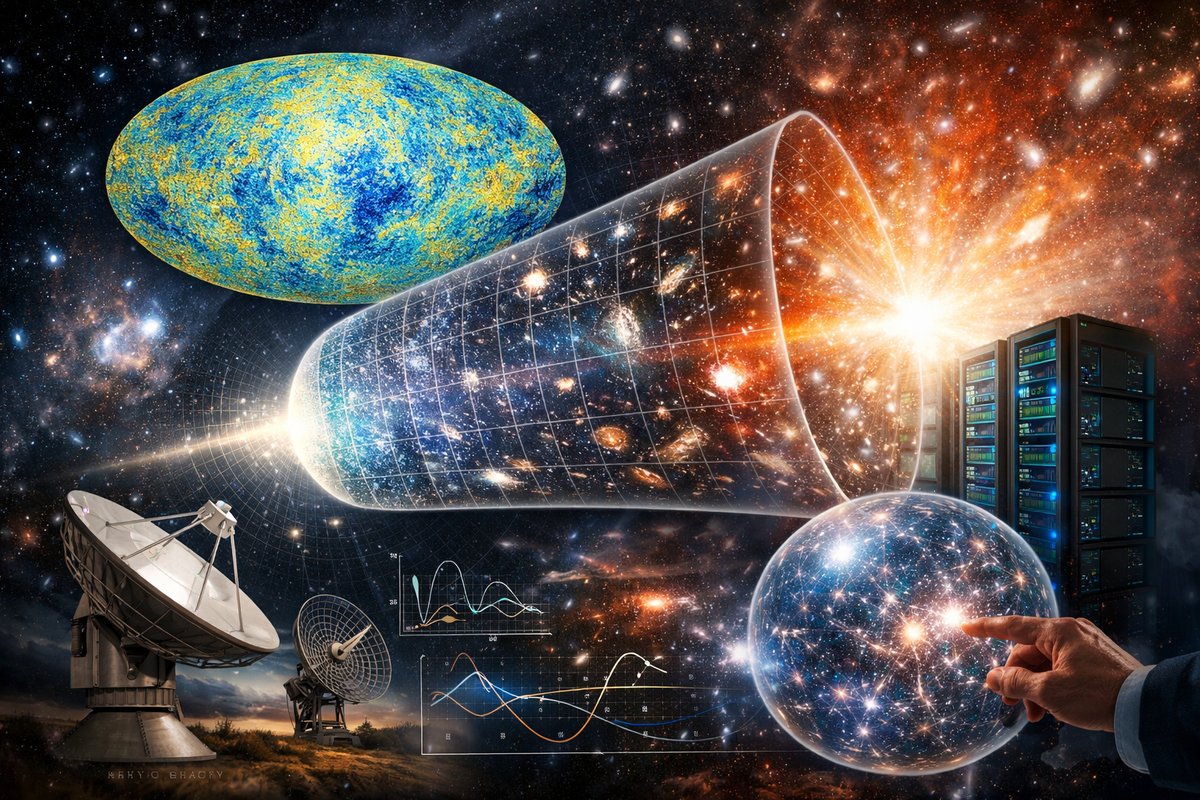
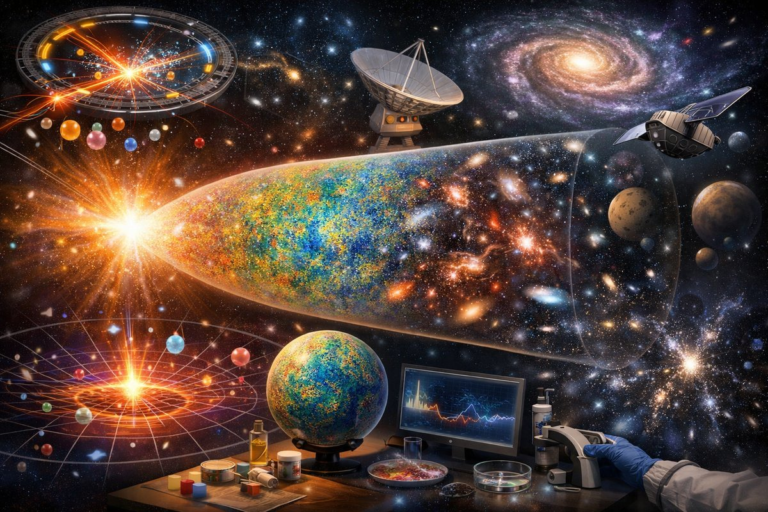
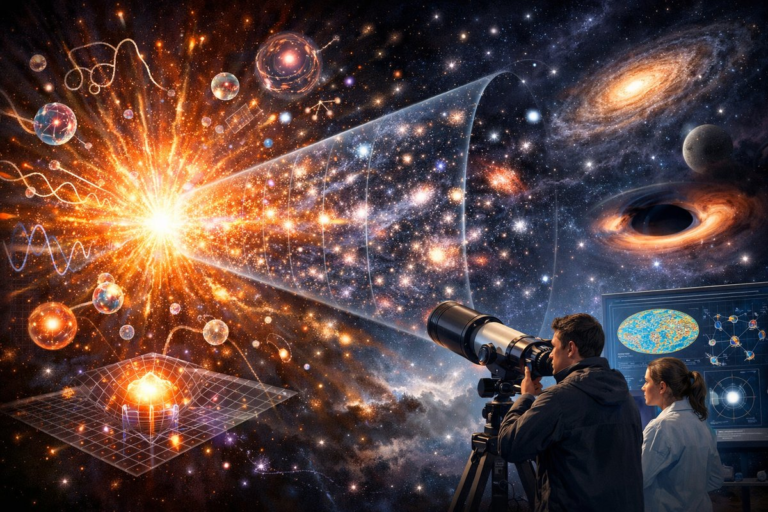
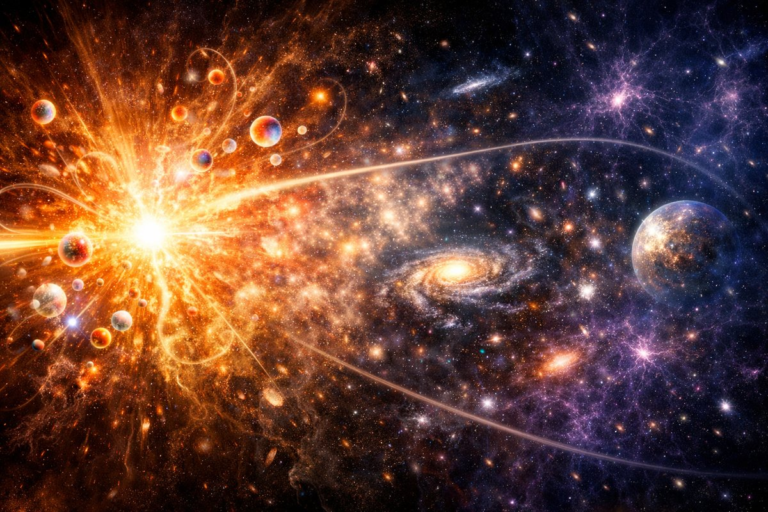
A convergence of observational breakthroughs and theoretical innovations is reshaping our view of the cosmos' origin. From subtle anomalies in the microwave background to exascale simulations that stretch back to the Planck epoch, researchers are piecing together a narrative that could redefine the Big Bang framework.
In laboratories around the world and observatories perched on remote summits, scientists are racing to unlock the universe’s hidden blueprint. A flurry of recent results-from new measurements of cosmic expansion to the first hints of inflationary gravitational waves-has thrust origin studies into the spotlight. Teams analyzing data from advanced sky surveys say these emerging signs could bridge the gap between quantum mechanics and general relativity, offering a unified glimpse at how space, time and matter sprang into existence.
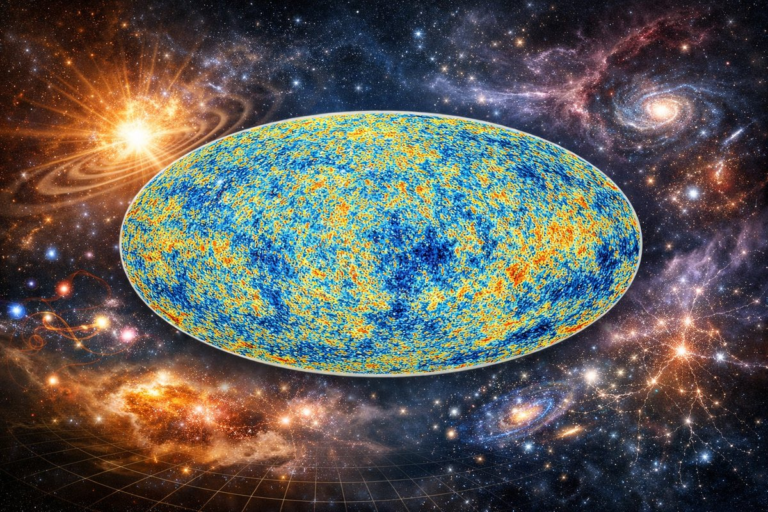
One of the most compelling threads comes from detailed maps of the cosmic microwave background (CMB). Decades after its discovery, the afterglow of the Big Bang still yields surprises. Recent polarization studies using ground-based telescopes in Chile have revealed faint patterns that may trace primordial gravitational ripples. If confirmed, these signals would carry the imprint of inflation-a rapid expansion that smoothed the newborn cosmos and seeded the galaxies we see today. Researchers caution that foreground dust and instrumental effects can masquerade as true inflationary signatures, driving an intense push for cross-validation with independent facilities and new frequency bands.
Complicating the narrative is the persistent Hubble tension, a mismatch between early-universe estimates of cosmic expansion and measurements taken from nearby supernovae. Observations of the CMB suggest one expansion rate, while direct observations of Cepheid-variable stars and exploding supernovas point to a faster pace. This discrepancy sits at more than a five-percent level-small enough to elude casual notice but large enough to challenge the standard cosmological model. Proposed resolutions range from undiscovered dark radiation to subtle breakdowns in general relativity at large scales, and some theorists even entertain exotic early-universe phase transitions that could leave residual effects still detectable today.
To test these ideas, computational cosmologists are harnessing exascale supercomputing to simulate the universe’s first fractions of a second. These simulations model quantum fluctuations at energy scales billions of times higher than those produced in terrestrial accelerators. By tweaking parameters for particle interactions under extreme conditions, researchers can predict the density fluctuations that evolve into galaxy clusters and cosmic voids. The latest runs, conducted on multi-petawatt GPU arrays, have improved resolution by an order of magnitude and are already generating new predictions for the distribution of dark matter and gravitational lensing signatures.
Meanwhile, on the experimental front, particle colliders continue to explore high-energy physics that could shed light on the very earliest moments of creation. Upgrades to existing accelerators aim to probe beyond the current energy frontier, seeking rare processes that might hint at supersymmetry or extra dimensions. Although no direct evidence has emerged, sensitive detectors are now capable of measuring multi-boson interactions with unprecedented precision. Should any of these interactions deviate from Standard Model expectations, they could reveal how fundamental forces unified when the cosmos was less than a trillionth of a second old.
Beyond colliders, neutrino observatories at the South Pole and deep underground labs are tuning in to ghostly particles produced in cosmic accelerators and supernovae. These detectors, filled with thousands of tons of ultrapure water or ice, capture fleeting flashes of Cherenkov light when neutrinos interact. By analyzing the energy spectrum and arrival directions, scientists hope to trace neutrinos back to extreme astrophysical phenomena-and perhaps detect the faint background of relic neutrinos from the Big Bang itself. Securing a direct measurement of cosmic neutrino background would mark a milestone in reconstructing the universe’s thermal history.
Cosmic rays, too, carry information from the universe’s most violent epochs. Balloon-borne experiments and mountain-top detectors monitor high-energy protons and atomic nuclei that traverse intergalactic space. Patterns in their energy distribution and arrival angles can hint at magnetic fields woven throughout the cosmos and test models of particle acceleration. A recent campaign detected an unexpected excess of high-energy electrons, prompting fresh debate over whether dark matter annihilation or pulsar wind nebulae serve as the dominant source. Resolving this question could narrow down the particle properties that shaped the early universe’s chemistry.
On the gravitational wave side, ground-based interferometers have become more sensitive with each observing run. Detecting mergers of black holes and neutron stars has already opened a new window on cosmic history. Yet a quieter, primordial background of gravitational waves-echoes from the universe’s birth-remains elusive. Proposed space missions plan to launch laser interferometers millions of kilometers apart, targeting the low-frequency band where inflationary waves would linger. Securing a detection would offer direct evidence of quantum fluctuations in spacetime itself.
Theoretical paradoxes persist at every corner of origin research. The infamous information paradox, born from attempts to reconcile black hole evaporation with quantum mechanics, now finds echoes in cosmological singularities. If classical descriptions break down at time zero, how do we define physical observables before the Planck time? Some radical proposals invoke a bounce preceding our expanding universe, while others suggest that time itself emerges from entangled quantum degrees of freedom. Although highly speculative, these ideas drive new mathematical frameworks that may one day converge with experimental data.
Central to these investigations is the dark sector, comprising dark matter and dark energy-components that represent 95 percent of the universe’s content yet remain invisible. Direct detection experiments underground are pushing sensitivity to unprecedented levels, searching for weakly interacting massive particles or alternative candidates like axion-like fields. Astronomers, meanwhile, map the large-scale galaxy distribution to infer how dark energy accelerated cosmic expansion over eons. Future surveys will overlap spectroscopic and imaging data to reconstruct the three-dimensional cosmic web, testing whether dark energy is a cosmological constant or a dynamic field.
A surprising ally in cosmology’s quest has been artificial intelligence. Machine-learning algorithms sift through petabytes of telescope images to identify faint galaxies at extreme distances. Neural networks extract subtle patterns in CMB maps, isolating potential inflationary imprints from astrophysical foregrounds. Reinforcement learning techniques optimize complex simulation parameters, speeding up convergence and reducing systematic biases. By embracing these tools, researchers can explore broader model spaces and uncover hidden correlations that traditional methods might miss.
Looking ahead, a suite of next-generation observatories and experiments promises to deepen our understanding of cosmic origins. Ground-based facilities will deploy arrays of small telescopes to survey the radio sky, while space observatories tuned to infrared and submillimeter wavelengths will peer through cosmic dust to find the first stars and galaxies. Meanwhile, upgrades to terrestrial interferometers and neutrino detectors will sharpen our view of the universe’s most energetic events. On the theoretical side, interdisciplinary collaborations are forging connections between quantum information theory, condensed-matter physics and gravity, seeking a common language for the primordial epoch.
As these efforts unfold, one theme emerges: the universe’s origin story is more intricate than any single observation or theory can capture. Each experiment contributes a piece to a cosmic puzzle-whether it’s a subtle twist in a gravitational wave signal, a new class of particles glimpsed in a collider or a simulation that reveals unexpected structure at the smallest scales. Together, these advances bring us closer to an epochal understanding of where everything came from-and hint at mysteries that may forever lie beyond our horizon.
Taking stock of this whirlwind of discoveries, the field stands at a crossroads. Will the next breakthrough finally unite quantum and gravity, or will it expose deeper layers of paradox? Either way, the journey to the beginning continues to challenge our assumptions, inspire new technologies and awaken a sense of wonder about the cosmic tapestry that envelops our world. More than a quest for facts, it is a story of human curiosity reaching back to the moment when time itself ignited.