Location
Mount Vernon, WA 98274
Location
Mount Vernon, WA 98274


Small-scale operations and regional cooperatives are harnessing solar power, sensor networks, and rotational grazing to cut emissions, boost animal welfare, and build resilient rural economies. This article explores real-world examples of farms integrating tech and tradition to sculpt more sustainable livestock systems.
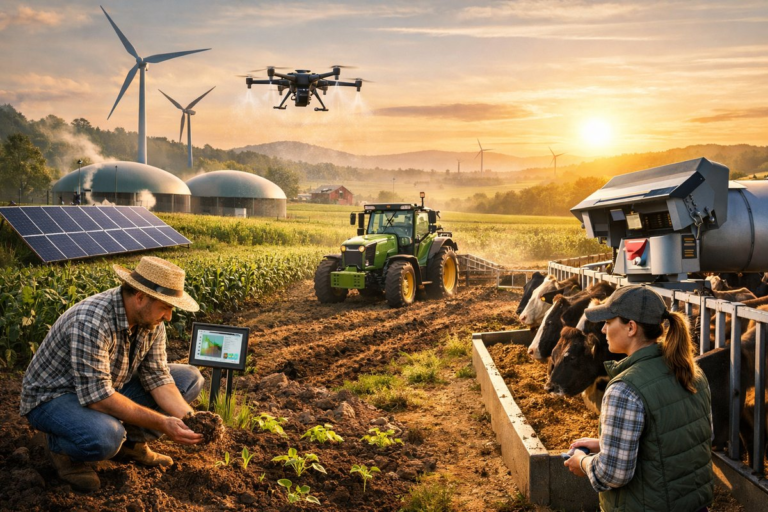
On a rolling ridge of reclaimed prairie in the Upper Midwest, a multigenerational family farm has become a quiet laboratory for sustainable livestock care. Here, cattle graze on carefully managed pastures, water troughs powered by rooftop solar panels fill automatically at dawn, and sensor kits buried four inches into the soil alert the farm manager when moisture levels dip below critical thresholds. What was once a legacy cattle operation reliant on fossil-fuel irrigation and uniform pastures has evolved into a living blueprint for rural innovation.
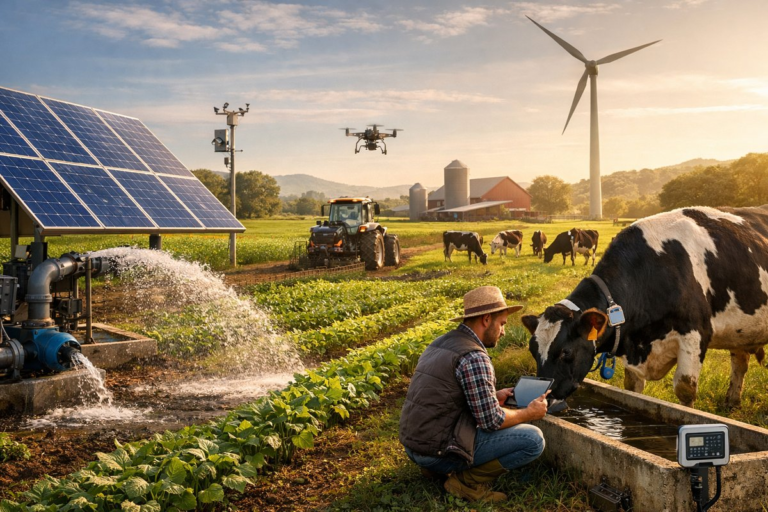
The conversion to this mixed-technology model began five years ago, when extreme weather swings-from parching droughts to unseasonal frosts-threatened both hay yields and herd health. Driven by farm budgets squeezed by rising feed costs, and spurred by a regional university extension grant, the family installed a modest solar array atop its old main barn. That investment financed a solar-powered livestock water pump, eliminating the need for a propane generator and slashed annual energy costs by nearly 40 percent. The system now supports three automatic stainless-steel troughs distributed across rotational paddocks, guaranteeing fresh water at all hours with minimal manual labor.
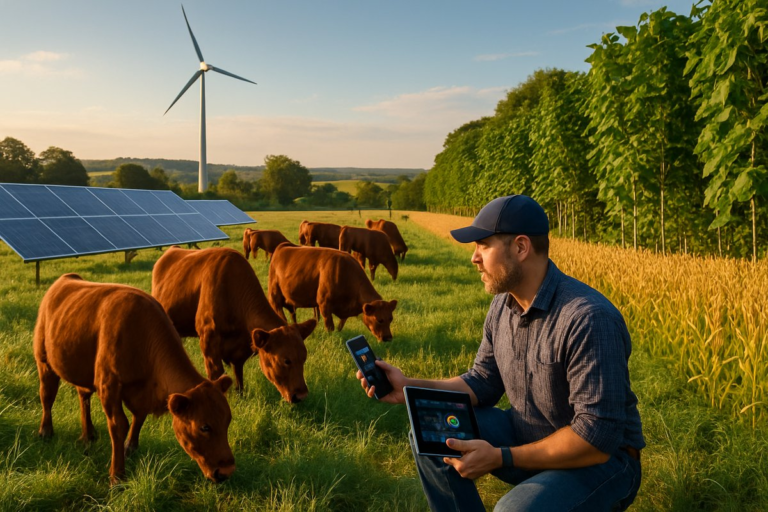
But the transition wasn’t simply about the power source. It grew from a philosophy that land, animals, and people thrive best when managed holistically. The farm introduced a wireless soil moisture sensor kit that collects data every hour, feeding it into an open-source dashboard accessible on smartphones. When readings indicate drying soils, an automatic drip irrigation line delivers targeted hydration only where needed. That precision watering not only conserves water-it ensures that grasses maintain high nutritional value, improving weight gains in grazing cattle and reducing reliance on expensive supplemental feed.
Across the region, other farmers have adapted similar solutions. One cooperatively owned ranch in the Great Plains uses real-time pasture mapping via drone imagery. Lightweight multispectral cameras chart vegetation health across hundreds of acres, creating heatmaps that pinpoint zones suffering from overgrazing or nutrient stress. Managers then rotate herds away from depleted patches and toward newly rested grasslands. According to a recent Food and Agriculture Organization study, rotational grazing combined with data-driven pasture planning can boost forage productivity by up to 20 percent, while cutting methane emissions per pound of beef produced.
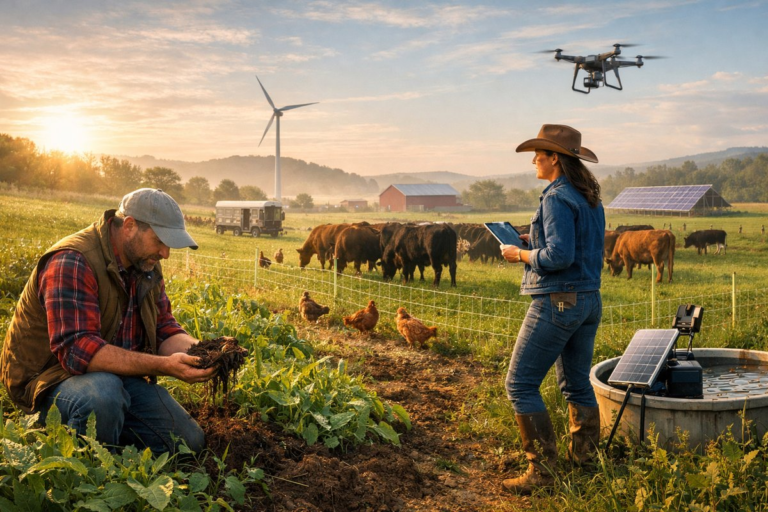
Integrating technology doesn’t mean abandoning tradition. On a small hillside homestead further south, a handful of shepherds still uphold age-old practices like daily herd checks and seasonal lambing camps. But they supplement these rituals with mobile electric fence energizers, enabling them to create temporary night pens anywhere along steep ridges or creek bottoms. The portability of these energizers-powered by rechargeable batteries rather than mains electricity-has let them trial new grazing layouts without extensive fence posts or trenching. The result is a mosaic of rested and grazed fields that promotes deeper root systems, improved carbon sequestration, and lower feed costs during winter.
Animal welfare remains central to all these experiments. In Wisconsin dairy barns, for example, compost bedded pack systems are replacing sand stalls. These stalls are littered daily with wood shavings or straw, which, over time, decompose into rich compost. Cows spend their days on a soft, warm surface that encourages longer resting times, better hoof health, and lower stress levels. When the bedding material has served its purpose, it is co-composted with crop residues to return nutrients to fields, completing a circular nutrient flow.
Yet sustainability reforms reach beyond equipment and barn floors. Regional cooperatives are building local feed mills that process cover crop residues, like rye and oats, into high-fiber pellets. These byproducts, once tilled under or left to rot, now become affordable winter feed with predictable nutritional profiles. Cooperative members share equipment costs, split the milling facility’s operating hours, and rotate responsibilities for quality control-ensuring that even smallholders can access feed they can trust without long-distance hauling.
Meanwhile, veterinary care is evolving to match these on-farm innovations. Mobile vet clinics equipped with solar panels on their rooftops bring ultrasound scanners, digital scales, and portable hoof trimmers directly to pastures. Farmers no longer need to trailer animals miles for routine checkups. Preventive protocols-like tailored vaccination schedules and parasite monitoring with fecal egg count kits-are facilitated by real-time data logging on tablets. Herd health records become living documents, helping producers identify emerging issues before they escalate into costly outbreaks.
What drives adoption of these technologies? For many, it’s a confluence of necessity and curiosity. Smaller profit margins have pushed operations to seek efficiencies. Extreme weather events-now more frequent according to global climate assessments-have revealed vulnerabilities in traditional systems. And a new generation of farmers, digitally fluent and attuned to environmental challenges, is ready to pilot experiments that grandparents once dismissed as fads.
Policy support amplifies these grassroots efforts. State-level incentives for on-farm renewable energy installations have funded solar arrays and wind turbines at a dozen pilot sites in recent years. Grant programs now offer cost-share funding for precision irrigation kits and electric fence energizers. And low-interest loans through agricultural banks encourage early adopters to trial sensor networks and drone-guided pasture planning without risking their entire balance sheet.
Community engagement completes the innovation cycle. Demonstration days, hosted on working farms, invite neighbors and curious students to walk through rotating pastures, inspect compost stalls, and view data dashboards. These events spark rich conversations about soil biology, animal behavior, and farm resilience. They yield practical tips-like mixing cover crop species to balance root depths or placing solar pumps on the north side of barns to maximize sun exposure in winter months. Attendees leave with a toolkit of ideas they can tailor to their own landscapes.
Still, challenges remain. Upfront costs-though reduced by incentives-can deter the smallest operations. Data management requires basic digital skills and reliable internet connectivity, which can be sparse in remote counties. And integrating multiple systems-solar power, sensors, herd mobility-demands a level of planning and maintenance that can strain limited farm labor.
Yet the long-term returns are promising. Farms using integrated technology report lower energy bills, improved grazing yields, and healthier livestock with fewer veterinary interventions. Regional studies indicate that farms adopting climate-smart livestock practices can lower their greenhouse gas footprint by up to 30 percent over a decade. Equally important, these innovations help safeguard rural livelihoods, foster new markets for eco-certified beef and dairy, and strengthen community ties through knowledge sharing.
In the end, the story of sustainable livestock care isn’t just about gadgets or grazing charts. It’s about reshaping a centuries-old vocation to meet twenty-first-century realities: volatile weather patterns, rising input costs, and growing public demand for ethically raised food. By weaving tradition with technology, farmers are charting a path toward resilient production systems that benefit animals, ecosystems, and the people who depend on them.
Fields of tomorrow are still fields. But in them, the future is already growing.