Location
Mount Vernon, WA 98274
Location
Mount Vernon, WA 98274

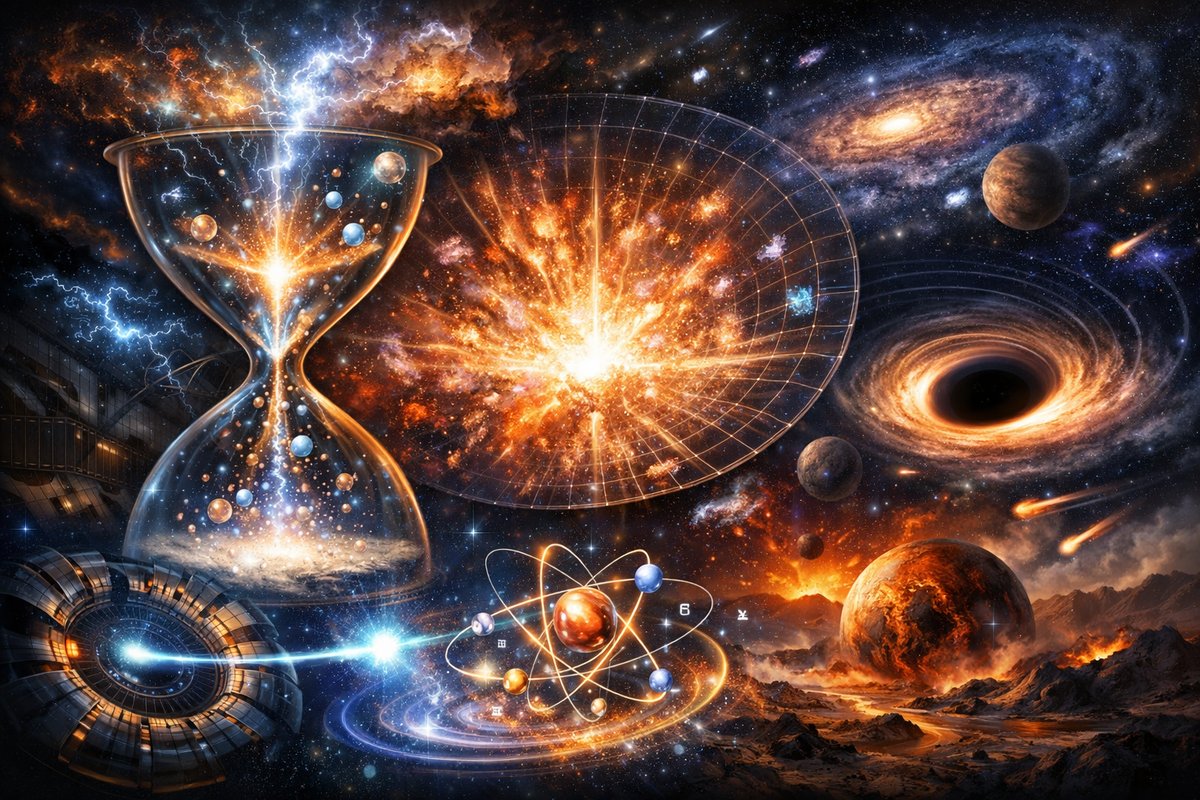
Embark on a journey back to the threshold of time, where quantum fluctuations and primordial forces converged to seed everything we see today. This exploration unravels the paradoxes, experiments, and enigmas that continue to reshape our understanding of the cosmos.
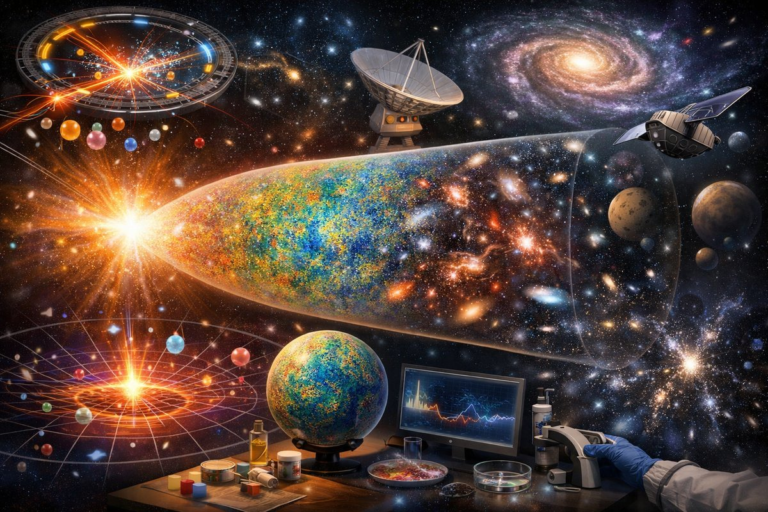
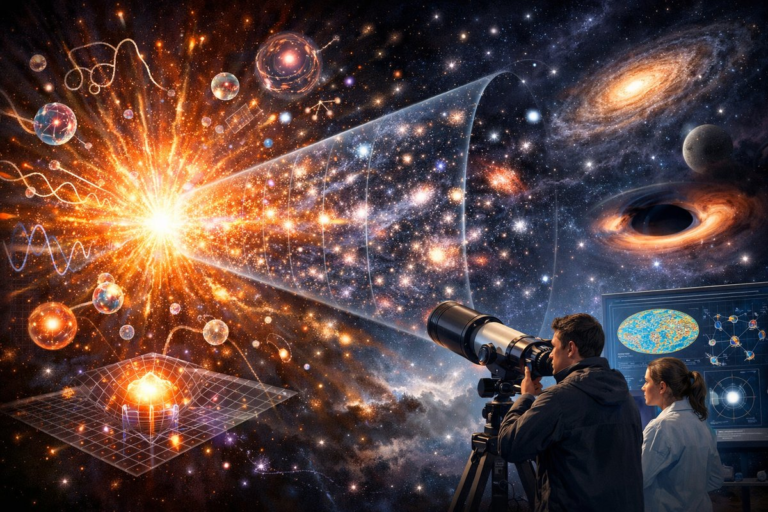
In the first sliver of existence-an expanse measured in trillionths of trillionths of a second-space itself unfurled in a blistering crescendo. Quantum ripples, once confined to subatomic uncertainty, ballooned into the scaffolding of galaxies. This dramatic episode, known as cosmic inflation, set into motion a cascade of events that would transform empty nothingness into a rich tapestry of matter and energy.
Cosmic inflation theory arose to answer vexing puzzles: why does the sky appear so uniform in all directions despite vast distances? How did the universe strike such a delicate balance between eventual collapse and unbounded expansion? Scientists suggest that a fleeting burst of exponential growth ironed out temperature differences and stretched space so swiftly that microscopic irregularities became the seeds for galaxy clusters.
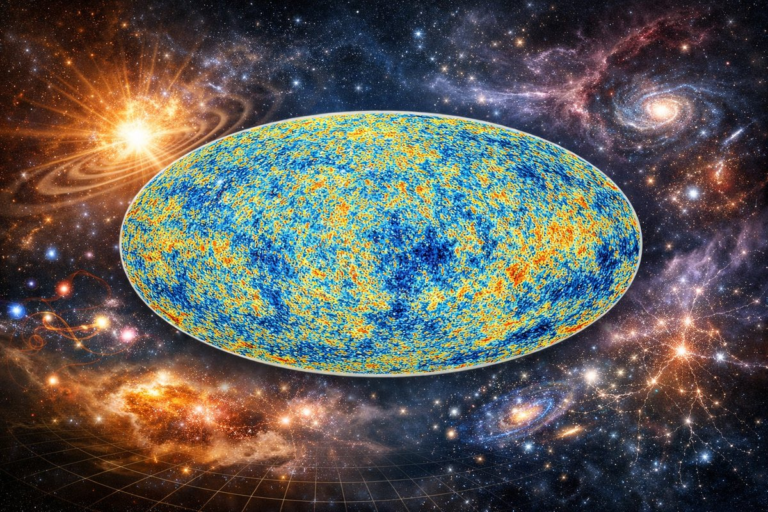
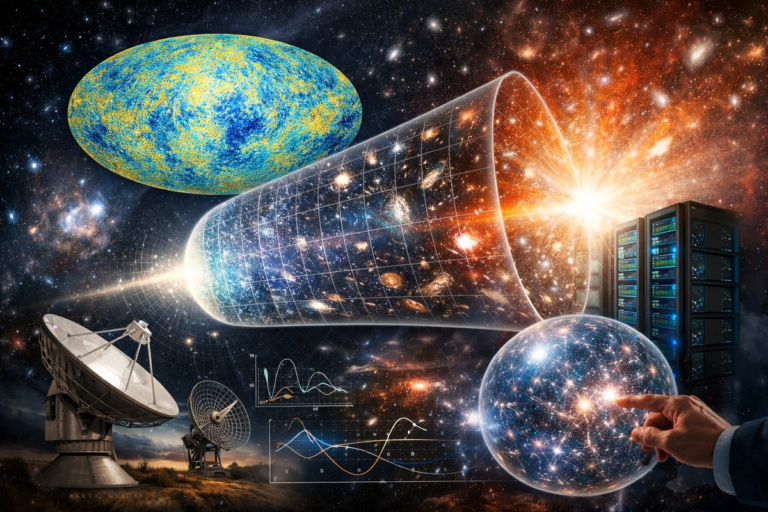
Remarkably, these primordial irregularities left an imprint we can still detect: minute temperature anisotropies in the cosmic microwave background (CMB). Launched decades ago, orbiting observatories mapped this faint afterglow at microwave frequencies, revealing a pattern of hot and cold spots at the microkelvin level. Each speck corresponds to a region where matter was fractionally denser or lighter, foreshadowing the web of galaxies that would emerge over billions of years.
But cosmic inflation is only part of the story. Just as dramatic is the tale of particle interactions in the universe’s opening act. In those first moments, temperatures soared to trillions of degrees, energies so intense that fundamental particles collided and transformed at will. Quarks, the building blocks of protons and neutrons, zipped in a plasma so dense and hot that light itself was trapped in perpetual scattering. As expansion cooled the cosmos, quarks bound together, forging protons and neutrons in a process called hadronization.
Within mere seconds, a balance between protons and neutrons was struck by nuclear reactions. This alchemy culminated in primordial nucleosynthesis: the fusion of protons and neutrons into light elements. Hydrogen, helium, and trace amounts of lithium emerged in precise abundances that modern telescopes still confirm by observing ancient gas clouds. These measurements remain one of the strongest pillars supporting the Big Bang framework.
Yet even this narrative encounters paradox. Why do we observe a universe dominated by matter when the laws of physics seem to treat matter and antimatter equally? In theory, the Big Bang should have generated equal parts of both, leading to mutual annihilation and a cosmic graveyard of photons. Instead, we find an overwhelming surplus of matter-our atomic heritage. This imbalance, known as baryon asymmetry, suggests that subtle violations of symmetry occurred in the earliest instants, tipping the cosmic scales.
To probe these mysteries, physicists turn to powerful accelerators that recreate mini-Big Bangs on Earth. By smashing particles together at near light speed, experiments can glimpse exotic interactions that might explain the matter-antimatter divide. Complementing these laboratories are gravitational wave observatories that listen for ripples in spacetime generated by cataclysmic events. Although these instruments have detected mergers of black holes and neutron stars, one day they may capture the faint hum of cosmic inflation itself.
Beyond the visible horizon, dark matter and dark energy dictate the fate of the cosmos. Dark matter, an invisible scaffold detected only through its gravitational tug, appears essential for assembling galaxies. Without this unseen glue, ordinary matter would have fled the weak pull of its own gravity. Meanwhile, dark energy-the mysterious force driving accelerated expansion-has reshaped cosmic destiny once more. After billions of years of slowing down under gravity’s pull, the universe began speeding up again in its middle age, an observation that earned its discoverers a Nobel accolade.
These discoveries raise profound questions about the ultimate origin. Could our universe be one bubble among countless others in a grand multiverse? If inflation repeats in isolated patches of spacetime, each pocket could spawn its own realm, governed by different physical constants. Such speculation remains controversial, since direct evidence for other universes is elusive. Yet the multiverse concept offers an intriguing explanation for why our cosmic parameters appear finely tuned to support complexity and life.
Investigators also explore relics of even earlier epochs. A prime target is the cosmic neutrino background, a sea of nearly massless particles that decoupled mere seconds after the Big Bang. Though far fainter than the microwave background, these neutrinos carry fresh information about the universe’s infancy. Next-generation detectors buried deep underground hope to catch these ghostly visitors, offering an unprecedented window into those earliest moments.
Even more exotic is the quest for primordial gravitational waves: ripples in spacetime created by inflationary dynamics. Telescopes sensitive to polarized light patterns in the CMB seek the distinctive swirl that such waves would imprint on the sky. A confirmed detection would crown inflation as more than a mathematical convenience-it would become a measured phenomenon etched in the cosmic fabric.
Despite the prodigious range of tools-from particle colliders to space-based observatories-the story of cosmic origins remains incomplete. New telescopes scanning the sky at multiple wavelengths continue to map the distribution of matter, testing models of dark matter interactions. Laboratory experiments shine lasers on vacuum chambers to search for hypothetical dark sector particles. And theoretical physicists challenge prevailing paradigms, exploring quantum gravity frameworks that might unify the physics of the very large with the very small.
This mosaic of inquiry reflects a core truth: the universe’s beginning is not a single event but a tapestry of processes woven across extremes of energy and scale. Each thread-quantum fluctuations, particle interactions, cosmic expansion, symmetry violations-contributes to the grand design. And just as scientists piece together clues from the heavens, readers can cultivate their own cosmic perspective. A backyard telescope reveals our planet’s tiny niche among planetary neighbors. A star projector can recreate the Milky Way’s swirls on a bedroom ceiling. And educational kits allow curious minds to build rudimentary detectors that echo the ingenuity of professional experiments.
As we refine our measurements and refine our theories, the primal questions endure: Where did space come from? What sparked the first inflationary breath? Why does reality manifest this particular set of laws? By embracing uncertainty and probing the unknown, scientists edge closer to answers that will reshape our identity in the cosmos.
In the years ahead, new missions will probe the CMB with unprecedented resolution, next-generation colliders will push energy frontiers, and deep-space probes will search for faint relics of ancient eras. Each instrument joins a global constellation of curiosity, united by a shared desire to journey to the beginning.
Though we may never witness the precise moment of creation, we can illuminate its shadows with ingenuity and perseverance. From the quivering quantum field to the spiraling galaxies, the universe’s origin story is one of transformation, subtlety, and wonder. And as long as our curiosity burns, the quest to understand the cosmos will blaze on-charting a path from quantum whispers to the vast galactic tapestries that inspire us to look up and ask, “Where did it all begin?”