Location
Mount Vernon, WA 98274
Location
Mount Vernon, WA 98274

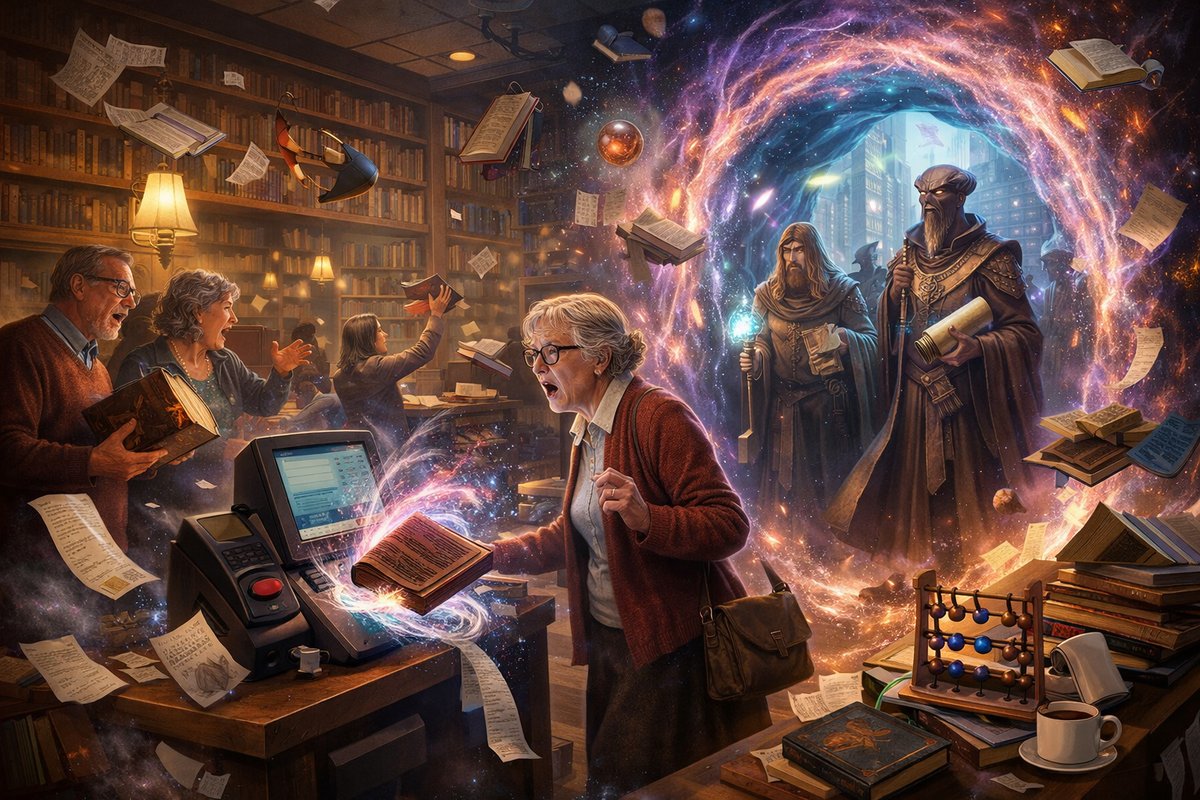
A routine upgrade to the public library's self-checkout kiosk goes off the rails when patrons begin checking out books from alternate realities. As bookmarks vanish into thin air and cosmic librarians demand overdue fees in antimatter units, the once-quiet reading room transforms into a bureaucratic warzone of unimaginable absurdity.
Late last Tuesday evening, members of the Pleasant Creek Book Club arrived at the local public library expecting nothing more than a discussion of 19th century melodrama and the occasional slice of homemade lemon loaf. Instead, they found themselves caught in the middle of a calamity that no catalogue entry, Dewey Decimal classification, or librarian’s common sense could have foreseen.
It all began when the library’s beloved but painfully outdated self-checkout kiosk finally received a promised hardware refresh. The vendor’s rep assured the city council that the new device would be faster, more secure, and impervious to the kind of “phantom checkouts” that used to plague fragile library cards. What the vendor did not mention was that the updated circuit board had been designed for cross-dimensional asset management-an obscure enterprise solution originally meant for corporate archives on four remote planets.
The first hint of trouble emerged when Phyllis Harper scanned her overdue copy of Victorian Poetry. Instead of hearing the familiar beep and the authoritative proclamation that her card was “good to go,” the kiosk shuddered, its touchscreen flickered in impossible color gradients, and then emitted a sound resembling a librarian clearing her throat on Jupiter. A shimmering tear opened in the air above the scanner, dropping Phyllis’s worn paperback onto a mahogany lectern . . . in a parallel universe.
Phyllis blinked. The book lay face up, but its cover was now coated in a living script of glowing luminescent runes. The air smelled faintly of burnt paper and ozone. Around her, other book club members stared at the empty lectern. Somewhere beyond the portal, they could hear a stern voice reciting binding conditions in a tonal key that caused library plants to wilt on cue.
At first, Helena Ramsbottom, president of the book club and undefeated in annual lemon loaf bake-offs, assumed it was an elaborate new publicity stunt by the library director. She tapped the kiosk screen, hoping for a pop-up tutorial or at least a sarcastic emoji explaining the glitch. Instead, the screen displayed a new menu labeled “Interlibrary Extradimensional” with categories like Cosmic Epistolary Collections, Dirges of the Next Age, and Manuals for Knitting Time Crystals.
Reginald Finch, an account manager by day and amateur conjurer by night, suggested they try scanning another book: his battered hardcover of travel memoirs. The kiosk obliged by whisking the memoir to an unknown shelf on a floating barge in a sea of swirling violet mist. Moments later, the kiosk printed a receipt so long it spilled across the entire floor. On it were check-in dates stamped centuries from now and fines calculated in electron-volts per page.
A hush fell over the reading room until a sound like rolling steel carts announced the arrival of three towering figures. Clad in tweed robes with high collars and carrying oversized scrolls, they introduced themselves as the Custodians of Resonant Bookflow. Their job, they explained, was to monitor the movement of literary property across dimensional thresholds. Unfortunately, the library had violated clause 12.7b of the Multiversal Preservation Act by circulating so-called extradimensional works without first applying for a Temporal Lending License.
Murmurs spread among the club members. Who knew an overdue copy of detective fiction could turn into a misdemeanor in fourteen known realities? One member gingerly opened a book on drawing banana peels in the style of Baroque iconography and another found herself reading a children’s epic about hyper-intelligent dust bunnies that grew to the size of barns if left unchecked.
Before long, the reading room brimmed with books that twisted space, tables that levitated when turned into makeshift podiums, and ink-stained quills channeling all manner of cosmic aberrations. Every sneeze from an unsuspecting patron ricocheted through four lifetimes of borrowed narratives. It took the combined efforts of the Custodians, an emergency summons to the city council, and two dozen frantic emails to the original vendor just to stop the kiosk from printing fines in light-years.
Meanwhile, the book club tried to preserve a shred of its original purpose. Helena insisted they push through with the discussion chapter, so they formed a circle amid the floating dictionaries. Phyllis read an excerpt from her glowing poetry volume, only to discover the lines kept rewriting themselves with increasingly elaborate meter. Reginald offered to exorcise the glitch with a binding incantation he found scribbled on the back of his library card, but only succeeded in summoning a pocket dimension that swallowed a stack of romance novels.
Somewhere between the mushroom cloud of overdue notices and the choir of whispering footnotes, Mrs. Delacroix produced her lemon loaf and announced that nothing, not even a cosmic breach, could stand in the way of a proper snack. The smell of citrus briefly calmed the pandemonium, until a minor wormhole ruptured in the snack tray and spat out an endless parade of scones shaped like esoteric geometric solids.
At that point, the library director arrived in full crisis mode. She wore a headset that projected a realtime feed of the catastrophe onto an emergency projector. The slide deck showed images of hallways flooded with floating lexicons, a literal stack of never-ending cookbooks, and coffee-stained pages drifting off to unknown timelines. On the last slide, a single bullet point read: “Contact vendor. Pray.”
In a last-ditch effort to restore order, the city IT team disconnected the kiosk from the network. The tremors ceased, the portals shuddered closed, and the Custodians, incensed but professional, extracted themselves along with all the extradimensional volumes. With a polite cough, they reminded everyone to return the remaining cosmic books by next calendar cycle or face punitive measures ranging from docked reading privileges to a surprise audit of personal annotations.
As the swirls of purple mist dissipated and the reading room returned to its usual hush, club members looked around at scattered bookmarks, charred paperback corners, and a lingering aftertaste of ozone. Helena, ever the optimist, raised her slice of lemon loaf in salute.
“Well,” she said, brushing powdered sugar from her cardigan, “that was certainly more excitement than our usual critique of foreshadowing techniques. Next month, perhaps we’ll just discuss gardening books.”” ,
Despite the chaos, the incident has sparked a surge of interest in library services. Patrons are signing up for adult literacy classes just to skim the new extradimensional catalog, and the city council is investigating permanent security measures to prevent future intergalactic mishaps. Meanwhile, rumors persist that one missing volume-an illuminated bestiary of sentient houseplants-remains in local circulation, and that it might be responsible for the inexplicable phenomenon of garden gnomes rearranging themselves overnight.