Location
Mount Vernon, WA 98274
Location
Mount Vernon, WA 98274

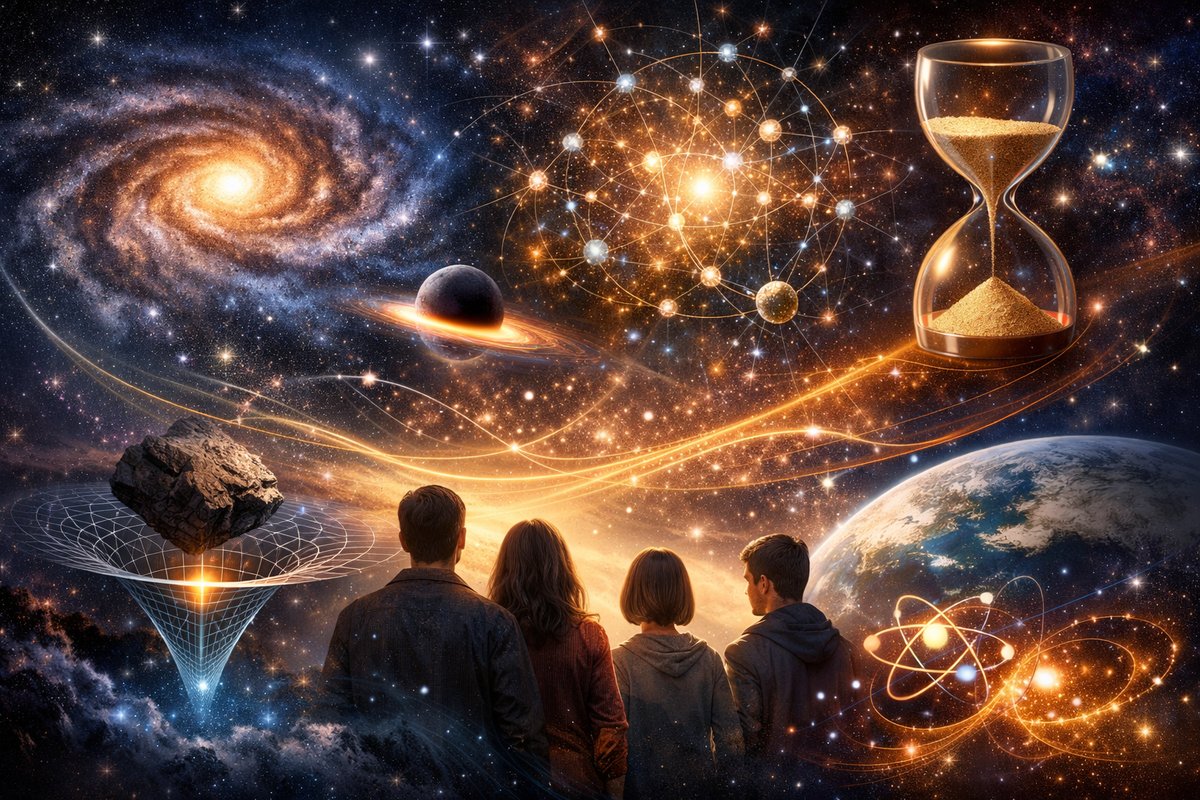
From the flicker of distant starlight to the subtle shift of mass under gravity's pull, this article journeys through the science of time, matter, and entropy, revealing how these pillars of physics ripple through both the cosmos and our inner lives. Discover the interconnected dance that binds particles and people.
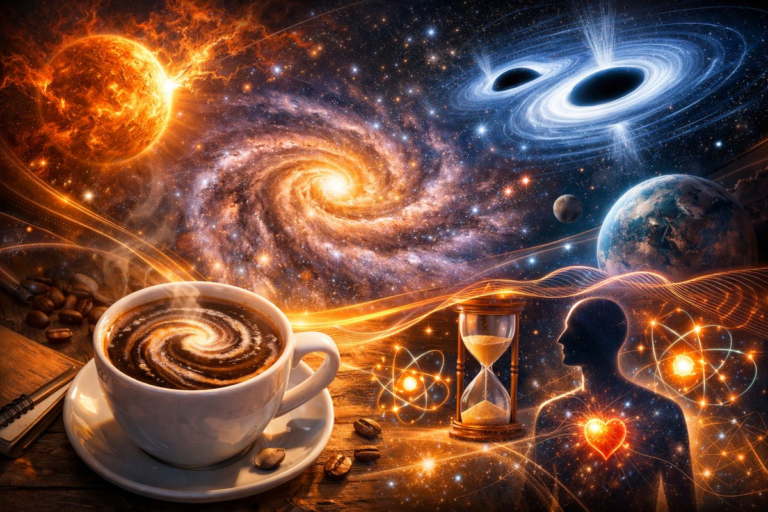
Every moment we experience ripples through a tapestry woven from threads of light, matter, and the inexorable arrow of entropy. The night sky’s distant glow, captured millennia ago, reminds us that time is both a measure of change and a medium that carries stories. From the tiniest particles colliding in a lab to the spiral arms of galaxies stretching across millions of light-years, these phenomena are bound by the same physical laws that guide our daily routines-from brewing morning coffee to watching seasons shift.
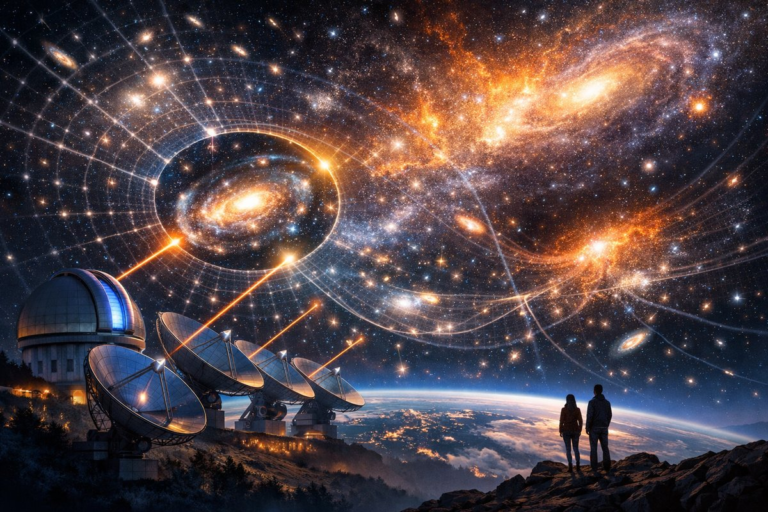
When a photon leaves the surface of a star, it begins an epic voyage through space and time. That journey may last a few minutes, centuries, or even billions of years before it reaches our instruments. Telescopes and spectrometers decode these ancient signals: the distribution of wavelengths reveals temperature, chemical composition, and motion. Here, light becomes both messenger and historian, chronicling the birth of elements forged in stellar furnaces and echoing the expansion of the universe itself.
Consider the cosmic microwave background-the afterglow of a primordial fireball-now cooled to mere fractions of a degree above absolute zero. Its faint hiss, detected by sensitive radio arrays, carries imprints of density fluctuations that later shaped galaxies. In peeling back these layers, astronomers trace the universe’s growth, measuring the rate at which space stretches and calculating the age of everything that exists. Time and expansion are inseparable partners in this grand narrative.
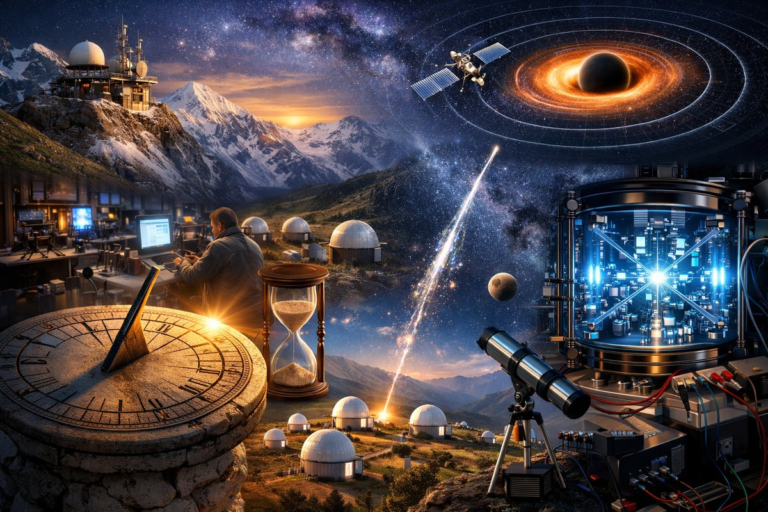
Closer to home, timekeepers ranging from pendulum clocks to atomic references govern our sense of duration. A mechanical clock’s pendulum swings in a near-perfect rhythm, setting seconds with remarkable precision, while atomic transitions in cesium or hydrogen yield tick-tocks accurate to billionths of a second. These instruments are more than tools for scheduling-they anchor our understanding of time as a quantifiable, shared framework.
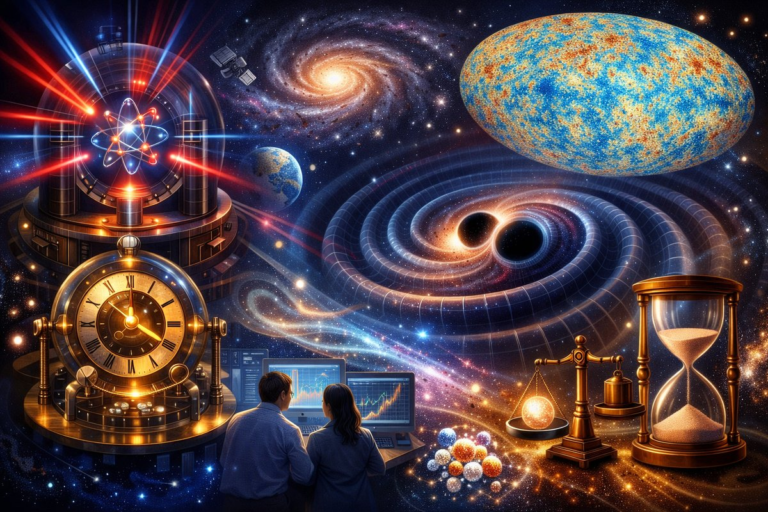
Mass might seem like a simple property-how much “stuff” resides in an object-but in relativity, mass and energy are two sides of the same coin. A small amount of mass, when converted, can release an immense burst of energy, as evidenced by the glow of a nuclear reactor or the cataclysm of a supernova. On laboratory benches, high-precision scales measure milligrams, enabling chemists to combine reagents with exacting ratios. Those same principles scale upward to balance planets in a celestial dance.
Gravitational lensing offers a cosmic scale demonstration: massive galaxy clusters warp spacetime, bending light and creating mirages of more distant objects. By analyzing image distortions, researchers infer hidden mass-dark matter that does not emit or absorb light yet dominates the gravitational landscape. Thus, our understanding of mass extends beyond what we can see, reminding us that reality often hides more than it reveals.
Back on Earth, engineers and designers grapple with mass in everyday contexts. Automakers optimize chassis and materials to improve fuel efficiency, while architects calculate load-bearing capacities to ensure skyscrapers withstand wind and seismic forces. Even in the kitchen, a baker’s digital scale brings precision to flour measurements, transforming a handful into a flawless loaf.
Entropy, the measure of disorder, governs irreversible processes from heat flow to information decay. In thermodynamics, a hot cup of tea cools because microscopic particles move toward more probable, higher-entropy states. In cosmic terms, stars run down as they exhaust nuclear fuel, increasing overall entropy even as local structures form. Far from a dry concept, entropy shapes weather patterns, biological aging, and the eventual fate of the universe.
Every signal transmitted over a noisy channel carries an entropy cost. Data-compression algorithms, from image formats to file archives, exploit patterns to reduce redundant information, effectively harnessing low entropy for efficiency. Yet each compression and decompression cycle edges closer to the thermodynamic limit, where erasing a single bit of information dissipates a fundamental quantum of heat.
At the human scale, entropy dances through our daily lives. A tidy room tends toward chaos unless we invest energy-our mental and physical effort-to restore order. Creative projects often face this drift: manuscripts accumulate outdated notes, workspaces collect stray papers, and digital folders become labyrinthine. Recognizing entropy’s pull can inspire better habits, from regular backups to mindful organization.
In biology, entropy’s influence is equally profound. Living cells maintain low-entropy states by consuming nutrients, exporting waste, and generating heat. This constant battle against disorder powers muscles, smartphones, and entire ecosystems. The same laws that doom a hot cup of tea to cool also allow life to persist, adapt, and flourish.
Time, mass, and entropy converge in technology and storytelling alike. Filmmakers use slow-motion sequences-essentially stretching time-to reveal unfolding processes. Sound engineers manipulate reverberation, an auditory analogue of entropy, to create atmosphere. Engineers exploit mass distribution and time-tested materials to build structures that endure. In every creative endeavor, physical principles underpin narrative power.
Beyond their scientific definitions, these concepts resonate emotionally. Time invites reflection, offering both the sting of loss and the promise of renewal. Mass evokes substance, grounding imagination in tangible reality. Entropy reminds us of impermanence-and of the creative spark that resists the drift toward chaos. Together, they frame a worldview in which curiosity becomes a force for order, creativity, and wonder.
As we stand beneath star-filled skies, timing a heartbeat or weighing a favorite stone, we become participants in an epic story. Each experiment, each observation, and every small choice coalesces into a narrative thread stretching from quantum scales to galactic spans. Whether we aim a telescope at distant nebulae, chart the decay of an unstable isotope, or simply savor a quiet moment of awareness, we tap into the same cosmic ledger that records all change.
In unraveling the threads of light, mass, and entropy, we discover more than scientific facts-we glimpse our own place in the grand mosaic. Facts transform into meaning when we connect data with memory, calculation with instinct, and measurement with imagination. Through that alchemy, reality becomes story, and physics becomes poetry.
So next time you check a stopwatch, adjust a digital scale, or watch sunlight filter through leaves, remember that you are tracing the contours of an ever-evolving tapestry. Each measurement is an act of witness, and every observation a stanza in an unfolding epic that spans the smallest particle to the farthest galaxy, and the quietest thought to the loudest beat of the human heart.