Location
Mount Vernon, WA 98274
Location
Mount Vernon, WA 98274

Explore the mysteries of the universe—from the birth of light to the bending of time. This is where physics meets philosophy, and curiosity meets cosmic scale.

A new constellation of quantum-equipped microsatellites is revealing subtle patterns in the cosmic microwave background while similar devices at the cellular level are unlocking unseen processes. This interdisciplinary approach bridges the quantum and the cosmic, promising fresh insights from particle physics to planetary science.

Recent surveys reveal an intricate network of matter connecting galaxies across the universe. Advanced techniques are now charting these cosmic filaments, offering fresh insights into how galaxies grow, evolve, and cluster within the grand tapestry of space.

A recent mission has dispatched a constellation of miniature satellites equipped with quantum accelerometers to map shifts in ocean mass and reveal hidden patterns of plankton blooms. Early data are already reshaping climate forecasts by linking microscopic marine life to global carbon flows.

A new generation of quantum-metrology detectors is poised to open a mid-frequency window on gravitational waves, revealing collisions of intermediate-mass black holes and echoes from the universe's infancy. By merging cold-atom interferometry with squeezed-light techniques, researchers are advancing beyond traditional laser interferometers to capture cosmic ripples with unprecedented precision.
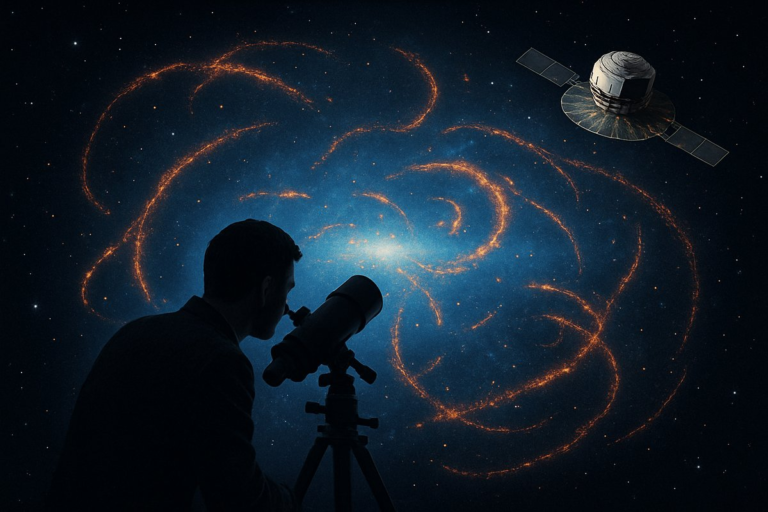
Astronomers have harnessed data from the European Space Agency's Gaia mission to map the elusive dark matter halo enveloping our galaxy. By tracing the arcs of ancient stellar streams, researchers are unveiling the shape and density of the invisible mass that governs the Milky Way's evolution.

A pioneering spaceborne polarimeter has delivered the first high-resolution maps of magnetic fields in a supernova remnant, challenging long-standing models of cosmic ray acceleration. These results open a novel observational window on the turbulent processes that sculpt high-energy environments after a star's explosion.

What if the same cables carrying our internet traffic could also detect earthquakes, track ocean shifts, and even glimpse cosmic ripples? Researchers are injecting precision light pulses into telecom fibers to turn a global web of data highways into a versatile scientific instrument. This breakthrough could democratize environmental monitoring, improve early warning systems, and open a new band of gravitational-wave astronomy.
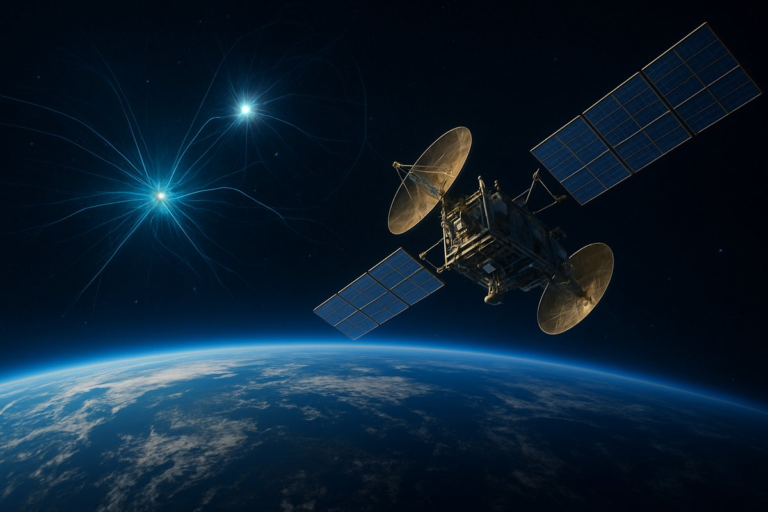
A breakthrough quantum communications satellite has taken to orbit, promising unhackable encryption across continents. This article dives into the technology of quantum key distribution in space, its potential to thwart digital surveillance, and the broader implications for privacy, ethics, and a future quantum internet.

An ambitious cosmic survey using quantum-entangled telescopes has sparked a debate over data privacy and digital rights. As researchers push the boundaries of space-time observation, questions arise about who controls the streams of sensitive information and how to defend against ever-more-sophisticated spyware.
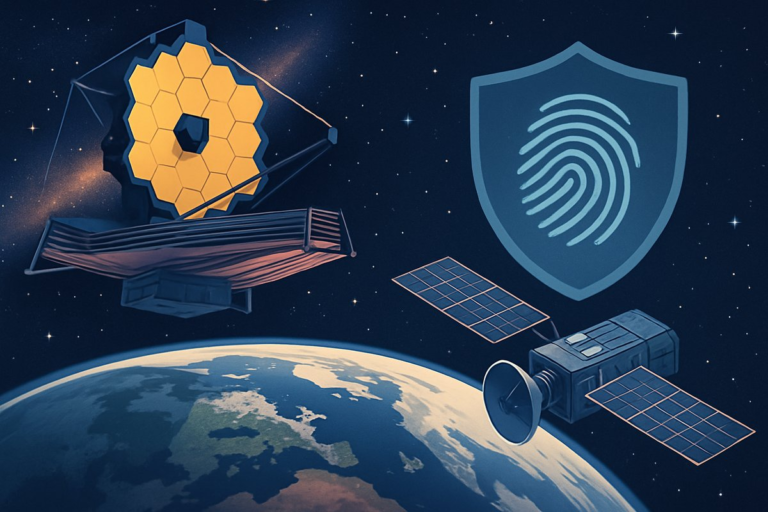
Advanced space telescopes and Earth-observing satellites are opening new frontiers in astrophysics and climate science, but they also collect immense volumes of terrestrial data. Balancing the promise of cosmic discovery with robust privacy protections requires a fresh ethical toolkit, transparent governance models, and next-level spyware detection in both orbit and on the ground.