Location
Mount Vernon, WA 98274

Location
Mount Vernon, WA 98274
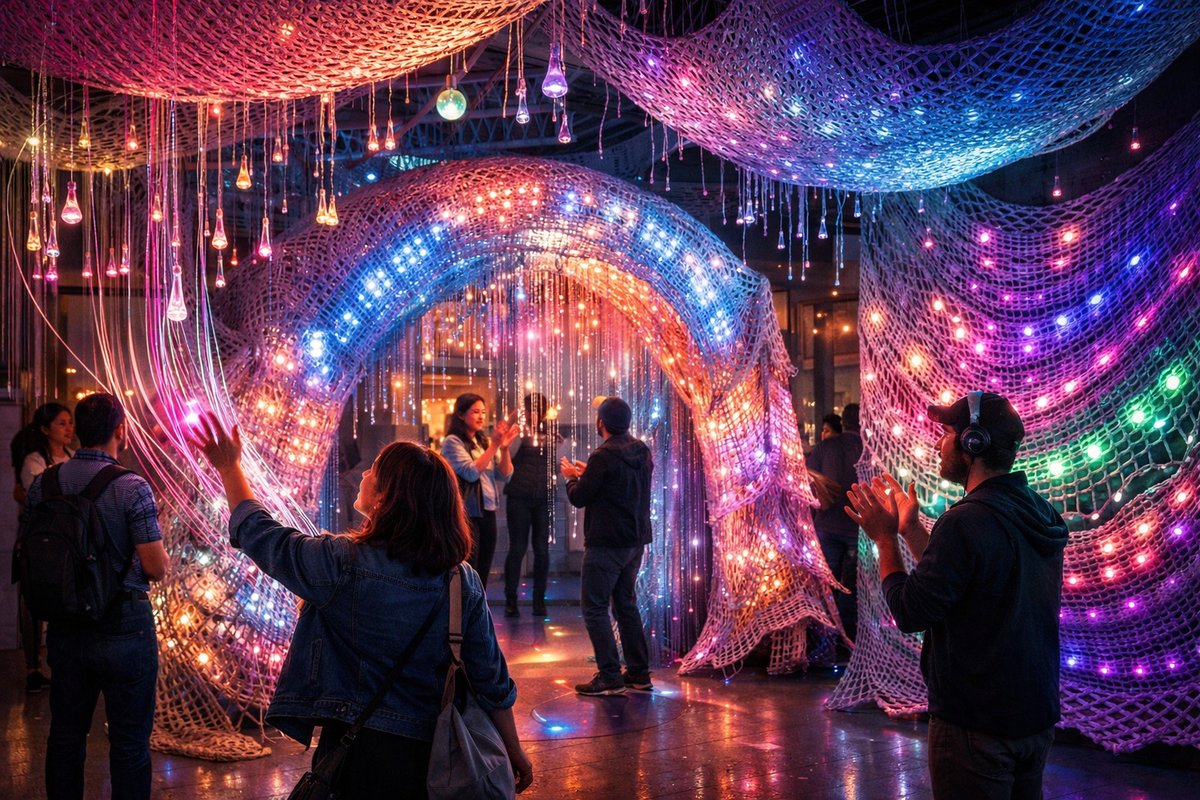
Artists are weaving together threads of conductivity, light, and community to create immersive fiber installations that respond to movement and sound. These collaborative projects blend traditional textile crafts with sensors and LEDs, transforming urban hubs into dynamic galleries of tactile, luminous experiences.
In the corner of a bustling transit hall, commuters pause as a 20-foot tapestry pulses with soft hues of blues and pinks, synchronized to ambient noise. Far from a static mural, this fiber work responds to footsteps, laughter, and passing trains, illuminating pathways in real time. This is the new frontier of interactive fiber art: a practice that marries age-old weaving techniques with sensors, microcontrollers, and addressable lights to transform public spaces into living, breathing canvases.
At its heart, interactive fiber art is a dialogue between human expression and technological possibility. Artists today are reaching into traditions of knitting, weaving, and tapestry-craft forms once confined to private or domestic realms-and elevating them to large-scale installations. By embedding conductive threads, accelerometers, and LED strips within hand-stitched loops, they invite audiences to become active participants rather than distant observers. Every tug of a loose yarn or step across a sensor triggers ripples of light, turning spectators into co-creators of a shared experience.
One striking example debuted in a coastal boardwalk last spring, where a gentle sea breeze threaded through hanging banners of wool and conductive fiber. Each banner carried small wind sensors and batteries concealed in handcrafted pockets. As the wind picked up, the sensors morphed static textile patterns into shifting waves of azure luminescence, echoing the ocean’s rhythm. Visitors could lean into the flags, feeling vibration modules hum at the base, creating an intimate interplay of textile vibration and glowing color. Onlookers found themselves not only appreciating craft but also sensing environmental forces through novel, multisensory feedback.
Sustainability is a guiding principle for many of these projects. Artists are scouting thrift shops, fiber co-ops, and recycling centers for surplus yarns and reclaimed fabrics. Conductive thread spools crafted from copper and silver alloys are used sparingly, often woven alongside natural linen or recycled polyester yarns to reduce electronic waste. Solar-powered battery banks tucked discreetly behind textile backdrops harvest daylight to keep installations glowing after dusk. By reimagining discarded fibers and coupling them with low-energy components, makers underscore the circular ethos of their practice.
Collaboration often drives scale and scope. In one metropolitan museum, a collective of makers hosted open-studio workshops where visitors learned to stitch tiny LED nodes into swatches of felt. Over a week, hundreds of separate swatches were joined into a patchwork wall nearly 30 feet long. Each contributor’s stitch became an integrated pixel in a sprawling mosaic, capable of displaying patterns generated by a central microcontroller. The final presentation allowed the community to project visuals drawn on smartphones onto the tapestry, dissolving boundaries between digital drawing and analogue textile art.
The technical backbone of these fiber installations is surprisingly accessible. Many artists start with off-the-shelf microcontroller starter kits, addressable LED strip modules, and conductive thread spools. Tutorials pepper online creative forums, guiding novices through essential skills: soldering tiny pads, programming basic interactivity, and securing battery packs inside fabric linings. As knowledge transcends the domain of professional emblem-embroiderers and hobbyists alike, the repertoire of techniques expands. Sensor arrays can detect sound frequency ranges, pressure mats track footsteps across tiled rugs, and proximity detectors sense when viewers raise smartphones to capture a close-up.
Yet technology remains subservient to the tactile qualities of fiber. A snarl of loose yarn becomes an invitation to explore, a raised bobble stitch accentuates the glow of a hidden LED, and a fringe wall shimmers as each strand transmits current. The luminous effect is never overpowering; artists often calibrate brightness to a soft, human-centered level that encourages a sense of wonder rather than sensory overload. Warm whites and pastel hues predominate, mirroring the gentle textures of wool and cotton.
Philosophically, interactive fiber art challenges conventions of authorship and permanence. Traditional public sculptures stand firm against weather and touch, their creators often anonymous once installed. By contrast, textile-based installations embrace impermanence. Loose threads may fray, sensors require recalibration, and community-stitched segments bear witness to a myriad of hand tensions and color choices. Each imperfection becomes part of the artwork’s story, reminding viewers that all creative endeavors evolve with time and handling.
Across continents, artists tailor installations to local contexts. In a desert municipality, a series of hand-woven canopies made from undyed sheep’s wool and copper wires provided shelter during daytime heat. Integrated light panels powered by photovoltaic strips offered gentle illumination at night, mapping across woven patterns reminiscent of shifting dunes. Nearby tribal craftspeople joined the project, sharing weaving techniques passed down through generations, thus forging a respectful dialogue between traditional artisans and contemporary technologists.
Even educational institutions are taking note. Textile departments are adding “interactive fibers” modules to their curricula, teaching students how to integrate e-textiles into exploratory projects ranging from wearable art to immersive stage sets. Lecturers emphasize emotional intelligence alongside technical fluency: learning to interpret audience interactions, designing for diverse accessibility needs, and balancing aesthetic judgment with sensor-driven logic. Graduates emerge with portfolios that bridge fine art, engineering, and user experience design.
Critics of high-tech public art sometimes worry that the allure of flashing LEDs may overshadow deeper conceptual rigor. But proponents assert that interactivity need not be superficial spectacle. Instead, the fusion of technology and fiber can raise questions about memory, ecosystems, and communal identity. One festival showcased an installation where participants recorded spoken anecdotes about their heritage into small voice-activated modules stitched into a blanket. When the blanket unfurled, each patch played a short personal story, weaving together a collective tapestry of memory.
Looking forward, emerging materials promise further innovation. Bio-derived conductive threads made from carbonized plant fibers are entering small-batch production, offering a biodegradable alternative to metal-based filaments. Hydrochromic dyes that change color when exposed to moisture or heat can be integrated into yarns, enabling textiles that visually respond to human touch. And advances in battery-less energy harvesting could allow fully passive installations powered only by movement and ambient light.
Urban planners are taking note of the social benefits. Interactive fiber installations can activate underused plazas, invite spontaneous engagement, and foster a sense of ownership among residents. Planners in one city commissioned a series of “memory quilts” in aging neighborhoods: community members brought in swatches of family textiles to be woven into illuminated banners. The result became a nightly gathering spot, where neighbors shared stories beneath a canopy of shifting light and color.
Artists emphasize that the simplest gestures often have the greatest impact. A handful of LEDs threaded through a small cross-stitched sampler can spark curiosity in a corner café. A portable knitted cuff equipped with vibration motors and lights can turn wearers into moving sculptures in a city parade. By thinking modularly-designing replaceable swatches, detachable power modules, and reconfigurable sensor patches-creators keep projects flexible and adaptable to new sites or contexts.
As public spaces evolve to accommodate digital life, interactive fiber art stakes a claim for tactility and human touch. These installations resist the screen’s flat glow by inviting grasp, pull, and co-creation. They remind us that technology can be soft, warm, and communal when woven into threads that carry both current and history. Whether in train stations, galleries, or open-air markets, a tapestry of light and fiber has the power to transform mundane moments into playful exchanges.
In a world increasingly mediated by glass and metal, the revival of fiber as a medium for public storytelling is a hopeful sign. By fusing craft knowledge with sensor technology and sustainable materials, artists craft experiences that are as much about gathering hands and voices as they are about color and pattern. And as each glowing stitch invites another, the boundaries between creator and audience, between tradition and innovation, begin to blur-much like the soft glow of light diffused through woven threads.
The next time you pass by a seemingly ordinary textile in a plaza or lobby, pause and feel for the hum beneath your fingertips. You might just discover that art, like community, thrives when it is woven together, illuminated from within by the collective pulse of human curiosity.