Location
Mount Vernon, WA 98274

Location
Mount Vernon, WA 98274
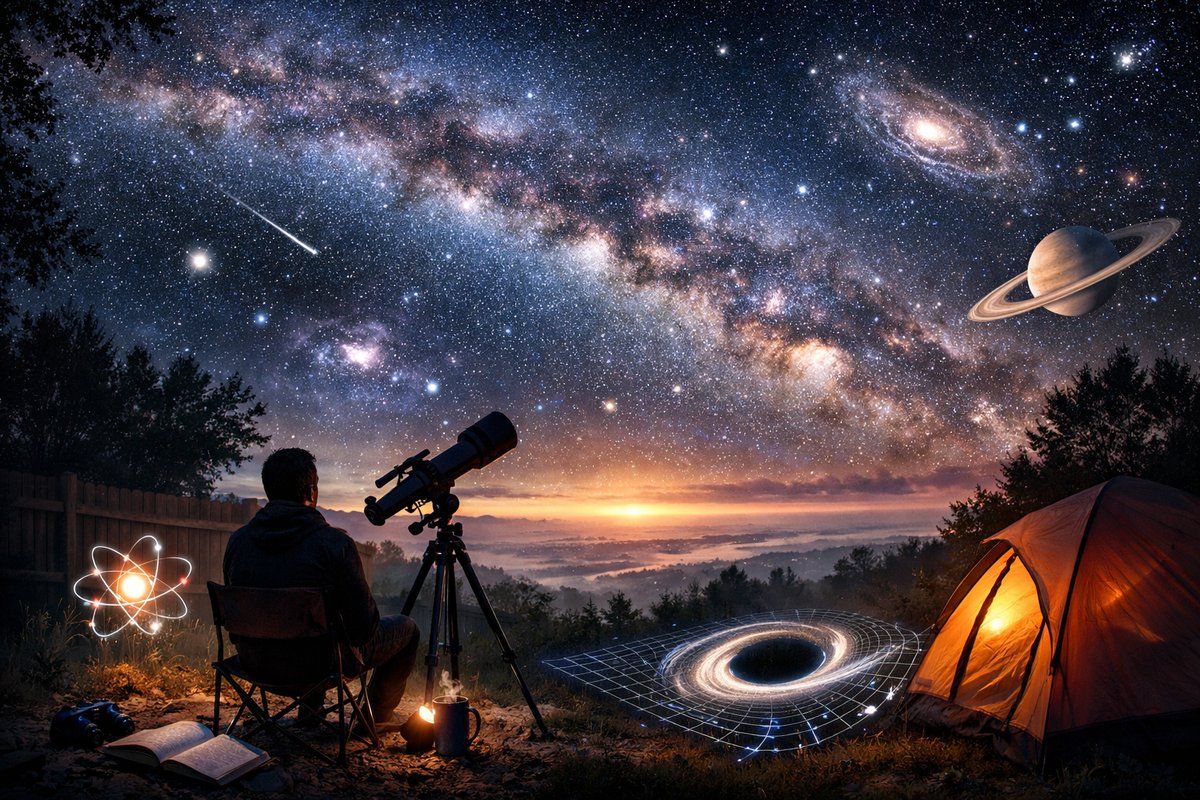
A restless wonder stirs under every dark canopy: the universe is inviting us to explore its secrets. From backyard stargazing to deep reflections on spacetime, readers are led on a journey that blends practical tips, scientific marvels, and philosophical musings.
Every evening, as the sun slips beyond the horizon, a hush falls across open fields and city rooftops alike. In that quiet moment, a tapestry of stars emerges-a cosmic invitation that has echoed through human history. Whether you’re peering up from a backyard lawn or gazing through a city balcony, that silent call ignites a flame of curiosity. What are those pinpricks of light? How far do they lie? And why does the vastness above make our own small worries seem so brief?
We often describe distances in conventional measures of miles or kilometers, but the universe demands a grander scale. Light years stretch our sense of time; a single glow from a distant star might have begun its journey before human civilization took shape. Voyager probes now drift beyond our solar system, carrying whispered songs of Earth into the interstellar medium. A comet’s tail, a supernova’s final burst-each phenomenon traces a story written in photons, neutrinos, and the subtle curvature of spacetime.
Gravity can stretch and warp not only space but time itself. In regions of intense mass, clocks slow, and paths bend. Gravitational waves ripple through the cosmos like the aftershock of a cosmic bell, carrying news of colliding black holes or merging neutron stars. Observatories buried beneath mountains and oceans listen constantly, translating faint tremors into signals that reshape our understanding of reality. Every detection offers a chapter in a saga that began with the Big Bang, billions of years ago.
Yet the simplest tools often awaken our cosmic senses most directly. The unaided eye can identify clusters like the Pleiades or trace the hazy band of the Milky Way. Upgrade to a pair of binoculars, and you open a doorway to craters on the lunar surface or the fuzzy glow of distant galaxies. A well-worn star chart-perhaps illuminated gently by a red LED flashlight-guides your gaze along constellations that once served as calendars, navigational aids, and mythic canvases for ancient storytellers.
For those ready to refine their observations, a tripod-mounted telescope can transform specks of light into rings of Saturn or the swirling clouds of Jupiter’s atmosphere. Smartphone apps map the night sky in real time, overlaying annotations on whatever your camera lens captures. Yet no app replaces the tactile thrill of charting a new meteor streak, sketching a nebula by hand, or simply reclining on a blanket and letting the Milky Way spill overhead.
Citizen scientists play an indispensable role in modern astronomy. Networks of observers log meteor showers, search for transient phenomena like supernovae or novae, and even track the dimming of distant stars as exoplanets transit their host suns. Participants contribute to open databases, and occasionally amateur observers spot anomalies that lead to professional follow-up. In this grand partnership, every curious soul becomes part of a global survey, turning stargazing into a shared quest for discovery.
Astrophotography has its own language of long exposures, guiding mounts, and carefully calibrated sensors. A sturdy tripod, an inexpensive camera adapter, and a night free of clouds can yield your first framed portrait of the Orion Nebula or the Andromeda Galaxy. Processing techniques-stacking multiple shots, adjusting color balance to highlight hydrogen emissions-elevate raw data into images that almost seem to breathe with cosmic life.
Beneath the technical details lies a deeper resonance. Gazing skyward reminds us of our fleeting place in the universe and the fragile blue dot we call home. We are moments along a vast timeline, woven from the same elements forged in the cores of ancient stars. That sense of kinship with the cosmos rekindles humility even as it sparks awe, urging us to cherish our planet and the ways we share it.
Despite geopolitical fault lines on Earth, space exploration continues in a spirit of cooperation and wonder. International missions land rovers on distant worlds, probe the atmospheres of Mars and Venus, and map the fine structure of cosmic microwave background radiation. Private ventures loft small satellites, enable rapid-response experiments, and test new propulsion concepts. Across borders and cultures, a common fascination unites us around the cosmic campfire.
Orbiting observatories-unfettered by atmospheric distortion-deliver deep-field images that reveal galaxies billions of light years away. Space telescopes survey the skies for exoplanets, some in habitable zones, and measure the faint signatures of water vapor or methane in alien atmospheres. Each new data set teases out clues about planetary formation, the prevalence of Earth-like worlds, and the possibility of life beyond our own.
The most profound questions remain. What is dark matter, the mysterious substance that anchors galaxies yet eludes direct detection? What drives the accelerating expansion known as dark energy? Does our universe reside within an unfathomable multiverse, one of many cosmic bubbles each with its own rules? Physicists and philosophers alike wrestle with these enigmas, finding in their answers revolutions in how we think about reality itself.
Looking ahead, planned missions aim to return samples from asteroids, study the icy moons of Jupiter and Saturn for signs of subsurface oceans, and test new propulsion systems that could one day ferry humans to Mars. Meanwhile, the next generation of ground telescopes will peer with unprecedented clarity into the early epochs of galaxy formation. The coming decades promise discoveries that will stretch our imaginations even further.
But you don’t need a multimillion-dollar mission to begin your own voyage. Tonight, step outside, let your eyes adjust to darkness, and look up. Consult a star chart, adjust binocular focus, or set up an entry-level telescope on a stable tripod. Note the positions of bright stars, track the passage of satellites, and await the occasional meteor’s brief blaze. In those silent moments of wonder, the universe whispers to you in starlight, and you become both observer and explorer of the greatest frontier of all.